All species › Sandgrouse › Sandgrouse › Crowned sandgrouse
Crowned sandgrouse | Pterocles coronatus
Kroonzandhoen | Ganga coronada
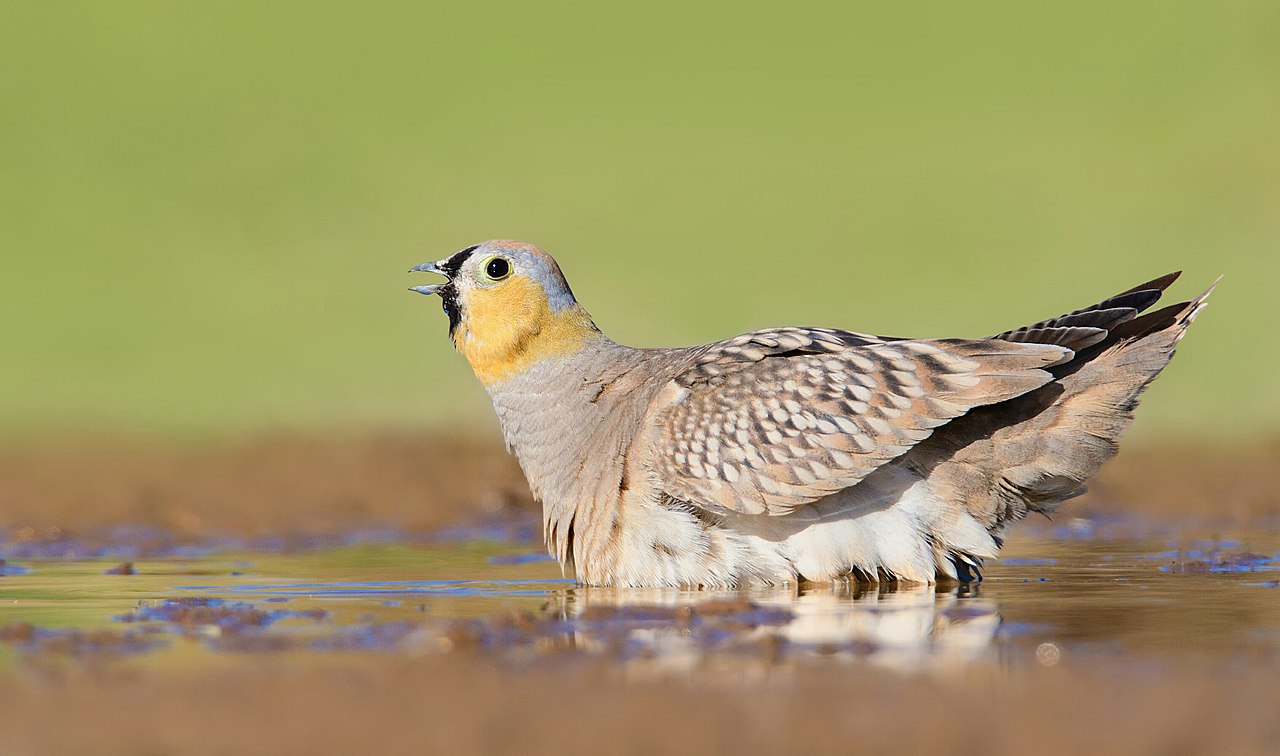
The sandgrouse of the hardest, stoniest desert: smaller and more compact than the spotted sandgrouse, with a short pointed tail and completely unmarked underparts. The male carries a black-and-white face mask that is obvious at close range and gone entirely at a hundred metres. This is the species you hear first and see last on the Moroccan hamada.
Voice
The flight call is a hard, nasal, multi-syllabled tju-ku tju-ku-kurr, often also heard as a fast rattling cha-chagarra. It is one of the most vocal desert birds: on arrival at water the whole flock calls at once, and the tone is sharper and more pinched than the soft bubbling of the spotted sandgrouse. On the ground there are quiet, briefly repeated contact notes within the group.
No freely licensed recording is available for this species yet.
Identification
Compact and medium-sized, with a short, pointed tail and no elongated feathers. The male has a blue-grey crown with a chestnut centre, a broad blue-grey supercilium, an orange-yellow cheek and throat, and between them a black band running from the forehead across the lores to the chin, edged white — a short, severe mask. The underparts are plain pinkish-grey: no breast band, no belly patch, no stripe. Scapulars and wing coverts are ochre with dark drop-shaped spots. The female lacks the mask altogether and is densely and finely barred above and below, with a yellowish face and throat. In flight dark flight feathers contrast with sandy coverts, and the underwing coverts are creamy rather than clean white.
Confusion species
The comparison that matters is with the spotted sandgrouse, which often shares the same drinking pool. This bird is smaller and shorter, and the difference shows at the back end: a short pointed tail with none of the fine streamers the other one carries. The male gives itself away on the head, with that black line from forehead to chin, where a male spotted sandgrouse has a wholly plain orange face. Then check the belly: unmarked here, without the narrow dark central stripe of the other. Females are harder — the female here is finely barred across the whole underside, while a female spotted sandgrouse is covered in dark spots and still shows the belly stripe. Lichtenstein's sandgrouse is smaller again, with an orange bill and much coarser, higher-contrast barring. The voice here is hard, nasal and multi-syllabled — a short phrase rather than a soft two-note bubbling.
Habitat
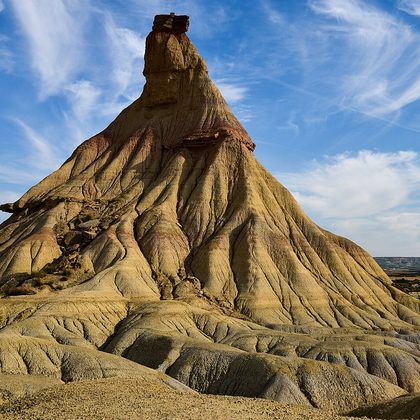
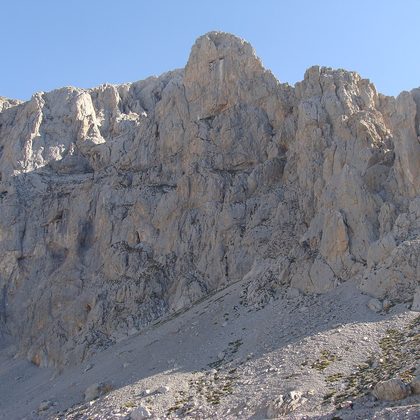
The stoniest and barest desert: hamada, reg, hard-packed gravel plains, low bare ridges and rock pavements with almost no vegetation. It avoids anything too well vegetated and favours ground where the rock is dark red to brown, a colour its plumage matches exactly; in North Africa it breeds by preference on that red sandstone. Food is hard seeds, supplemented by grass shoots and other plant material, taken from the ground. Nest and drinking site are often tens of kilometres apart: the birds need permanent water within reach, and they visit it in the early and mid morning and again towards sunset. The male soaks his belly feathers there; those feathers hold the water, so that chicks far from any pool can still drink.
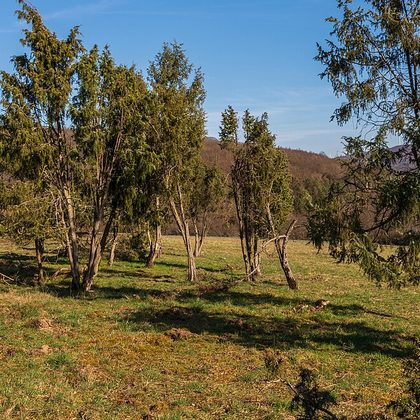
Where the bird is most at home, classified with EUNIS — the European standard for habitats.
Range and movements
Three countries within the area of the maps. In Israel it is resident in the Negev and Arava south of a line from Be'er Sheva to the Dead Sea. In Morocco it is the classic sandgrouse of the hamada south of the High Atlas: the Tagdilt plain near Boumalne Dadès, the stone desert around Ouarzazate and Goulmima, the Draa plains and the Tafilalt. In Algeria it occupies the northern Sahara, from the Béchar region east through Ghardaïa and El Goléa. Beyond the map the range runs from Mauritania right across the Sahara and Arabia to Iran, Afghanistan and Pakistan.
- Resident
- Breeding (summer)
- Winter
- Passage
- Migration direction
- dark = core range, pale = thinly spread
Where and when to look
Find the water, not the bird. On the Tagdilt plain near Boumalne Dadès a single pool is sometimes the only open water for miles; arrive shortly after sunrise and keep your distance, because a flock put to flight will not come back that morning. If the water fails, drive at walking pace across the gravel and stop every few hundred metres to listen — the hard nasal call is the only thing that gives them away, since a settled bird simply cannot be picked out on this ground. The same rules apply at the water points of the southern Arava in Israel. Write off the middle of the day entirely.
Conservation status
Not globally threatened; across the Sahara and Arabia the species is still common. Along the northern edge the picture differs. In Israel it is listed as vulnerable nationally, with fewer than a thousand birds and a decline of more than a fifth per generation; the fall began in the 1980s and is sharpest in the north of the range. Numbers swing from year to year with rainfall and seed supply, and flocks are smaller than those of other sandgrouse, which makes counting awkward. Which pressures matter most has not been established; the loss of open water in the desert and of quiet, undisturbed stony plains are the obvious candidates. No targeted measures are in place.