All species › Sandgrouse › Sandgrouse › Lichtenstein's sandgrouse
Lichtenstein's sandgrouse | Pterocles lichtensteinii
Lichtensteins zandhoen | Ganga de Lichtenstein
The smallest and the oddest sandgrouse in this guide: a squat, short-tailed bird that looks as though fine black ripples have been drawn across it from head to tail. It is also the only one that sleeps through the day and comes to water after dark — which is why, although it sits under an acacia somewhere close by, it counts among the hardest breeding birds to see in both Israel and Morocco.

Voice
The flight call is a soft, high, whistled quitl or quee-tl, repeated in short series with a plaintive quality; it is one of the few sandgrouse sounds heard more often in darkness than in daylight. Disturbed birds give a harsh chuckling kree-kree-kree. Because the birds arrive at dusk, the call is often all a flock gives away, and on a still evening in a wadi it carries a surprising distance between the rock walls.
No freely licensed recording is available for this species yet.
Identification
Small, rounded and short-tailed, with no elongated tail feathers. Both sexes are closely barred blackish on a cream to buff ground, above and below, with far more contrast than any other sandgrouse: close to, it looks like finely woven basketwork. The male has a black-and-white barred forehead, a yellow-orange eye-ring and an orange-red bill, and on the breast an unbarred buff panel crossed by two narrow black bands. The female lacks the forehead pattern, has a grey bill, and is evenly barred right across the breast with a much weaker band or none at all. The legs are feathered and flesh-coloured, the wings short and rounded.
Confusion species
None of the other four sandgrouse in this guide is barred across the whole underside, and that settles it at once: where the spotted and crowned sandgrouse are plain sandy below and the two Iberian species carry a white or black belly panel, this bird is patterned from throat to tail. Structure backs it up — clearly smaller and shorter than any of the others, with rounded wings and a quick, slightly fluttering beat instead of the long scything flight of the desert species. No other sandgrouse has the male's orange-red bill. And the hour helps: a sandgrouse coming in to water in the last of the light or well after sunset is almost certainly this one, since the other four drink in daylight. The call is a soft high whistle, quite unlike the nasal phrases of crowned sandgrouse, which often shares the same wadis.
Habitat
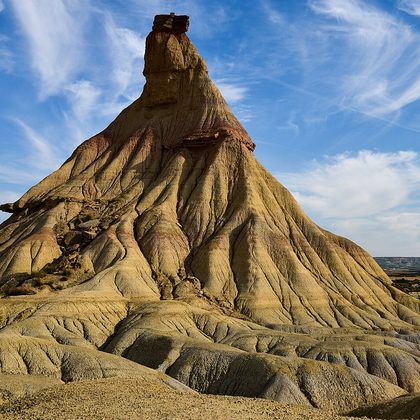
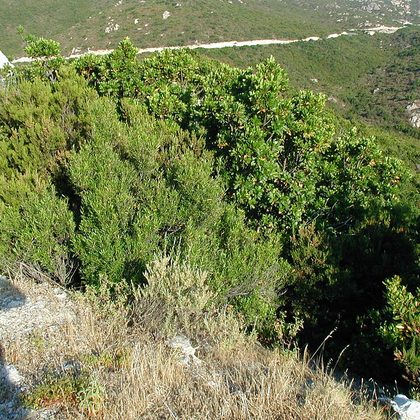
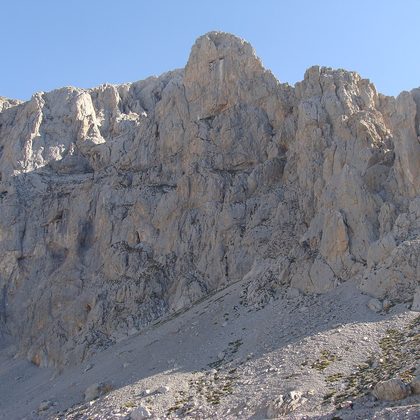
Narrow stony wadis with acacia scrub, and the screes and rock pavements around them. Unlike the other two desert sandgrouse it is not a bird of the open plain but of enclosed, broken ground: dry beds with scattered acacias, thorn scrub, boulders and steep walls. Through the day it rests there in the shade of a rock or a bush and barely moves. It feeds on foot beneath the scrub, on acacia and desert-herb seeds, chiefly in the last hour before dark. Drinking is done after sunset and again before first light, in small parties at the same pool or spring. Here too the male soaks his belly feathers; those feathers hold water and carry it to the chicks, and the quantity this species can carry that way is the largest measured in any sandgrouse.
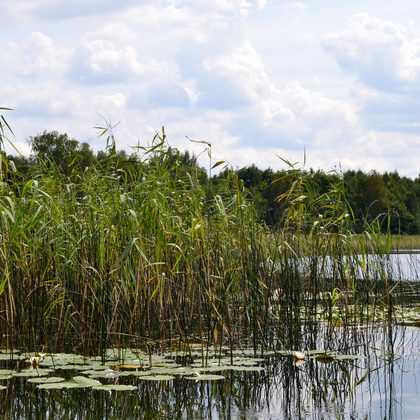
Where the bird is most at home, classified with EUNIS — the European standard for habitats.
Range and movements
Within the area of the maps this is the rarest of the five sandgrouse, with two small centres. In Israel it holds on in the southern Arava, in the triangle between Eilat, Lotan and Neot Smadar, using regular drinking places and occasionally nesting close to a settlement. In southern Morocco it is a rare pre-Saharan breeder: known sites lie at Oued Tissint on the Tata to Foum Zguid road and in the middle Draa near the dry bed of Lake Iriqui, where it sometimes comes to drink alongside spotted and crowned sandgrouse. Beyond the map it breeds patchily across the Sahel, the Horn of Africa, Arabia and eastwards to Pakistan and Afghanistan.
- Resident
- Winter
- Passage
- Migration direction
- dark = core range, pale = thinly spread
Where and when to look
This is the one sandgrouse in the guide you have to look for in the dark. Settle at a known spring or pool in a wadi in the last of the daylight, back against the rock, and stay until it is fully dark; the parties come in low and announce themselves with that soft whistle. Use no lamp — a flock that is disturbed moves elsewhere and will not return the following evening. Deliberate searching by day is close to hopeless; anyone who finds one then has flushed it by accident from under an acacia, and sees only a small bird going away low and fast. Moroccan records are worth submitting to the Moroccan Rare Birds Committee, as the distribution there is still poorly known.
Conservation status
Not globally threatened — taken across Africa and Arabia this is a widespread species — but at the northern edge the position is serious. Israel assesses it as critically endangered: fifty to a hundred pairs were estimated in the 1980s, and the population is now put at fewer than fifty adult birds confined to one small area. Rapid development in the southern Arava is altering the habitat and disturbing the regular drinking sites, and higher numbers of predators press on the breeding success of ground-nesting birds generally and of sandgrouse in particular. In Morocco too it comes down to a handful of localities. No targeted conservation measures exist.