All species › Owls › Typical owls › Desert owl
Desert owl | Strix hadorami
Palestijnse bosuil | Cárabo árabe
A tawny owl with no need of a tree. The desert owl lives in the bare rock canyons of the Judean desert, the Negev and Wadi Rum, sitting out the day in a crevice and calling from the cliff at dusk with the rhythm of a collared dove. It has been treated as a separate species since 2015; before that it and an owl from the mountains of Oman passed as one.
No freely licensed photograph of a living wild bird of this species exists.
Voice
A soft, hollow call that opens with one long-held hoooo and then runs into three or four shorter, quickly falling notes: hoooo … ho-ho-ho-ho. The rhythm suggests a collared dove and the whole phrase lasts two to three seconds, repeated every five to ten seconds. The female calls lower and duller, with a less pure tone. Between the walls of a narrow wadi the sound bounces, so that it seems to arrive from two sides at once and the bird is hard to place. Most vocal from December into March, in the hour after dark and again just before first light; breeding in Israel runs from March to August.
No freely licensed recording is available for this species yet.
Identification
A compact, round-headed owl without ear tufts, thirty to thirty-three centimetres long — a good deal smaller and slimmer than a tawny owl, about barn-owl size but far heavier-headed. Weights run from a hundred and forty to two hundred and twenty grams, and that wide margin is largely the difference between the sexes: the female is the bigger and heavier bird of the pair, which shows well when a duetting couple is on the same face. It is startlingly pale: sandy cream above with small greyish-brown flecks, almost white below with only a scatter of fine dark shaft streaks across the breast, so that the belly reads as plain white at any distance. A pale buff collar crosses the nape. The facial disc is creamy white and virtually unmarked, with a thin dark rim, and set in it are large orange-yellow eyes. The bill is pale, the legs feathered to the toes. In flight short and broad-winged, low along the cliff and utterly silent; against dark rock it seems almost to glow.
Confusion species
It parts from the tawny owl on every character, and in Israel the two live surprisingly close together. The tawny owl is bulky, dark grey-brown or rufous, heavily streaked right down the belly, and has wholly black eyes in a dark face; the desert owl is a third smaller, sand to white, essentially unstreaked below, and carries large orange-yellow eyes in a creamy-white disc. The landscape decides it: in the Levant the tawny owl holds the wooded Mediterranean hills of Galilee, Carmel and the western slope of the Judean range, while the desert owl begins a few kilometres east, exactly where the trees stop and bare rock runs on to the Dead Sea. A tawny-owl shape in a treeless wadi is this bird. The barn owl, also white below, has a heart-shaped face, black eyes, long bare legs and a buoyant, wavering flight.
Habitat
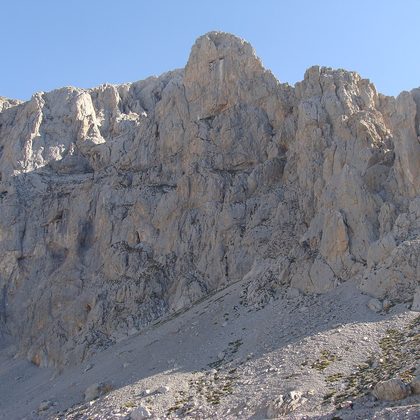
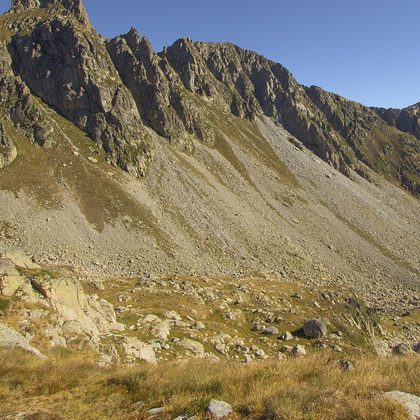
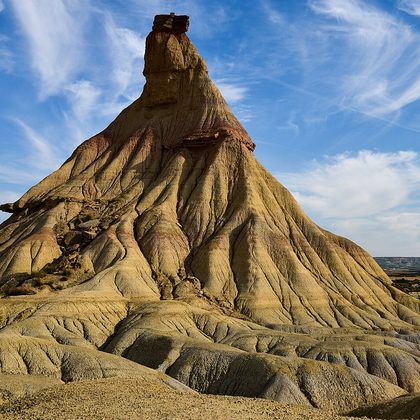
Bare rock desert with relief: deep wadis and canyons, steep faces, ledges, crevices and shallow hollows in the rock, screes and weathered outcrops. It breeds in a crevice or niche in the face and hunts from a lookout over the floor of the ravine, taking desert mice, jirds, shrews, geckos, scorpions and large insects. Densities are highest where such a ravine holds a spring with acacias or a few date palms; those trees are not a home but a hunting ground.
Where the bird is most at home, classified with EUNIS — the European standard for habitats.
Range and movements
Israel, Jordan, Sinai and on south along both sides of the Red Sea into Arabia. Within the region covered here it is a Levantine bird and nothing else: the ravines of the Judean desert and the faces above the Dead Sea, the Negev, the Arava, and on the Jordanian side Wadi Rum, Dana and the country around Petra. It does not occur in Europe and has never been recorded there as a vagrant. Resident, with pairs holding the same canyon for years.
- Resident
- Breeding (summer)
- Passage
- dark = core range, pale = thinly spread
Where and when to look
In January or February stand at the mouth of a wadi on a still evening, ideally where there is a spring or a few acacias, and wait until half an hour after sunset. The call almost always comes from high on the face. Do not walk into the gorge; stay at the bottom and scan the ledges against the last pale sky, because the bird is pale enough to stand out on dark rock. Ein Gedi and Wadi Rum are the classic places. Do not use playback — in the few reachable canyons the species sits at low density and reacts strongly to it.
Conservation status
Not globally threatened; the range is large and numbers are stable, but density is low everywhere and the suitable ground amounts to narrow ribbons of canyon. That makes every disturbance count. The threats are easy to name: climbers, canyoning and night photography on the breeding faces, growing tourist pressure in exactly the wadis that hold the best densities, rodenticides around desert settlements, and road casualties on desert highways, where the bird hunts low along the verges. Lighting along visitor paths in the gorges takes away the darkness it needs.