All species › Owls › Typical owls › Ural owl
Ural owl
Strix uralensis | Oeraluil | Cárabo uralense
The Ural Owl is like a scaled-up, pale Tawny Owl with a long tail and a plain, expressionless face. It lives in the old forests of Fennoscandia, the Baltic states and the mountains of central and south-eastern Europe. At the nest it is fiercer than any other European owl.

Voice
A deep, barking and clearly two-part hoot: hoo-hoovoo … hoovoo-hoovoo, with a pause of a few seconds between the parts, lower and hoarser than Tawny Owl and without its quaver. The female answers hoarser still, and when disturbed gives a barking wau-wau with bill-snapping. Most vocal from February to April, in the first hour after sunset and again just before first light.
Recording: Alexander Kurthy — CC BY-SA 4.0 · Wikimedia Commons
Identification
Large owl, in size midway between Tawny and Great Grey, with a big round head without ear tufts and a plain creamy-white face lacking rings or markings, with small dark, almost black eyes and a yellow bill. The plumage is pale greyish-brown with sharp dark streaks on a light ground, without barring on the breast. In flight the long barred tail is obvious, projecting well beyond the broad rounded wings and ending in a wedge; the beats are slow and heavy, almost buzzard-like. Females are larger and can be nearly twice the weight of males.
Confusion species
Tawny Owl is the classic confusion: far smaller and stocky, big-headed but with a short tail, a round plain face with wholly black eyes and heavy streaking on a browner ground; in flight broad and round-winged, with slow and utterly silent beats. Great Grey Owl is larger and greyer, with concentric rings in an enormous face, a black chin patch with white moustache and small yellow eyes. Eagle-Owl is much heavier, warm ochre-brown, with long ear tufts and blazing orange eyes. Ural is the palest of the three, with the longest tail and dark eyes in a plain face; and an owl that flies at you near a nest tree and strikes at your head is almost certainly this species.
Habitat
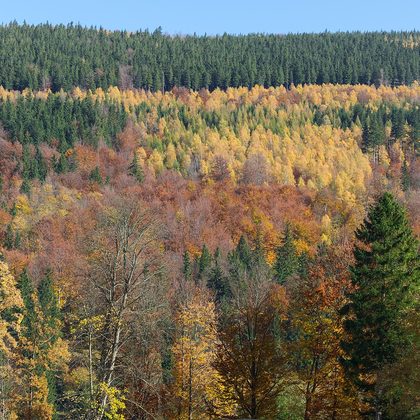
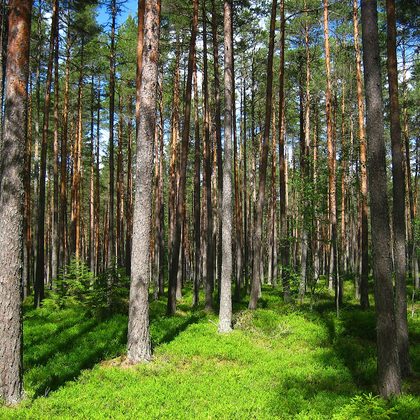
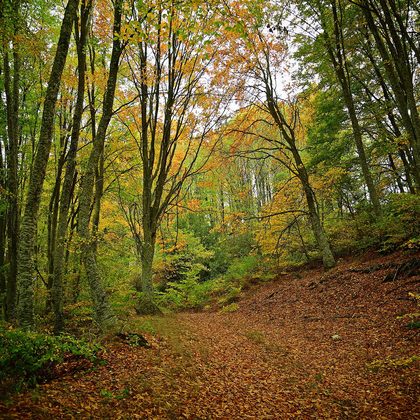
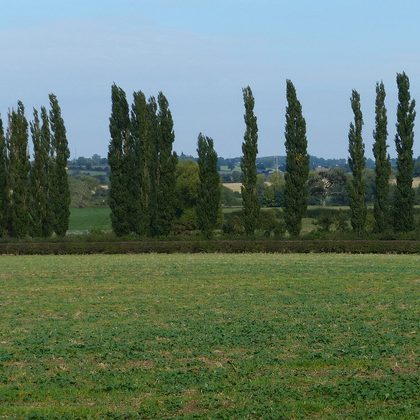
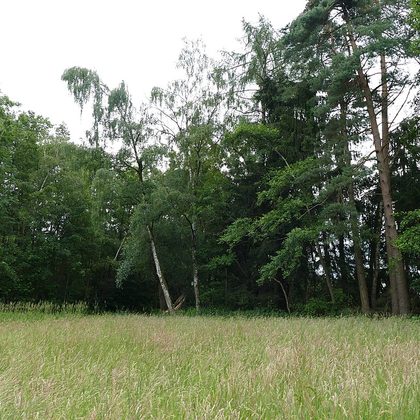
Old closed forest with openings in it: spruce and pine with birch in the north, beech and beech-silver fir in the Carpathians, Alps and Balkans. It needs heavy trees with cavities, broken-off trunks and old raptor nests, and readily takes large nest boxes. It hunts voles along clear-fells, forest meadows and woodland edges, often already at dusk.
Where the bird is most at home, classified with EUNIS — the European standard for habitats.
Range and movements
Within the map area a breeding bird of Norway, Sweden, Finland, Estonia, Latvia, Lithuania, Belarus, Poland, Czechia, Slovakia, the Carpathians and the Dinaric mountains, with restored populations in Bavaria, Austria and Bohemia; from there the range runs unbroken to Siberia, China and Japan. The Netherlands and Belgium lie outside it. Resident: even in poor vole years most pairs barely move from their territory.
- Resident
- Breeding (summer)
- Winter
- Passage
- dark = core range, pale = thinly spread
Where and when to look
Go to the Bavarian Forest, the Bohemian Forest or the Slovak Carpathians in March and listen at the edge of old beech woodland in the first hour after sunset; calling pairs answer each other across hundreds of metres. In April and May keep well away from nest trees and boxes, because sitting females attack walkers and may desert the nest in doing so.
Conservation status
Not globally threatened (IUCN: Least Concern) and broadly stable to slightly increasing in Europe, helped by nest boxes and by restoration projects in Germany, Austria and Czechia. Threats are the felling of old forest with hollow and broken trees, collisions on forest roads and, locally in the mountains, persecution; in the Alps and Carpathians the subpopulations are small and separated from one another.