All species › Tubenoses › Petrels and shearwaters › Desertas petrel
Desertas petrel | Pterodroma deserta
Desertasstormvogel | Petrel de las Desertas
The Desertas petrel breeds on Bugio, the southernmost and narrowest island of the Desertas off Madeira, and nowhere else. A hundred and fifty to two hundred pairs lay there in high summer, and for the rest of the year the birds range across half the Atlantic. At sea it is the silhouette seawatchers are waiting for, and at the same time the bird they are rarely allowed to name.

Voice
Silent at sea. Over Bugio the birds call in flight after dark with a long drawn moaning wail that rises and then breaks, and from the burrow comes a repeated low, nasal two-part call. The voice is fuller and lower than that of Zino's petrel, and that difference in pitch was one of the arguments for treating the Bugio birds separately. Calling is heaviest on dark nights from August to October.
No freely licensed recording is available for this species yet.
Identification
About thirty-five centimetres, with long narrow wings that look broad-based and slightly bowed, and a short, deep, heavy black bill that gives the head a blunt, bull-necked look. The upperparts are grey with a blackish M from wingtip to wingtip; rump and tail are a paler, colder grey than the mantle and inner wing, and at range that contrast is the most useful mark on the bird. The face is white with a dark smudge round the eye, the crown grey. The underparts are white, with a grey patch on each side of the breast that does not close into a band. The underwing is dark throughout, with no pale central stripe. In wind the flight is fast and high-arcing: the bird throws itself several metres up out of the trough and shears over on stiff wings; in calm it glides low with short, snappy bursts of beats.
Confusion species
On plumage this bird cannot be separated from Fea's petrel of the Cape Verdes, nor from Zino's petrel — the same grey back, the same M, the same paler tail, the same dark underwing. Against Zino's it is a little larger and stockier and, above all, noticeably heavier-billed, averaging nearly thirteen millimetres deep at the base against a little over ten in the other, with a wing about a centimetre and a half longer on average. That is not a difference anyone reads through a telescope on a moving boat, and without a sharp photograph of the bill in profile a bird at sea rightly stays nameless: the correct field label is Fea's/Zino's petrel. Against Fea's there is not even a size difference that does the job; there, breeding place and breeding season are the only handles, and those do differ sharply. Desertas lays in July and August and its young fledge into December; Zino's lays in May and June, and the Cape Verde birds lay in midwinter. A petrel of this group calling over its burrow on Bugio in September is therefore this species. Outside the group it is simpler: great shearwater is larger and browner with a white collar and a white underwing, Cory's and scopoli's shearwaters are much bigger and slower with heavy yellow bills, and Bulwer's petrel is small, uniformly dark and long-tailed.
Habitat
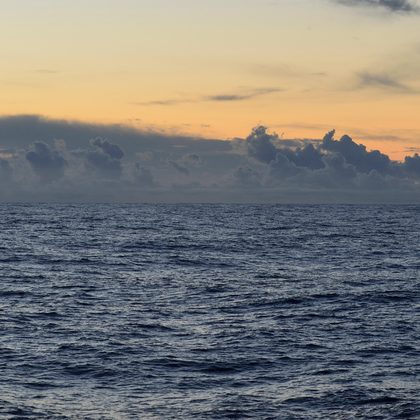
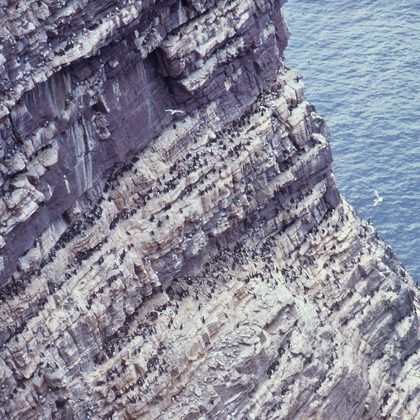
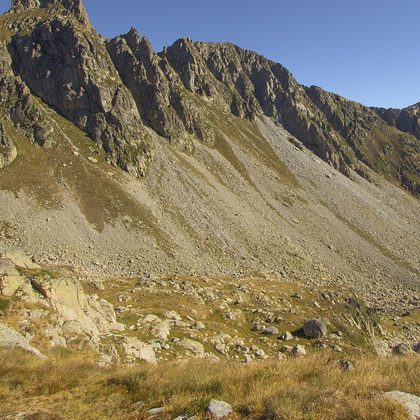
Deep open ocean, particularly along fronts and over seamounts where prey rises at night, and normally well out of sight of land. It takes squid and small fish from the surface, mostly after dark, in fast passes without settling. Birds tracked from Bugio make long looping foraging trips across the mid-Atlantic and deliberately work the winds around passing storms, which can carry them thousands of kilometres. Breeding is in burrows and rock cavities on the steep, scree-covered slopes and the narrow crest of Bugio.
Where the bird is most at home, classified with EUNIS — the European standard for habitats.
Range and movements
A breeding range of one island: Bugio, the southern island of the Desertas, twenty kilometres south-east of Madeira. A hundred and fifty to two hundred pairs, and that is the entire world population. At sea the birds range from Madeira and the Canaries north to the Azores, the Bay of Biscay and the approaches to Ireland and Britain, and south and west far into the tropical Atlantic; there is a regular autumn passage past the north-west corner of Iberia. Records north of Biscay are rare but annual and go into the books almost always as Fea's/Zino's.
- Breeding (summer)
Where and when to look
The reliable place is Madeira. Take a full-day or multi-day pelagic out of Machico or Funchal towards the Desertas between late July and early October; the boats work the deep water in the afternoon and chum brings birds close enough for the bill photographs the identification needs. Work from the photograph rather than from plumage, and do not be led astray by the pale tail — the whole group has it. Staying in Europe, the best chance is a seawatch from Estaca de Bares or Cabo Vilán in Galicia in the second half of August or in September, with a strong north-westerly behind a low; a Biscay ferry crossing in the same weeks is a reasonable second choice.
Conservation status
Vulnerable (IUCN). A hundred and fifty to two hundred pairs on a single island is a population that one accident could badly damage: an introduction of rats or cats on Bugio could empty the colony within a few years, and the island lies close enough to Madeira for that to be a real risk. Goats and rabbits once stripped the slopes of Bugio, so that the soil washed away and burrows collapsed; with those animals removed the vegetation and the nest burrows are recovering and numbers are rising slowly. Light pollution on Madeira draws fledglings down onto roads and harbours where they cannot take off again, and every autumn such birds are picked up on the island and released. Bugio itself is a strict reserve and can be entered only under permit.