All species › Gamebirds › Pheasants and partridges › Double-spurred spurfowl
Double-spurred spurfowl | Pternistis bicalcaratus
Barbarijse frankolijn | Francolín biespolado
A brown, streaked gamebird of Moroccan scrub, and an oddity in this region: the rest of the species lives in tropical West Africa, from Senegal to Cameroon. Only near Rabat is there a small, freestanding island of birds, the only ones that reach this side of the Sahara. You stand on a sand track between dwarf palms in the first light of March, and what reaches you is a hard grating rasp from a bush forty metres away.
Voice
The only practical way in. From a raised perch — a stone, an earth mound, a low branch — comes a harsh, hoarse, far-carrying rasp, three to five rough syllables like a rusty saw, usually delivered in series. Given at sunrise and towards dusk from February to April, with vocal activity peaking in the first ten days of March. Moroccan surveyors work in exactly those days and use playback, because otherwise there is next to nothing to count.
No freely licensed recording is available for this species yet.
Identification
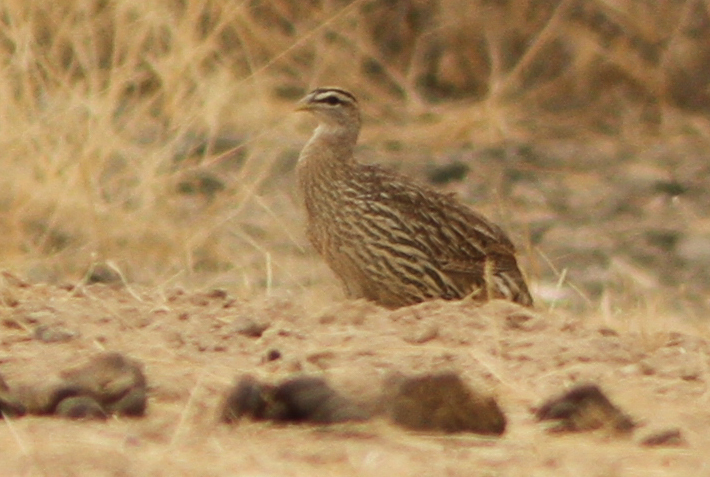
A slim, long-legged gamebird in brown and cream. A long creamy supercilium runs above a dark eye-stripe; cheeks and throat are pale, the crown chestnut. The upperparts are brown with pale shaft streaks, the underparts cream with dark drops and arrowheads that crowd together on the breast. The neck is long and the carriage upright, so that on an open edge the bird stands taller than any partridge. The male carries two spurs on each tarsus, which is what males use on one another in boundary disputes; the female usually has none and is smaller.
Confusion species
In Morocco it shares ground with Barbary partridge, and at close range the two are nothing alike: the partridge is grey with a chestnut, white-spotted collar, a red bill and red legs, and no streaking, while the francolin is brown, streaked throughout, longer in leg and neck, with a pale supercilium and a dark bill. At distance in low light the confusion is real, and then shape decides: the francolin stands higher and straighter. Quail is half the size and flies rather than runs. There is no second francolin in the region: black francolin sits two thousand kilometres to the east and has a black male with a white cheek patch.
Habitat
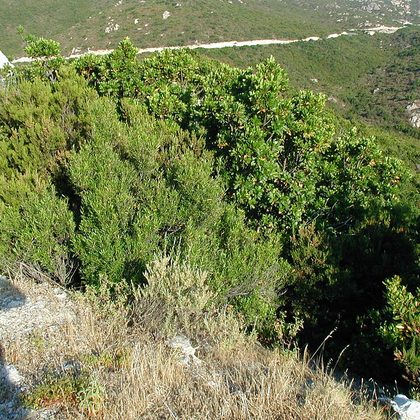
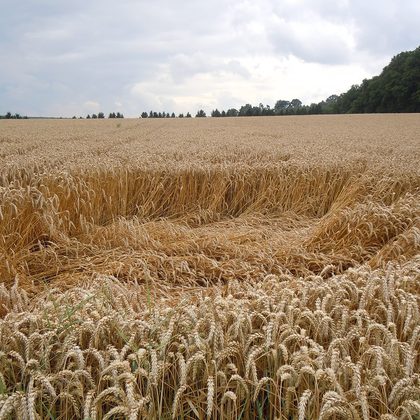
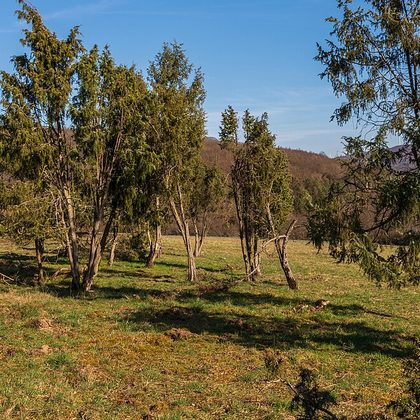
Matorral of dwarf palm, jujube, mastic and wild olive on the central plateau, with clearings and sand tracks between the thickets. The more woody the scrub, the more birds: males call markedly more in wooded matorral than in open matorral. Also the edges of the Maâmora cork oak forest, and the cereal fields, fallow strips and stubbles that lie between the blocks of scrub and where the birds feed.
Where the bird is most at home, classified with EUNIS — the European standard for habitats.

Range and movements
Within this region, Morocco only, and there just three adjoining areas forming a triangle: Sidi Yahya Zaër, Sidi Bettache and Benslimane, south of Rabat. The Moroccan birds are a race of their own, P. b. ayesha, found nowhere else. The range was far wider through the twentieth century and took in the Oued Korifla valley and the Maâmora forest among others; a separate population in the Souss went out in the 1980s. Outside Morocco the species picks up again only in the Sahel, from Senegal and the Gambia eastwards.
- Resident
- Passage
- Migration direction
- dark = core range, pale = thinly spread
Where and when to look
Be on a sand track in the matorral near Benslimane or Sidi Bettache before sunrise in early March, and listen for half an hour before walking anywhere. You will hear far more than you see. Then work the open ground and the low stones between the dwarf palm clumps with binoculars: the birds step up onto a rise in the first sun and withdraw as soon as it warms. Do not walk into the scrub; they run through it faster than you can.
Conservation status
Not globally threatened, because the West African population is large. That reassurance does not reach Morocco: the endemic race is squeezed into those three adjoining areas and is regarded as critically threatened. Clearance of matorral for cereal, grazing, hunting and the small size of the surviving core all pull the same way. Management leans on restocking: eggs from the royal reserve at Aïn Sferjla are hatched at a breeding facility and the young birds released — three hundred into the Maâmora in 2011, a hundred into the central plateau reserves in 2021 and a hundred and twenty into Souss-Massa National Park in 2022, the last an attempt to bring back the vanished southern population.