All species › Gamebirds › Pheasants and partridges › Reeves's pheasant
Reeves's pheasant
Syrmaticus reevesii | Koningsfazant | Faisán venerado
The longest-tailed bird in Europe, and one that does not belong here. A gamebird with a white, black-masked head, a golden scaled body and a tail that reaches a metre and a half in old cocks. Native to central and eastern China, and in Europe entirely the product of releases for shooting from 1870 onwards.

Voice
Remarkably weak-voiced for so large a bird. The cock gives a short, high, almost passerine warbling trill, more a tuwee-tuwee than a crow, carrying barely a hundred metres; that lack of volume is cited as one reason the species has established so poorly in Europe. He also whirrs his wings audibly in display, and flushed birds give a hard rattling kek-kek-kek. Most is heard early on March and April mornings.
No freely licensed recording is available for this species yet.
Identification
The cock is 150–210 cm long, most of it tail: silvery white with broad chestnut and black bars, growing some 30 cm a year in an old bird. The head is white with a broad black eye mask and a black collar, the body golden buff with heavy black scaling and dark underparts, the legs grey. The hen is about 75 cm, the size of a cock Pheasant, sandy brown with a dark crown, a pale face and a barred greyish-brown tail.
Confusion species
At distance the hen is the problem: she recalls a Pheasant hen but is bigger, with a distinctly dark crown against a pale face and a shorter, more broadly barred tail. The cock is unmistakable once the head is visible; only a glimpse of tail in long grass invites confusion with a cock Pheasant, whose tail is narrow, plain ochre and barred, with no white. Where Reeves's lives alongside Pheasant the two interbreed, and hybrids show a diluted mask, a rufous wash over the scaled body and a tail of intermediate length.
Habitat
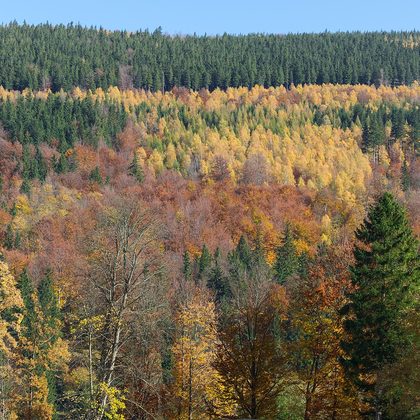
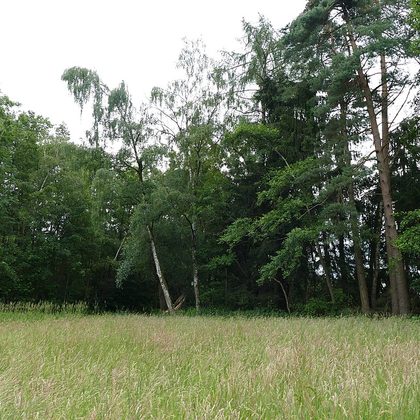
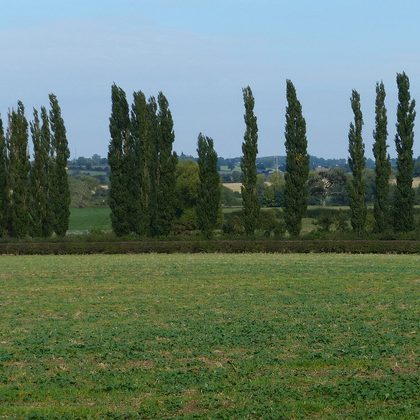
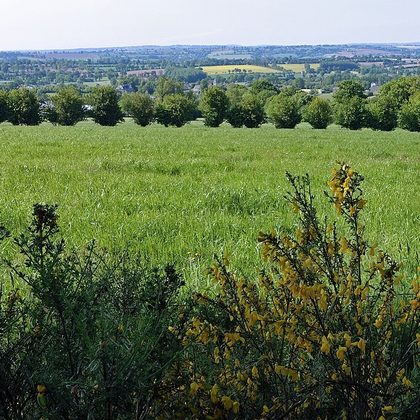
Broadleaved and mixed woodland with clearings, wide rides and felled patches, plus woodland edges, hedgerows and small-scale farmland against woods. In China, oak and mixed forest on hills between 400 and 2,600 m, with closed canopy and sparse undergrowth. In France it holds the large forest blocks of the Sologne, the Ardennes and Champagne, walking rides and margins by day.
Where the bird is most at home, classified with EUNIS — the European standard for habitats.

Range and movements
Native to central and eastern China. Brought to England by John Reeves in 1831 and to France in 1870, and released for shooting in both ever since. France now holds the largest European stock, with nuclei in the Sologne, the Ardennes, Champagne, parts of the south-west and a few upland areas such as the Vercors; the Czech Republic has had releases since the nineteenth century and keeps birds locally around pheasantries. Britain never established the species: after Woburn and Kinveachy in the 1970s, no notable breeding was recorded by 2009. Anywhere else in Europe the birds are escapes or fresh releases.
- Breeding (summer)
- Passage
- dark = core range, pale = thinly spread
Where and when to look
Walk the wide forest roads of the Sologne or an Ardennes massif in the first hour of light in March or April; the bird crosses open rides on foot and the tail shows at a great distance. In autumn and in snow the tracks give it away: a pheasant-like footprint with the drag mark of the tail beside it. Expect birds to stay within a few kilometres of a release site or shooting estate.
Conservation status
Vulnerable in its native range: perhaps two thousand wild birds remain in China, reduced by forest loss and by hunting for meat and for the tail feathers used in Peking opera costume. In France the population depends heavily on annual releases from game farms; a few forest nuclei breed on their own, but numbers would fall sharply without restocking. Interbreeding with Pheasant and the tendency of cocks to wander from release sites are given as reasons establishment so often fails. The European birds contribute nothing to the survival of the species in China.