All species › Passerines › Thrushes › Dusky thrush
Dusky thrush | Turdus eunomus
Bruine lijster | Zorzal oscuro
Dusky thrush is the east Siberian counterpart of the Fieldfare: a bird of open larch woodland and treeline scrub that pours into the fields and parks of Japan, Korea and eastern China by the thousand each winter. In Europe it is the rarest of the three Siberian thrushes in this guide. The Netherlands has four accepted records: two old ones, from 1899 and 1955, and two modern birds — in the city of Groningen in November 2016 and on Vlieland in October 2019. Anyone lucky enough to see one mostly registers the rufous in the wing.

Voice
A vocal bird, and usually heard before it is seen. The flight call is a harsh, faintly nasal shek-shek or kwek-kwek, harder and lower than a Fieldfare's chatter; there is also a thin, drawn-out tsee recalling Redwing. When agitated it runs together into a rattling chack-chack-chack-chack. The song, not to be heard in Europe, is short and simple: two or three clear, slightly shrill whistles that turn up and then down, followed by a dry squeaky grating — a phrase built like a Redwing's but rougher, and delivered more slowly.
No freely licensed recording is available for this species yet.
Identification
About song thrush size but heavier and broader across the chest, short-tailed and with a stocky, Fieldfare-like set. The head is boldly marked: a long, broad creamy supercilium runs from the base of the bill well behind the eye, below it a dark ear-covert patch, and below that a white submoustachial edged underneath by a black malar stripe. The throat is white. Breast and flanks are white with heavy black crescents and arrowheads that form a broad band across the breast and continue in rows along the flanks; belly and undertail coverts are white. The decisive mark is on the closed wing: the greater coverts and the fringes of the secondaries are bright rufous and together make a broad warm panel that no other thrush in this region shows. There is rufous on the rump too, and in the fringes of the tail feathers, and the underwing coverts are rufous. The mantle is dull brown and looks drab beside all that red. Males are heavier and blacker-marked than females; first-autumn birds are duller, with browner crescents and a less vivid wing panel.
Confusion species
Black-throated thrush is the confusion species — see its own page, where the same difference is set out from the other side. That bird is greyer, plainer and longer-tailed, and its upperparts are exactly the same cold shade from crown to tail-tip: no rufous panel, no rufous rump, no rufous in the tail. Its face is flat and near-featureless, with at most a weak supercilium instead of the bold white stripe of Dusky, and the black forms a closed bib on throat and upper breast in the male and a plain necklace in the female — never rows of black crescents across the whole breast and flank. What does not help is the underwing: both are rufous there. Naumann's Thrush Turdus naumanni, formerly counted as one species with Dusky and treated separately in the world lists since about 2010, is the hardest of all: its red is softer and more orange and sits on the breast, flanks and tail instead of in the wing, and its upperparts are a warmer brown. The two interbreed where their ranges meet and intermediates reach Europe, so a dusky thrush with too much orange on the flanks or too little black on the breast gets a hard look. Redwing is far smaller and has rufous flanks and underwing but no wing panel, and fine streaks rather than crescents. Fieldfare is bigger, with a grey head and rump and a brilliant white underwing. The large spotted Asian thrushes show a broad black-and-white band across the underwing, which no Turdus thrush has.
Habitat
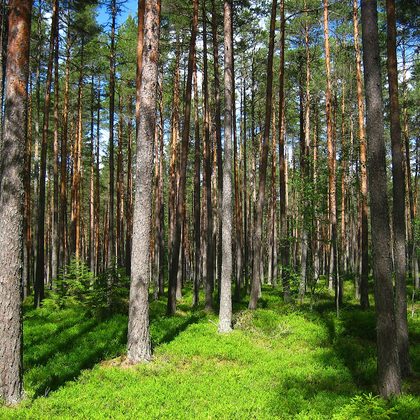
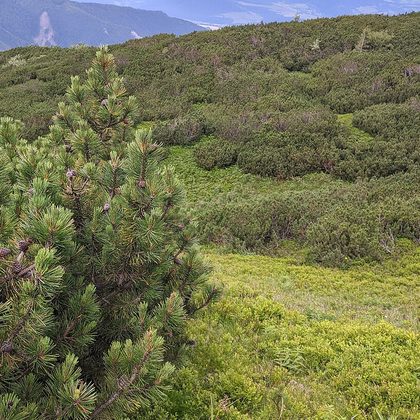
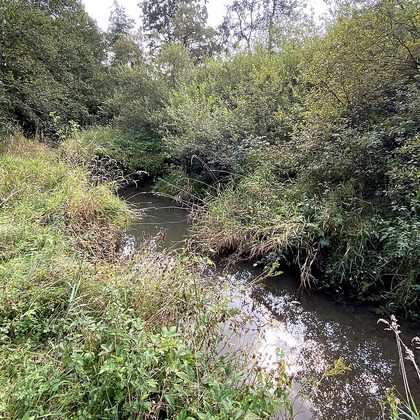
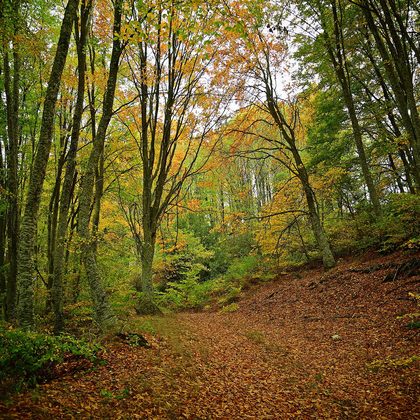
Breeds in the open forest and scrub of the east Siberian treeline: larch woodland with a low understorey, birch woods, willow and alder thickets along tundra streams, and the last wind-bent tree clumps of the forest tundra. Of the three species here it is the most northerly and the one most tied to the open zone where forest breaks into scrub. The nest is low in a tree or bush, sometimes almost on the ground. It feeds walking on damp ground among moss, litter and dwarf shrubs. In winter it takes to stubble, rice fields, parks and orchards, often in large flocks; the European vagrants end up in hedges, town shrubberies and orchards with rowan, hawthorn and ivy.
Where the bird is most at home, classified with EUNIS — the European standard for habitats.
Range and movements
Breeds from central Siberia east to the Kolyma and Kamchatka and winters in Japan, Korea, eastern China and Taiwan, with smaller numbers reaching the Himalaya and north-east India. Westwards it is a major rarity: a few tens of records for the whole of Europe, spread across Britain, Scandinavia, central Europe and the Mediterranean, weighted from late October into the winter. The four Dutch records are a bird at Dantumadiel on 20 November 1899, one at Kampen on 20 February 1955, one in the city of Groningen from 8 to 11 November 2016 and one on Vlieland from 25 to 28 October 2019. That pattern — an autumn bird that settles in a village or a housing estate and sometimes tries to sit out the winter — holds for western Europe as a whole.
Where and when to look
Realistically this is a species you travel to: follow the rarity news from late October into January and expect the bird to hold a good berry bush for days or weeks. To search for your own, work the berry-bearing hedges and village gardens of the Frisian islands in the second half of October, preferably after a settled spell of easterly wind. In a flock of Fieldfares and Redwings, look at wings rather than heads: one bright rufous panel among a hundred grey-brown wings registers at tens of metres, and only then check the white supercilium and the black crescents. Keep listening while you do it — the harsh shek-shek is a shade rougher than the Fieldfares' chatter around it.
Conservation status
Not globally threatened — the range is huge and the population runs into millions — but the trend points downwards. Japan, where the species is most numerous in winter and where counting goes back almost a century, shows a clear decline; the loss of wet rice fields, land consolidation and the tidying away of field margins are all cited, and on the breeding grounds the felling of larch forest plays a part. The Red List now assesses dusky thrush in its own right rather than under the broad Turdus naumanni, and that assessment is Least Concern. For the region of this guide it is a vagrant and stays one: there is no part of the map where it appears regularly, and the records that exist concern single wind-blown birds.