All species › Passerines › Thrushes › Gray-cheeked thrush
Gray-cheeked thrush | Catharus minimus
Grijswangdwerglijster | Zorzalito carigrís
Of all the American songbirds that make the crossing, Grey-cheeked Thrush is the most predictable: in almost every year one or a few appear on the west coast of Ireland and the Scottish islands during the first half of October. It breeds in the lowest, most wind-scoured scrub at the arctic treeline and heads from there straight out over the Atlantic towards South America — a route that, given a gale at the wrong moment, pushes it into Europe.

Voice
The call is the best character for anyone who cannot see the bird well: a thin, nasal and distinctly descending tsee-ur or veer, plaintive and slightly grating, recalling a muffled Redwing but shorter and more nasal. On nocturnal migration over the coast this is what gives the species away, and in North America it is counted that way. The song, not to be heard here, is a thin, rather reedy, nasal series that turns up and then down, chee-ee-oo-ee-a, and sounds as though the bird is short of breath.
No freely licensed recording is available for this species yet.
Identification
A small, cold-toned thrush the size of a Starling, with a big head, short tail and proportionately long, pointed wings. Uniformly grey-brown to olive-grey above: mantle, wings, rump and tail all exactly the same colour, and that very monotony is the mark. The face is strikingly flat and grey, with no pattern at all: no supercilium, no warm cheeks, and a grey to greyish-white lore. The eye-ring is thin, incomplete and usually visible only behind and above the eye — never the broad creamy spectacles of a hermit thrush. The breast is creamy white with diffuse, greyish drop-shaped spots, less crisply defined than a song thrush's; the flanks are cold grey-brown. A pale band crosses the base of the primaries on the underwing; in this species it is cold greyish-white, not buff. The basal half of the lower mandible is yellowish-pink and the legs are dull pink. Sexes alike. The overall impression is a grey, sober, rather sombre bird sitting almost motionless in cover — it does not cock its tail.
Confusion species
Hermit thrush is the counterpart, and the difference is one of contrast — see its own page, where the same case is set out from the other side. There, rump and tail are warm rufous against a dull brown back; here everything from crown to tail-tip is the same cold shade. Hermit also has a broad creamy eye-ring worn like spectacles, warmer buff tones on the breast and underwing band, and cocks its tail incessantly. Grey-cheeked is larger, longer and more pointed in the wing, and looks drabber. Swainson's Thrush Catharus ustulatus, slightly commoner in Europe than Hermit, is the third of the set: bold warm buff spectacles running forward to the bill, buff cheeks and a buff wash across the upper breast, and a call that is a short clear whit like a water drop. Bicknell's Thrush Catharus bicknelli is essentially inseparable from Grey-cheeked in the field — smaller, with a slightly warmer tail and more yellow on the lower mandible — and has yet to be certainly recorded in Europe; so a grey Catharus that has not been measured in the hand is best left as Grey-cheeked, or left unnamed. It differs from song thrush in its much smaller size, flat grey face, diffuse spotting and pale underwing band against song thrush's buff-yellow underwing. The Asian vagrant thrushes that can appear in the same October weeks are all true Turdus: bigger, longer-tailed, with an obvious supercilium or a marked throat, and no pale underwing band.
Habitat
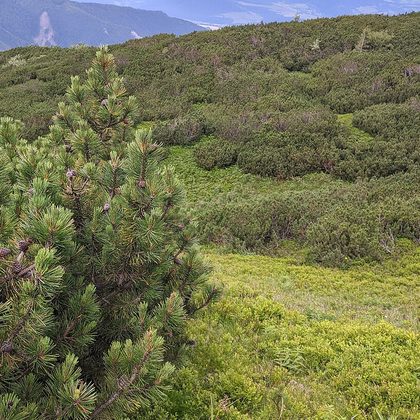
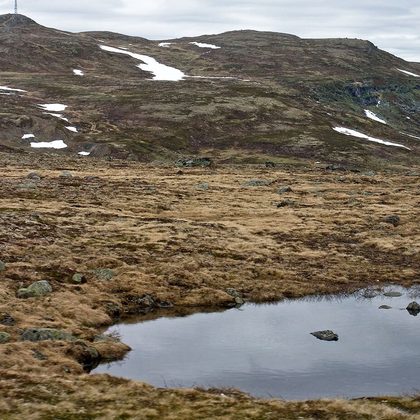
Breeds in low dense scrub at and beyond the arctic treeline: willow and alder thickets along tundra streams, dwarf birch, and the last stunted, wind-flagged spruce of the taiga edge. The nest is placed low in a willow or spruce, or almost on the ground within the scrub. Feeds by hopping and running in the litter beneath the scrub; on migration in dense thickets and woodland edge.
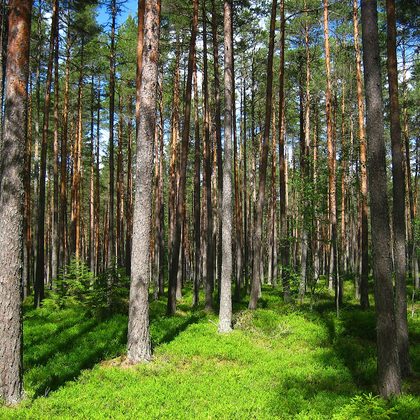
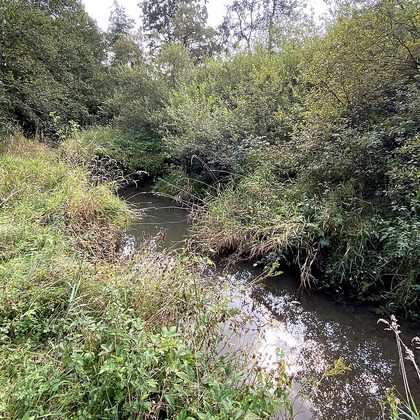
Where the bird is most at home, classified with EUNIS — the European standard for habitats.
Range and movements
Breeds from Newfoundland, Labrador and northern Quebec across arctic Canada to Alaska and the far north-east of Siberia, and winters in northern South America — one of the longest migrations in the genus, with part of the route flown over open ocean. That is exactly what makes it the most regular American thrush in Europe: since the first, trapped on Fair Isle in 1953, there have been tens of records, with Ireland (Cape Clear, Mayo, Kerry), the Isles of Scilly, the Outer Hebrides and the Northern Isles as the fixed sites, and annual numbers on Corvo in the Azores. The Netherlands has a single record: on 5 November 2018 an emaciated first-year bird was picked up near Monster in the Westland, ringed at the De Wulp bird hospital and released after recovery — at once the first for the Benelux.
Where and when to look
The first two weeks of October, two to four days after a fast-moving low has run from Newfoundland to Ireland. Then work the classic spots: the tamarisk and elder clumps and the walled gardens of Cape Clear, Scilly or Corvo, and on the Hebrides the small willow thickets and vegetable plots by the crofts. Search low and watch for a grey, near-featureless bird slipping silently from one bush to the next. Look first at the tail against the back: if there is no colour difference at all, this species is the strong favourite. Then check the flat grey face and the absence of a bold eye-ring, and try to flush the bird to see the underwing band.
Conservation status
Not globally threatened, but the picture is less quiet than that category suggests. The eastern, Newfoundland-breeding form has fallen by tens of per cent within a few decades, with the introduced red squirrel — which robs nests — identified as the main cause, alongside loss of wintering habitat in northern South America. For the far larger population in arctic Canada and Alaska the trends are poorly known, simply because almost nobody counts there. In Europe it is a matter of storm-driven individuals only, with no population of its own.