All species › Passerines › Swallows and martins › Eurasian crag-martin
Eurasian crag-martin | Ptyonoprogne rupestris
Rotszwaluw | Avión roquero
The one European hirundine that does not flee the winter: a solid, uniformly brown-grey bird that sails to and fro along cliffs, dam walls and viaducts all year round. It looks nothing like the swallow of the farmyard — no fork, no white, no gloss — and gives itself away above all by a row of white windows in the spread tail.

Voice
A taciturn hirundine. The usual note is a short, low prrt or chirp that is easily lost in the wind against the rock, together with a thin, high pli. The song is a short, soft run of linked trills, usually delivered in flight in front of the nest site and rarely audible more than a few dozen metres away. At the nest cup a hoarse twitter passes between the pair.
No freely licensed recording is available for this species yet.
Identification
Heavily built for a hirundine, with a broad wing base, a thick chest and a short, squarely cut tail with no fork and no streamers. The upperparts are dull ash-brown, the underparts dingy white to buff, with a finely speckled, dusky throat that shades gradually into the breast: nowhere a sharp border, nowhere a breast band. The underwing coverts are dark and the undertail coverts are dark too, so the rear end of the bird looks heavy and shadowed. The decisive mark appears only when the tail is briefly spread: a row of white spots near the tips of the tail feathers, like small windows in a dark frame. The flight is slow and weighty, with long glides hugging the rock and sudden, agile turns. Sexes alike; juveniles show pale feather edges above.
Confusion species
Sand Martin is clearly smaller and lighter, clean white below and with a sharply drawn brown breast band — a band Crag Martin never has — and flies with light, fluttering strokes low over water. House Martin has a big white rump and brilliant white underparts and is blue-black above; anyone in Spain who sees a 'House Martin with no white rump' is looking at a Crag Martin. Barn Swallow has a deeply forked tail with long streamers, a rusty throat and a blue breast band. Swift is far bigger, wholly dark, scythe-winged and shows no white in the tail. In North Africa and the Near East add Rock Martin: smaller, paler and sandier, with a warmer throat and smaller tail spots, and a bird of lower, drier ground.
Habitat
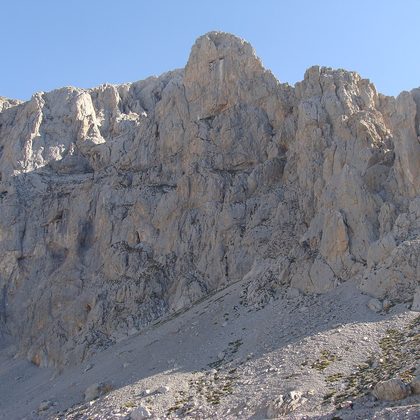
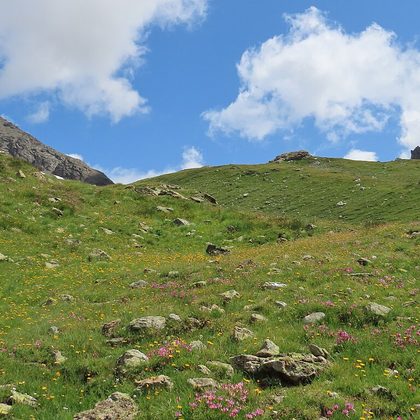
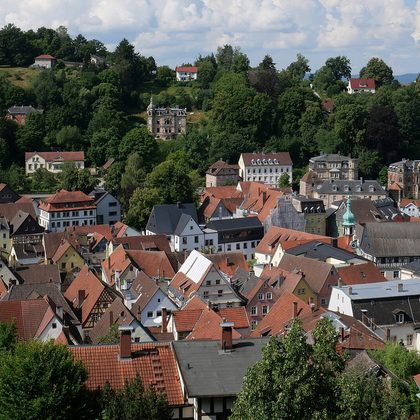
Cliffs, gorges, ravines and high crags, from sea level to well above the treeline, and nowadays just as readily dam walls, bridges, viaducts, castle walls and tall concrete buildings. It hunts along the face itself and over the alpine grassland, scree and mountain streams above it, taking the insects that the updraught presses against the rock. In winter it drops to river valleys, reservoirs, coastal towns and warm south-facing walls, where tens to hundreds of birds may roost together.
Where the bird is most at home, classified with EUNIS — the European standard for habitats.


Range and movements
Breeds in Iberia and north-west Africa, the Pyrenees, the Alps, the Apennines, the Balkans, Greece, Turkey, the Caucasus and the Near East, and eastwards through Iran and Central Asia to China. In Spain it is the only hirundine that stays all year and is widespread, from the Picos de Europa and the Pyrenees to the Baetic ranges and the Mediterranean sea cliffs. Northern and high-altitude populations move to North Africa and the Mediterranean basin. The Netherlands holds thirteen accepted records, the first in Amsterdam on 5 November 2006; apart from one June bird they all fell in October and November.
- Resident
- Breeding (summer)
- Winter
- Passage
- Migration direction
- dark = core range, pale = thinly spread
Where and when to look
In Spain, pick a large dam wall or a deep gorge and stand on the sunny side, even in midwinter: the birds then hunt right along the warm rock. Follow one bird through the binoculars until it spreads its tail on a turn, when the white windows light up and the matter is settled. Farther north, October and November on the coast or along the big rivers are the times to look, watching for a heavy brown hirundine patrolling slowly and on stiff glides along a dyke or a building, often among late House Martins.
Conservation status
Not globally threatened and one of the few European aerial insectivores doing better than it used to. The range is expanding and numbers are rising, largely because dams, viaducts, bridges and tall buildings supply artificial cliffs where natural ones are missing; in Spain it now breeds into city centres and at airports. Wintering ever farther north belongs to the same picture. Renovation of bridges and dams during the breeding season is the one real pressure: the nests sit open on the outside and a morning's pressure-washing removes them all.