All species › Waders, gulls and terns › Stone-curlews › Eurasian thick-knee
Eurasian thick-knee
Burhinus oedicnemus | Griel | Alcaraván común
A large, sandy-coloured wader of dry stony ground that spends the day motionless and comes to life at dusk. The huge yellow eye and the wailing, curlew-like call are what this species is about.

Voice
The key to the species. From about half an hour after sunset comes a plaintive, drawn-out, rising coor-leee, genuinely curlew-like but sharper and more strident and falling away at the end. Birds answer one another and build the calling into a chorus that can run for half an hour, the tempo quickening and the notes growing shorter and hoarser, kwee-kwee-kwee. When alarmed, a short hard kik-kik-kik. On a still night the sound carries close to a kilometre across open ground, and in the dark it is almost always the only way the species is recorded.
No freely licensed recording is available for this species yet.
Identification
Coarsely streaked sandy brown, with a long thick neck and a heavy rounded head. The eye is large and staring yellow, set off by a white supercilium and a white line below the cheek stripe; the bill is yellow with a black tip and the legs are thick and greenish yellow with a conspicuously swollen joint. A black-white-black bar crosses the greater coverts on the closed wing. In flight the black primaries carry two white patches and the bird looks broad-winged and slow, more like a small raptor than a wader.
Confusion species
In Europe there is little to confuse it with. A crouching bird is far more often overlooked than misidentified: it flattens itself, stretches the neck along the ground and merges completely into stones and stubble. In flight the black and white wing pattern can suggest a large plover, but the slow beat, the long neck and the projecting legs rule that out. In North Africa and the Middle East the smaller Senegal Thick-knee overlaps, with a shorter bill, a grey panel on the greater coverts and one white primary patch instead of two. In the dark the call is most often put down to a Curlew.
Habitat
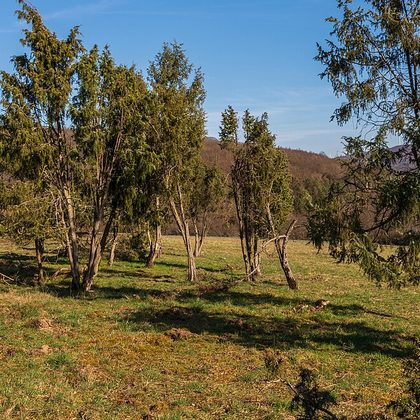
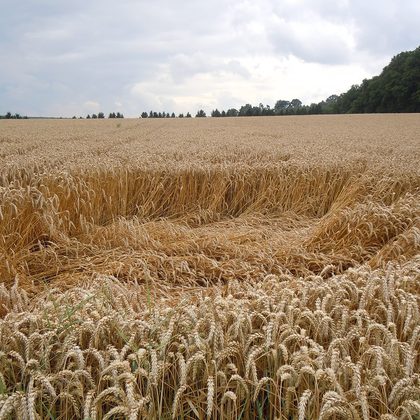
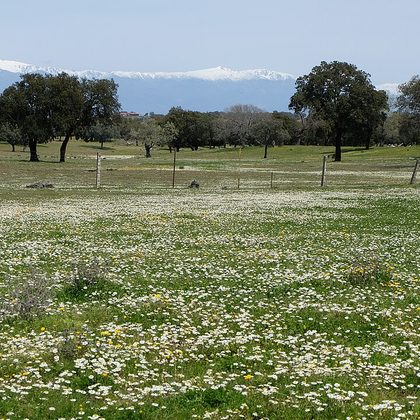
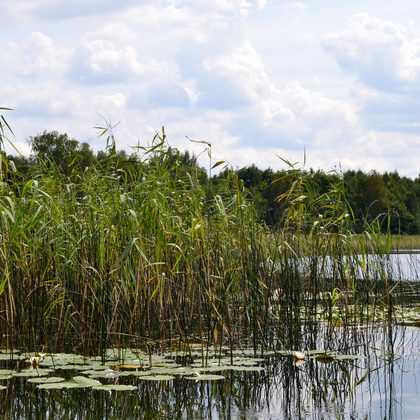
Open, dry and thinly vegetated ground on stony or gravelly soils: dry grassland, fallow and stubble, chalk grassland, river shingle, sandy heaths and young dunes, and in southern Europe also olive groves, vineyards and open dehesa. It needs short or absent vegetation to walk in and nests in a scrape on bare ground.
Where the bird is most at home, classified with EUNIS — the European standard for habitats.

Range and movements
Breeds across southern and central Europe with northern outposts in England and northern France. Iberia holds by far the largest population. In Britain the species is confined to the Brecks, Wessex and a few East Anglian arable areas, where nest protection on farmland has brought numbers back up. Northern breeders winter in Spain and North Africa.
- Resident
- Breeding (summer)
- Winter
- Passage
- Migration direction
- dark = core range, pale = thinly spread
Where and when to look
After sunset, park on the edge of an open stony plain, switch the engine off and listen; driving around achieves nothing, sitting still does. In September and October flocks of several dozen gather on fallow and stubble, and that is the best chance of daylight views: scan the bare ground from a slight rise and look for the yellow eyes. Do not put a lamp on the birds.
Conservation status
Not globally threatened but declining across much of Europe. Losses come from the disappearance of fallow, earlier and more frequent mowing, conversion of dry grassland to irrigated crops, infrastructure, and disturbance by dogs and off-road vehicles. Against that trend, targeted nest protection on English farmland has produced a steady recovery since the 1980s.