All species › Woodpeckers and allies › Woodpeckers › Eurasian three-toed woodpecker
Eurasian three-toed woodpecker | Picoides tridactylus
Drieteenspecht | Pico tridáctilo
The only European woodpecker with no red anywhere in its plumage, and the one most tightly bound to old conifer forest full of standing deadwood. Where bark beetles take hold in a spruce stand, or fire leaves a hillside black, it can go from scarce to numerous within a few years — and vanish again once the dead timber is used up.

Voice
Softer and duller than a woodpecker ought to sound: a short kyuk, less sharp and less far-carrying than Great Spotted's kik, strung into a low rattle when the bird is agitated. The drum is the better clue. It lasts a good second — around 1.3 seconds and some twenty strikes — accelerating slightly and fading at the end: clearly longer than Great Spotted's short dry roll and far shorter than Black Woodpecker's slow booming. Both sexes drum, from March into May.
Recording: Alexander Kürthy — CC BY-SA 3.0 · Wikimedia Commons
Identification
A little smaller and slimmer than Great Spotted Woodpecker, with a long, flat-crowned head and a heavy bill. Black and white, and nowhere red: the male carries a golden-yellow crown, the female one speckled black and white. A white band runs down the centre of the back from nape to rump, and the flanks are barred black and white, so the underparts never look cleanly white. The dark face is cut by a white supercilium and a white moustachial stripe. Each foot has three toes rather than four, and at close range through a telescope this really is visible. Birds of the Alps and Carpathians have a darker, more heavily barred back than those of Scandinavia, where the white band is at its broadest.
Confusion species
Elimination is the quickest route: no other European woodpecker lacks red altogether, so a black-and-white woodpecker with no red on crown, nape or vent is this one. Great Spotted Woodpecker has two big white shoulder ovals instead of a white back-stripe, unstreaked white underparts and a scarlet vent. White-backed Woodpecker also shows white on the lower back, but is larger and longer-billed, with a red crown in the male, pink under the tail and lengthways streaking on the flanks rather than barring. Black Woodpecker shares the same old spruce forest and the same dead trunks, but is crow-sized and entirely black; size alone rules out confusion. If doubt remains, look at the face: the dark mask with two crisp white stripes belongs to no other woodpecker.
Habitat
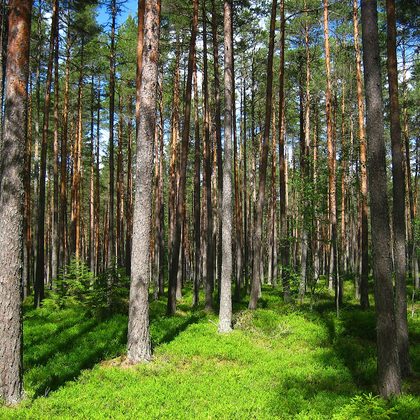
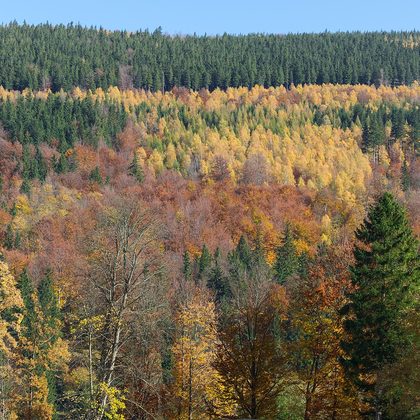
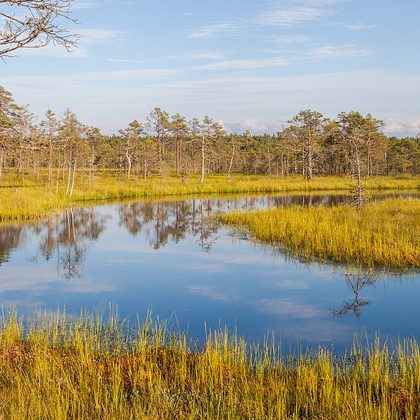
Old, open conifer forest with plenty of standing deadwood, spruce for preference; roughly a twentieth of the stand needs to be dead timber or the bird cannot hold on. In Scandinavia and Russia that means old taiga and wet bog forest with dying spruce; in the Alps and Carpathians, mountain slopes between about 1200 and 1800 metres. It works slowly and quietly, rarely chiselling large holes, instead flicking bark off dying trunks with short taps to reach bark beetle and longhorn larvae. It also rings trees — rows of small pits at one height around the trunk, from which it licks sap between spring and September.
Where the bird is most at home, classified with EUNIS — the European standard for habitats.
Range and movements
The boreal conifer belt from Norway, Sweden and Finland east through Russia to Kamchatka, Japan and Korea, with southern mountain outposts in the Alps, the Carpathians, the Dinarides and the Rhodopes, and lowland strongholds in old-growth forest such as Białowieża. It does not occur in Britain or Ireland, so this is a bird to travel for: the nearest dependable ground is the Norwegian and Swedish taiga, then the Bavarian, Austrian and Swiss Alps and the Polish and Slovak Carpathians. Resident, though mountain birds drop lower in hard weather and northern birds wander when larvae run short. The American Three-toed Woodpecker has been treated as a separate species since 2003.
- Resident
- Breeding (summer)
- Winter
- Passage
- dark = core range, pale = thinly spread
Where and when to look
Look in May and June in old spruce forest, and find the deadwood first: a windthrow, a bark-beetle-killed compartment, a burn a few years old. Walk slowly and listen for quiet tapping rather than for calls; drifting flakes of bark often give the bird away before the bird does. A trunk marked with horizontal rows of small pits means you are in the right territory — those are its rings. Reliable country: Swedish and Finnish taiga, the Bavarian and Austrian Alps, the Bohemian Forest, the Polish and Slovak Carpathians, and Białowieża.
Conservation status
Not globally threatened (IUCN: Least Concern), and over the long term the European Union trend is upward rather than downward, though numbers swing sharply with the supply of dead timber. Scandinavian populations have fallen since the 1970s under intensive forestry, and in France, at the western edge of the range, the species is rated critically endangered. Everything hangs on old spruce being left standing: clearing windthrow and beetle-killed trees removes an entire season's food supply at a stroke.