All species › Passerines › Chats and flycatchers › European pied flycatcher
European pied flycatcher
Ficedula hypoleuca | Bonte vliegenvanger | Papamoscas cerrojillo
Pied Flycatcher arrives in the oakwoods in mid-April and within a week takes over the nestboxes the tits have not yet claimed. The black-and-white male is one of the most conspicuous summer birds of sandy soils; the birds flicking through gardens in August are brown females and juveniles, and they take more work.

Voice
The song is a short, clear, slightly wistful tchee-tchee-tchoo-tchoo-tchee of five to eight notes, alternating clearly between two pitches and ending on a rising note; it sounds calm and measured, less hurried than a tit's. It is heard from mid-April to early June, most intensely in the first ten days after arrival. The call is a sharp, metallic bit or wheet, often in series, with a clicking tek in alarm.
Recording: Olivier Grimm — CC BY-SA 4.0 · Wikimedia Commons
Identification
Small, compact and short-tailed, perching upright on a low branch, sallying out and usually returning to a different twig, flicking wings and tail all the while. The spring male is black above and pure white below, with a large white wing patch across the base of the primaries and the secondaries, one or two white forehead spots, and white outer tail feathers. The female is grey-brown where the male is black, with the same white wing patch but smaller and duller. In autumn every bird looks like a female: brown, with a bold white wing patch, a pale line along the secondary tips and white tail sides — the plumage in which the species is most often seen here.
Confusion species
Collared Flycatcher is the classic comparison: the male has a complete white collar, a larger and continuous white wing panel that is broad on the primaries too, and a white rump. Females are far harder; look for the broader white base to the primaries and greyer, less brown upperparts. More important in practice is female Common Redstart: it lacks any white wing patch, is warmer buff below and always has a rusty tail and rump, shown at every departure. Spotted Flycatcher is larger and longer, uniformly grey-brown, without a wing patch but with a streaked crown and breast.
Habitat
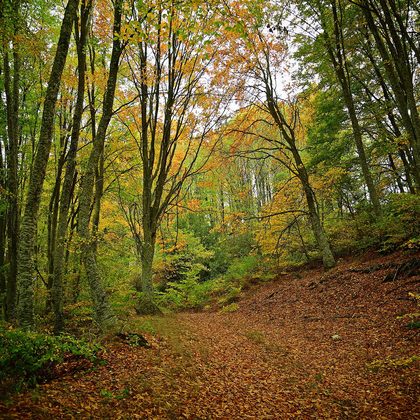
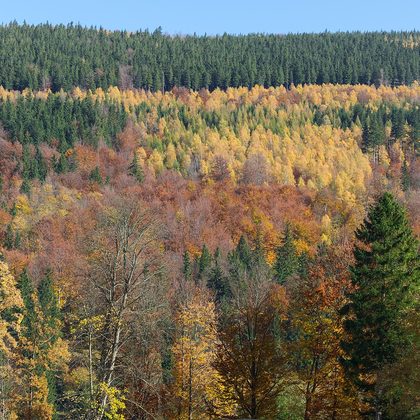
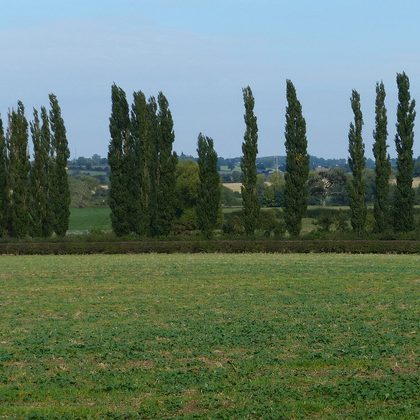
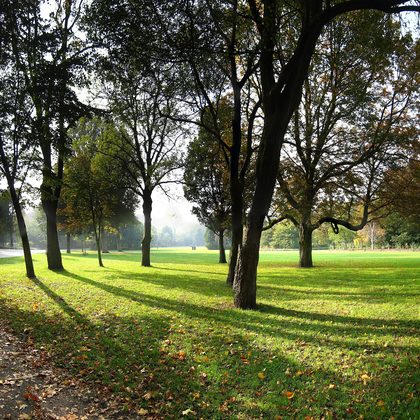
Mature broadleaved and mixed woodland with plenty of dead limbs, cavities and an open understorey: oakwood, beech, old avenues, hedgerow trees and estate woods, and anywhere nestboxes are put up. On migration and in autumn far more catholic, in gardens, parks, coastal copses and scrub, betraying itself by hunting from an exposed perch.
Where the bird is most at home, classified with EUNIS — the European standard for habitats.
Range and movements
A breeder of northern, central and eastern Europe, with an isolated stronghold in the mountain woods of central Spain. In the Netherlands twenty-one to twenty-six thousand pairs, concentrated on the Drenthe plateau and the Veluwe and further east; after halving between 1984 and 2002 the population recovered. All European birds winter in West Africa, which makes the species not only a breeder in Spain but above all a very numerous passage migrant there in August and September.
- Resident
- Breeding (summer)
- Winter
- Passage
- Migration direction
- dark = core range, pale = thinly spread
Where and when to look
The last week of April in mature oakwood on sandy soil, between sunrise and nine o'clock: males sing close to the nest hole and can be watched at eye level. For the autumn plumage you need not enter a wood at all: from mid-August to mid-September, look in coastal copses and gardens for a small brown bird sitting upright on a low branch, flicking its tail and returning again and again to the same twig — then check the white wing patch and white tail sides.
Conservation status
Least Concern, and partly increasing in north-west Europe over recent decades, helped by nestbox schemes in old woodland. The species is nonetheless under pressure: warming makes oaks flush and caterpillars peak ever earlier, while arrival from West Africa shifts more slowly, so chicks hatch after the food peak. Populations where that mismatch is greatest have declined most steeply.