All species › Tubenoses › Northern storm petrels › European storm-petrel
European storm-petrel
Hydrobates pelagicus | Stormvogeltje | Paíño europeo
The European Storm-petrel is the smallest seabird in Europe, hardly bigger than a House Martin and light enough to vanish in a closed hand. It spends its whole life over open water and comes ashore only at night, into dark crevices on remote islands.

Voice
Silent at sea. At the colony at night a sustained purring, churring rattle from rock crevices and dry-stone walls, ending abruptly in a small hiccup as if the bird were catching its breath: the classic arrrrrrr-oo-chik. Stand on Mousa in Shetland or Skokholm in Wales on a June or July night and dozens sing under your feet at once; over Dutch waters the species is entirely mute.
Recording: British Library — CC BY-SA 4.0 · Wikimedia Commons
Identification
Black and tiny, with short, broad wings rounded at the tip that carry it in a fluttering, light, irregular flight low through the wave troughs, feet often pattering briefly on a crest. The tail is square-cut, without a fork. The white rump patch is large and square and continues well onto the flanks and the sides of the undertail, so that in side view it reads as a white block wrapping downwards. The upperwing is almost uniformly dark, at most with a faint pale line across the greater coverts. The clinching mark is underneath: a sharp white bar along the underwing coverts, shown by no other European storm-petrel.
Confusion species
Leach's Storm-petrel is the key confusion species and the reason to check rump, wing and flight every time: it is larger and longer-winged, with an angled, kinked wing, a forked tail, a narrower rump patch often divided by a dark central line and not extending onto the flanks, an obvious pale diagonal band across the upperwing, and no white bar beneath the wing. The flight differs too: European flutters like a butterfly low through the troughs, Leach's moves powerfully and angularly, veering about more like a small nightjar. Wilson's Storm-petrel, rare but possible, has long legs projecting beyond the tail, yellow webs and a broad buffish band across the upperwing. Grey Phalarope and Black Tern can confuse at range, but both show white wing panels or pale underparts.
Habitat
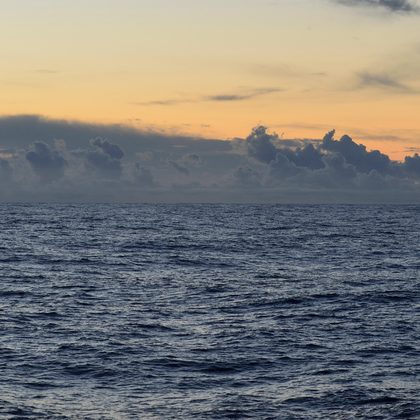
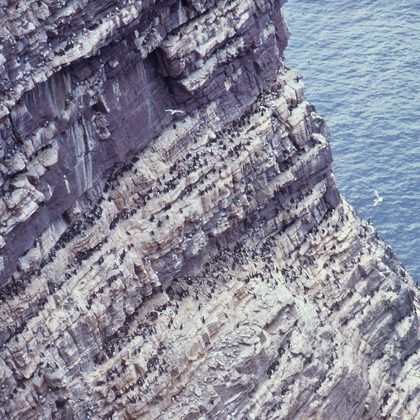
Outside the breeding season wholly pelagic, over the continental shelf and shelf edges, picking plankton, small fish and oily scraps from the surface while hovering and pattering. Breeds colonially in crevices and burrows on rocky islands, under stone walls and among boulders, always on islands free of rats. It visits the colony only on dark nights.
Where the bird is most at home, classified with EUNIS — the European standard for habitats.
Range and movements
Breeds in Iceland, the Faroes, Norway, Britain, Ireland, Brittany and, as a separate Mediterranean subspecies, on the Balearics, Malta, Sicily and the French Mediterranean islands. The Netherlands has no colonies; on the North Sea the bird is scarce but annual, mainly during summer gales in August and September. In Spain it is numerous off Galicia and in the Strait of Gibraltar, and it breeds on the Balearics and on islets off the Levante coast.
- Resident
- Breeding (summer)
- Winter
- Passage
- Migration direction
- dark = core range, pale = thinly spread
Where and when to look
In the Netherlands, seawatching after a firm north-westerly gale in August or September is the only realistic chance, with Westkapelle and the Brouwersdam the best stations; scan low over the water rather than at eye level, because the bird keeps disappearing behind the swell. Spain offers far better odds: Cabo Home or Estaca de Bares in Galicia in August and September, and Tarifa in the Strait of Gibraltar, where easterly winds push hundreds close inshore. An evening pelagic with chum off Galicia gives the best views of all, underwing bar included.
Conservation status
Not threatened; the European population runs to hundreds of thousands of pairs, by far the greatest part on British and Irish islands and in Iceland. The main threats are introduced rats and cats on breeding islands, light pollution that disorientates fledglings and occasional predation by large gulls. Rat eradication on islands in Scotland and Ireland has produced clear local recoveries; the Mediterranean population is small and considerably more vulnerable.