All species › Gamebirds › Pheasants and partridges › Golden pheasant
Golden pheasant
Chrysolophus pictus | Goudfazant | Faisán dorado
A gamebird coloured like a firework: scarlet underparts, a golden crest and an orange cape barred with blue-black. Native to bamboo scrub on steep slopes in central China, it is the bird that turned generations of British birders into pheasant hunters. Every European Golden Pheasant goes back to released ornamental stock, and that fact governs the whole British story.

Voice
The cock crows a hard, far-carrying, two-part chack-chack, sharpest at dawn in April and May; it is more metallic and less hoarse than a Pheasant's crow. In display, as he sweeps the cape across his bill, he adds a thin, high, metallic hiss audible only at a few metres. Outside spring the species is close to silent. Golden and Lady Amherst's cannot be told apart reliably on voice.
No freely licensed recording is available for this species yet.
Identification
The cock is 90–115 cm long, roughly two-thirds of that being a long, narrow, ochre tail finely marbled with black. Add a golden-yellow crest, an orange ruff barred with narrow blue-black lines that he fans across his bill in display, a dark green mantle, a golden rump and deep red underparts; bill, legs and iris are yellow. The hen is 60–80 cm, warm sandy brown and finely barred over the whole body, with yellow legs and a tail making up about half her length.
Confusion species
The real field problem is Lady Amherst's Pheasant, and above all the hybrids between the two. A pure Golden cock is red below with an orange cape; a pure Lady Amherst's is white below with a black-and-white scaled cape. British birds sat between the two for decades: red bleeding into a partly white cape, an orange wash across black-and-white cape feathers, or a tail with too much barring all betray mixed parentage, and virtually every surviving British Golden Pheasant carries Lady Amherst's genes. The hens are a separate puzzle. Golden hens are sandy brown, finely barred, with yellow legs; Lady Amherst's hens are more rufous, more coarsely barred, with blue-grey legs and bare blue-grey orbital skin. Both get passed off as Pheasant hens, but they are smaller, barred right across the belly rather than blotched, and shorter-tailed in proportion.
Habitat
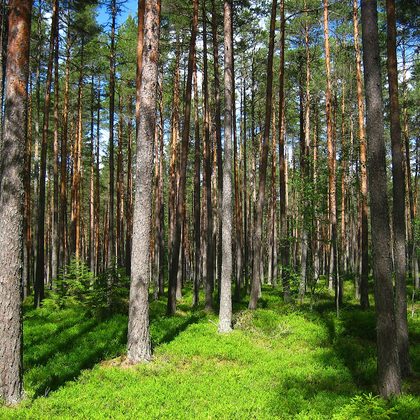
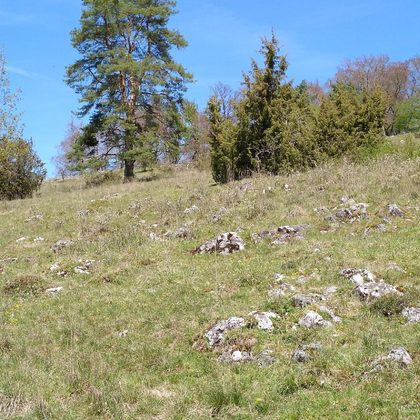
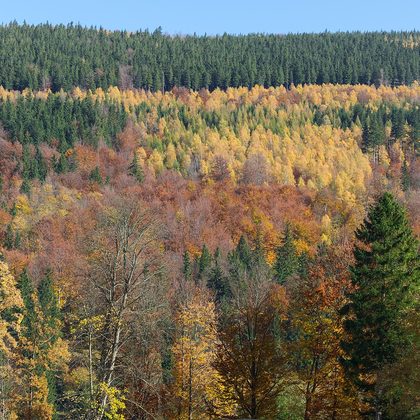
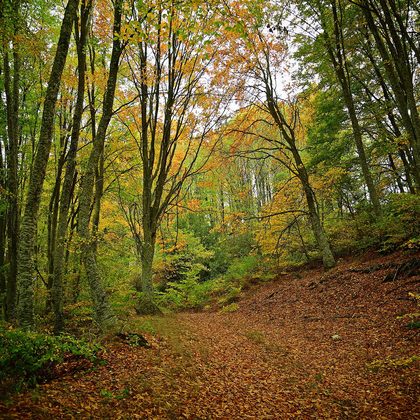
In Britain, mature conifer plantation, usually Corsican and Scots pine, with a dense rhododendron understorey, plus mixed woodland with thick scrub and the evergreen cover of the Poole Harbour islands. In China, bamboo thickets and secondary forest on steep slopes between 600 and 2,000 m. In every case it is dark, dense woodland where the bird stays invisible all day and feeds only on rides and small clearings.
Where the bird is most at home, classified with EUNIS — the European standard for habitats.
Range and movements
Native to central China, from Shaanxi and Gansu to Guizhou. In Europe it exists only as an introduction: released on British estates from the 1840s onwards, with strongholds in Breckland on the Norfolk–Suffolk border, around Sandringham in north-west Norfolk, on Anglesey, in Galloway and on the islands in Poole Harbour. The Scottish populations have died out and almost nothing is left of the English ones. Anywhere else in Europe, a Golden Pheasant is an escape.
- Breeding (summer)
- Passage
- dark = core range, pale = thinly spread
Where and when to look
Brownsea and Furzey Island in Poole Harbour now hold the only realistic chance in Europe, where a small group is fed; walk the boardwalks in the first hour of light and watch for birds crossing a path. Breckland and the Wolferton woods, the classic sites for forty years, are effectively finished. Elsewhere, a Golden Pheasant on a woodland ride is almost always a recent escape, and it is worth checking whether it carries rings on both legs.
Conservation status
The species is not globally threatened, though it is declining in China through logging and trapping. In Britain numbers peaked at 1,000–2,000 birds in the 1980s and 1990s; a survey in 2022 and 2023 found 37–40 birds at just two sites, both dependent on feeding, predator control or restocking. In May 2024 the BOU Records Committee moved the species from Category C1 to C6, the category for naturalised birds whose populations are no longer self-sustaining. The causes are the 1981 ban on releasing non-native birds, predation by Fox and Goshawk, and the clearance of rhododendron understorey.