All species › Woodpeckers and allies › Woodpeckers › Gray-headed woodpecker
Gray-headed woodpecker | Picus canus
Grijskopspecht | Pito cano
A slimmer, softer green woodpecker of old broadleaved forest in central, eastern and northern Europe, with a plain grey head and no mask. Unlike the green woodpecker it drums freely, and its song is a fading series of whistles.

Voice
The song is a series of six to fifteen clear, plaintive whistles, tyu-tyu-tyu-tyu-tyu, falling in pitch and slowing and fading towards the end; purer and more wistful than the ringing laugh of Green Woodpecker. It also gives a sharp kyuk. From February to May the male drums a great deal: a long, even, far-carrying roll of well over a second.
Recording: Matěj Tvarůžka — CC BY-SA 4.0 · Wikimedia Commons
Identification
A little smaller and finer built than Green Woodpecker, olive green above with a yellow-green rump and plain pale grey underparts without markings. The head is uniform grey with no more than a thin black lore line and a narrow black moustache; the male carries a small red forecrown, the female no red at all. The eye is dark red, the bill shorter and more pointed. Juveniles are duller and faintly barred on the flanks.
Confusion species
Beyond colour and head pattern, three things settle it against Green Woodpecker: the dark red eye against that bird's pale iris, the lack of any red on the nape — in the female the whole head is grey — and the duller, less yellow rump. Behaviour clinches it: Grey-headed drums long, loudly and regularly, and it stays much closer to closed forest.
Habitat
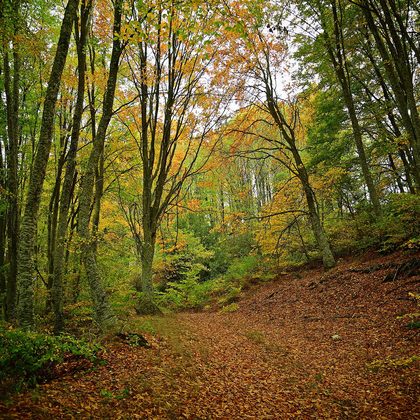
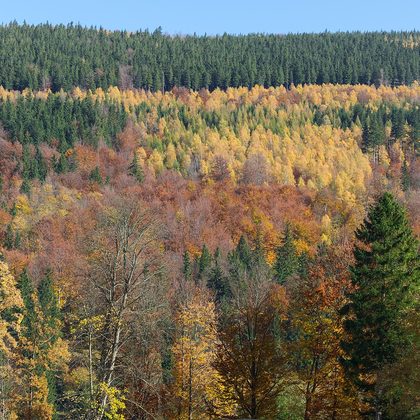
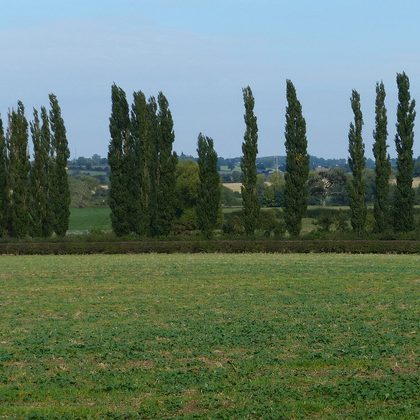
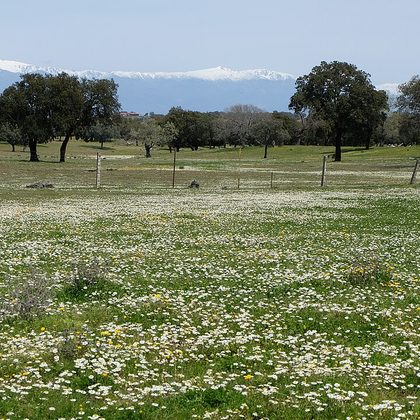
Old closed broadleaved forest with plenty of deadwood: beech, oak-hornbeam and above all floodplain woodland along rivers, up into mixed montane and boreal forest. Also traditional standard orchards and wooded meadows, and forest edges and clearings where it works ant nests on the ground. Distinctly more forest-bound than Green Woodpecker.
Where the bird is most at home, classified with EUNIS — the European standard for habitats.
Range and movements
From eastern France, Switzerland and Germany east through central and eastern Europe, the Balkans and Scandinavia into Russia, and on across Asia to Japan and the Himalaya. It does not occur in Britain or Ireland, nor anywhere on the Iberian peninsula. The nearest breeders to the North Sea are in the Ardennes and the Eifel. Resident.
- Resident
- Breeding (summer)
- Winter
- Passage
- Migration direction
- dark = core range, pale = thinly spread
Where and when to look
For British and Irish birders this is a bird for a trip abroad: the beech and floodplain forests of the Ardennes, the Eifel, Alsace or eastern Poland, in March and April. Be in the wood at first light and listen for the falling whistled series and the long drum roll; territories hold to the same hollow for years.
Conservation status
Numerous and stable across its world range, but in steep retreat in western Europe. France lists it as endangered with only one to four thousand pairs left, and in Belgium reports fell from eighty-five in 1972 to six in 2019. The loss of old broadleaved forest with standing deadwood, river canalisation and the disappearance of standard orchards are the main causes.