All species › Waders, gulls and terns › Sandpipers and snipes › Great knot
Great knot
Calidris tenuirostris | Grote kanoet | Correlimos grande
The largest of the Calidris sandpipers and the one in deepest trouble. A Great Knot in Europe is a bird thousands of kilometres adrift from a flyway that should run from the mountain tundra of Siberia to the tidal flats of Australia.

Voice
Silent even by sandpiper standards. On flushing an occasional low, disyllabic nyut-nyut, and a soft grunting chuk from a flock. A vagrant among other waders will almost certainly give nothing away by voice.
No freely licensed recording is available for this species yet.
Identification
Bulky and short-legged, clearly bigger and heavier than Red Knot, with a longer black bill that droops a little at the tip and dark olive legs. Breeding birds carry a solid gorget of black spots spreading onto the flanks, a rufous patch across the scapulars and a white belly below. Winter birds are grey but keep obvious dark streaking on breast and flanks, with a white, finely barred rump and a narrow white wingbar.
Confusion species
Red Knot is the only serious pitfall: smaller, shorter-billed, plain grey across the breast in winter and brick-red right through the belly in summer. Great Knot keeps a white belly under the black-spotted breast in every plumage. Bar-tailed Godwit is far longer in bill and leg; Dunlin is barely half the bulk.
Habitat
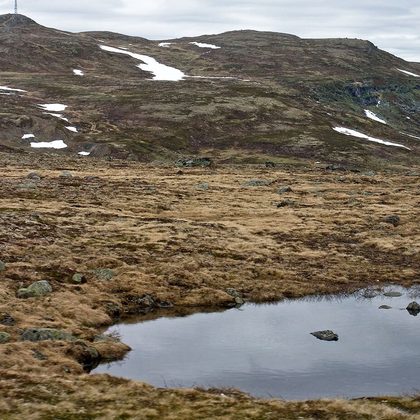
Outside the breeding season strictly a bird of broad intertidal sand and mud, probing for bivalves, roosting on adjoining sandy beaches, saltmarsh and salt pans. It breeds on stony, lichen-covered mountain tundra in north-east Siberia, roughly between 300 and 1,600 metres.
Where the bird is most at home, classified with EUNIS — the European standard for habitats.


Range and movements
Breeds in the mountains of north-east Siberia and winters from Arabia and Pakistan through South-East Asia to north-west Australia, with almost the whole population refuelling on the Yellow Sea. In the Western Palearctic it is exceptional, most regular in Oman and the Emirates, with a scatter of records in north-west Europe and Morocco.
Where and when to look
Work the tide line rather than a specific site. Scanning a large knot flock in August or September, look for one bird a size up, longer in the bill, spotted across the breast and heavier in its walk. The front edge of a flock being pushed by the tide is where an odd bird shows itself.
Conservation status
Endangered. The species depends wholly on the tidal flats of the Yellow Sea, more than half of which have been reclaimed; some ninety thousand birds disappeared after the Saemangeum seawall in South Korea was closed in 2006. Estuary pollution, disturbance at high-tide roosts and hunting along the flyway add to the pressure.