All species › Waders, gulls and terns › Sandpipers and snipes › Sharp-tailed sandpiper
Sharp-tailed sandpiper
Calidris acuminata | Siberische strandloper | Correlimos acuminado
The Asian counterpart of Pectoral Sandpiper, and the reason to work every Pectoral twice. Britain accounts for most of the western European records, and, unusually for a long-distance vagrant, the great majority of them are adults rather than juveniles.

Voice
Softer and more musical than Pectoral: a light, twittering wheep or trit-trit, often in a short series and with a cheerful, wagtail-like ring. Where Pectoral gives a low, dry krrrt, this bird sounds clear and higher pitched. On a bird seen only in flight that contrast is the quickest separation, provided both calls are already familiar.
No freely licensed recording is available for this species yet.
Identification
About the size of Pectoral Sandpiper but slightly more compact and shorter-billed, the bill straight and blunt-tipped with a pale base, the legs olive to yellow-green. The crown is warm rufous, finely streaked black, and stands out against a broad, strikingly white supercilium; a clear white eye-ring gives the face an open, gentle look. The breast carries a soft buff to orange-buff wash with streaking that fades away gradually and runs onto the flanks as chevrons and arrowheads, with no clean border. Juveniles have a plain orange-buff breast streaked only at the sides, rufous scapular fringes and white mantle lines. The central tail feathers taper to a point, which explains the name but rarely helps in the field.
Confusion species
Everything turns on Pectoral Sandpiper. There the dense breast streaking halts abruptly and horizontally against white; here the markings fade out and spill down the flanks. The second character is the head: a warm rufous crown, a broad white supercilium and an obvious white eye-ring, against the grey-brown, finely streaked crown and shorter, duller supercilium of Pectoral. The gap is widest in juveniles, since a juvenile Sharp-tailed shows a warm, largely unstreaked orange-buff breast where a juvenile Pectoral keeps the full bib. Bill and legs help little, as both have a pale bill base and yellowish legs, though Sharp-tailed's bill is shorter, straighter and blunter and the neck a shade shorter. Against Baird's and White-rumped Sandpiper this is a larger, heavier, yellow-legged bird lacking their long primary projection, and the rump is dark-centred with white sides, so there is none of White-rumped's white block. Dunlin is smaller, black-legged and longer-billed; Curlew Sandpiper is slimmer with an evenly decurved bill and a broad white rump. A juvenile Ruff is bigger, more scaly above and has a smaller head on a longer neck.
Habitat
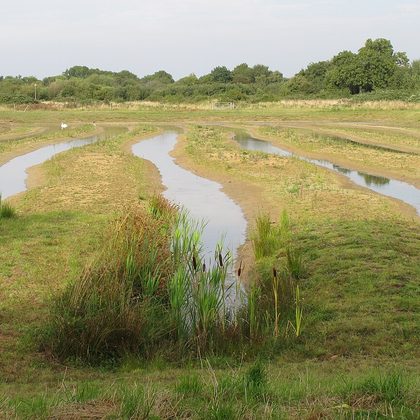
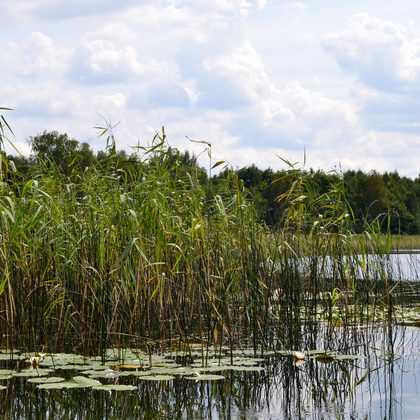
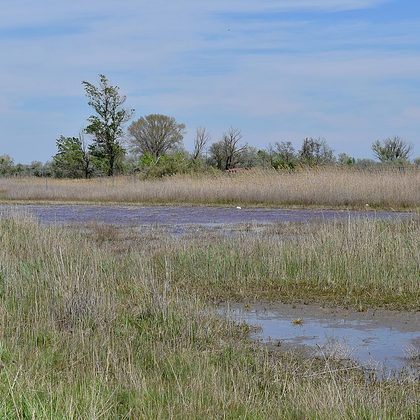
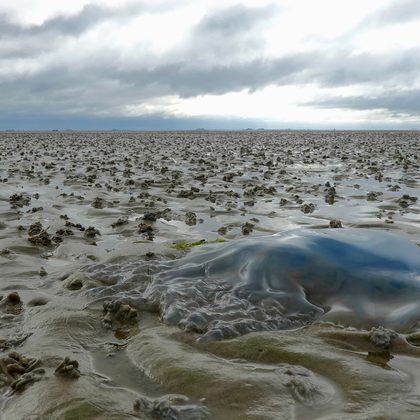
The same ground as Pectoral Sandpiper, which is exactly the difficulty: wet grassland, flooded field corners, vegetated margins of coastal scrapes and pools, and drawn-down reservoir shorelines. Rather more than Pectoral it also appears along saltmarsh edges and on brackish mud. It breeds on damp sedge and dwarf-birch tundra in north-east Siberia between the Lena and the Kolyma and winters in Australia and New Zealand.
Where the bird is most at home, classified with EUNIS — the European standard for habitats.
Range and movements
Practically the whole world population heads for Australasia, adults flying direct while many juveniles detour by way of Alaska. European records are therefore few and, unlike the Nearctic species, weighted towards adults. Birds have been found in eleven European countries, with Britain well ahead of the rest and August to October the main window; the Netherlands has nine accepted records from 1989 to 2017 and Spain none.
Where and when to look
Do not go looking for this bird; go looking for Pectoral Sandpipers and finish each one on crown, eye-ring and flank markings before ticking it off. August to early October is the window, with wet grassland, machair pools and the landward edge of coastal scrapes the best ground, and Shetland and the Northern Isles the most productive region. Any Pectoral that appears to have a Golden Plover's face, warm-capped and white-eyed, deserves photographs of head, breast and flank before it flies.
Conservation status
Uplisted to Vulnerable on the Red List in 2021. The species depends entirely on the East Asian flyway, and reclamation and pollution of the Yellow Sea tidal flats have stripped out the staging grounds it needs; Australian counts show a clear decline. Shallow freshwater wetlands on the Australian wintering grounds are being lost as well. Of these four sandpipers it is the only one carrying a genuinely worrying status.