All species › Waders, gulls and terns › Gulls and terns › Greater crested tern
Greater crested tern | Thalasseus bergii
Grote kuifstern | Charrán piquigualdo
The greater crested tern is the heavyweight of Red Sea terns: nearly gull-sized, with a dagger of a yellow bill and a slate-grey mantle. It barely reaches the map of this guide: the beach at Eilat, at the very head of the Gulf of Aqaba.

Voice
A hard, low, grating kerr-ak, coarser and hoarser than sandwich tern and without its sharp edge. When agitated it runs into a rapid krik-krik-krik, and over a colony that builds into a raw roar. On the Israeli coast you will rarely hear more than a single call from a passing bird; this is not a species that announces itself.
No freely licensed recording is available for this species yet.
Identification
Big and broad-winged, with slow, deep beats that read more gull than tern. The bill is long and heavy, lemon to olive-yellow, drooping slightly towards the tip; the legs are black. The black crown runs back into a shaggy, raisable crest, but a broad white band always stands between the bill base and the black — in full breeding dress as well, and that band is what settles the bird in one look. Mantle and upperwing are dark slate-grey, clearly darker than any other tern in the region, and the rump and tail carry the same grey; the underparts are white. Outside the breeding season the crown becomes flecked with white and the black retreats to the crest. Juveniles are scaly grey-brown above with dark bars across the wing and a duller, horn-yellow bill. Red Sea birds belong to velox, the largest, darkest and longest-billed form of the species.
Confusion species
Sandwich tern is where the comparison starts, and the difference carries at any range: that bird looks brilliant white, with a black bill tipped sharply in yellow and a white rump and tail, while greater crested shows an all-yellow bill and a single dark grey sheet running from mantle to tail tip. Lesser crested tern falls between the two in size and has a slimmer, clean orange bill and a pale grey mantle with a barely darker rump; in breeding plumage its black cap reaches the bill base, where greater crested keeps that white forehead all year. The crest differs too: long, heavy and bristling on greater crested, shorter and finer on lesser crested. Caspian tern is larger again but carries a thick blood-red bill, a dark hand from below, and a tail that is barely forked.
Habitat
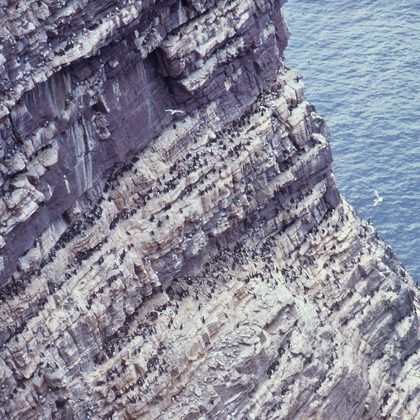
Inshore seas, coral reefs and shallow bays, resting on sandbars, spits, piers, buoys and floating fish cages. It breeds in dense colonies on flat, bare coral and sand islets, often beside lesser crested terns. Fresh water plays no part: the species stays tied to salt water and seldom follows the coast far out into open ocean.
Where the bird is most at home, classified with EUNIS — the European standard for habitats.



Range and movements
A bird of the warm coastal seas of the Indian Ocean and the western Pacific, with a strong population in the Red Sea and the Gulf. Almost none of that falls inside the map of this guide. The map stops at 29 degrees north, which is the latitude of the head of the Gulf of Aqaba: the beach at Eilat and the Jordanian shore at Aqaba are in, the rest of the Red Sea is not. At Eilat it is a scarce but near-annual visitor, most records falling in July and August with scattered birds in spring and winter. The top of the Gulf of Suez, around Ain Sokhna, produces records too. The nearest colonies lie hundreds of kilometres to the south, on islands well off the map.
- Resident
- Breeding (summer)
- Winter
- Passage
- Migration direction
- dark = core range, pale = thinly spread
Where and when to look
North Beach at Eilat is the place. Take up position near the marina early in the day in July or August and work through the terns resting on buoys, floats and the pier. Sort first on size and on the dark mantle, then wait for the bird to turn its head, because bill colour decides it. Expect one bird among dozens of common terns; offshore wind helps, since it keeps the terns close in.
Conservation status
Not globally threatened: the species is spread over an enormous range and numbers in the hundreds of thousands. It stays locally vulnerable, because the colonies pack onto a handful of low islets where egg collecting, disturbance by pleasure boats and oil pollution can cost a whole colony in a single season. Several Red Sea breeding islands now sit inside protected areas, which gives the main colonies some peace.