All species › Passerines › Larks › Greater hoopoe-lark
Greater hoopoe-lark | Alaemon alaudipes
Witbandleeuwerik | Alondra ibis
The biggest lark in this guide, and the only one you might first take for a wader: long-legged, long-necked, with a long decurved bill and a startling black-and-white wing that stays hidden until the bird finally flies. On hard desert ground it runs rather than flies. The song comes out of a steep climbing flight that ends in a tumbling free fall, and for many visitors to Morocco or Israel that display is the single thing they most want to see.

Voice
The song flight is the trademark. From the ground or a low bush the bird climbs almost vertically on quivering wings while delivering a series of pure, mournful whistles that rise in pitch and quicken; at the top it stalls, half-closes its wings and drops back to the ground in a tumbling, somersaulting fall, often finishing the phrase on the way down. The ordinary call is a high, drawn-out, plaintive whistle that carries remarkably far across an empty plain. It sings from midwinter into late spring, most intensely in the first and last hour of light, and on clear nights under the moon as well.
No freely licensed recording is available for this species yet.
Identification
A large, slim, pale lark of 19–22 cm, with long pale legs, a long neck and a long, evenly downcurved dark bill. Plain sandy to greyish brown above, white below with a band of sharp black spots across the upper breast and along the flanks. The head is pale, with a dark eye-stripe and a dark moustachial stripe framing white ear-coverts. The decisive picture only comes in flight: a broad white band crosses the black flight feathers, so the wing looks boldly black-and-white from above and below. The tail is dark with pale corners. Males are larger and longer-billed than females but otherwise identical. It walks and runs in long strides, stops dead, probes and digs in the sand with the bill, and now and then climbs onto a low bush.
Confusion species
Most mistakes happen in flight. Hoopoe has the same black-and-white wing pattern and a decurved bill, but an orange-buff body, a fannable crest and a floppy, butterfly-like flight, and it perches on walls, posts and trees. Cream-coloured courser walks the same bare ground, is equally pale and long-legged, but lacks the decurved bill, has a black-and-white stripe behind the eye and a blue-grey nape, and in flight shows an entirely black underwing. Dupont's lark also has a long decurved bill, but is far smaller, darkly streaked, skulks in low steppe scrub on higher ground, and never shows white in the wing. The small, compact Ammomanes desert larks — desert lark and bar-tailed lark — are at most half the size, plain sandy, short-legged and short-billed.
Habitat
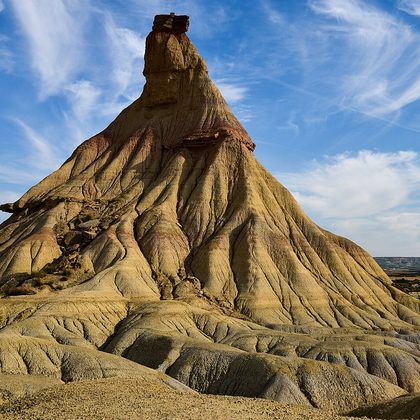
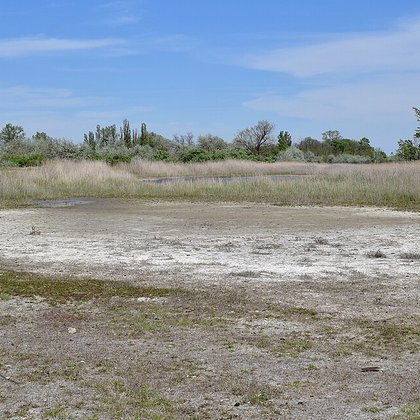
Flat sand and gravel desert with widely spaced low bushes: open reg and bare hamada, broad wadi beds, the margins of dune fields, the rims of salt flats and the sandy coastal plains of the Atlantic. It needs two things at once — plenty of open, firm ground to run and dig on, and the occasional bush to sing from and shelter under. It is absent from closed vegetation, and equally absent from a sand sea with no plants at all.
Where the bird is most at home, classified with EUNIS — the European standard for habitats.

Range and movements
From the Cape Verde islands and the Atlantic coast of Morocco and Western Sahara east across the whole Sahara — Algeria, Tunisia, Libya, Egypt — and on through Sinai to Israel, Jordan and Arabia, reaching Pakistan and north-west India beyond the area of this guide. Within the window of this book it is numerous in southern Morocco and Western Sahara, local in Tunisia and Algeria, and in Israel and Jordan confined to the Arava, the Negev and the surroundings of the Dead Sea. It is a strict resident, staying in the same stretch of desert all year.
- Resident
- Breeding (summer)
- Winter
- Passage
- Migration direction
- dark = core range, pale = thinly spread
Where and when to look
Drive early, drive slowly and watch the ground. On a desert track you usually pick it up first as a pale bird running away ahead of you on long legs; only when you push too close does it lift and open that black-and-white wing. From January to March it pays better to stop the car and listen: the rising whistle of a displaying male carries for hundreds of metres, and the tumbling fall beneath it is unmistakable. The plains around Merzouga, Boumalne and Dakhla in Morocco and Western Sahara are reliable, and in Israel the Arava between Eilat and the Dead Sea.
Conservation status
Not threatened (LC): the range runs from the Atlantic to India and the bird is present throughout, though always at low density. Locally the picture is less easy. Where desert margin is put under irrigation it disappears, and where wadi bushes are grazed out or cut for firewood the song posts go with them. The steep growth of off-road driving over dunes and plains presses on the broods as well, because the nest is a scrape on the ground and the young walk before they fly. None of those pressures acts across the whole range at once, which is why the species sits comfortably in the safe category.