All species › Passerines › Larks › Thick-billed lark
Thick-billed lark | Ramphocoris clotbey
Diksnavelleeuwerik | Calandria picogorda
A lark with the bill of a hawfinch and the face of a harlequin. That bill is huge, pale blue-grey and perfectly conical, and it cracks seeds and snail shells that no other desert lark can open. The bird belongs to the bare stony plains along the northern edge of the Sahara, where it walks about in parties one year and cannot be found at all the next.

Voice
The song is a set of short, full, fluty motifs with a rolling edge to them, faintly plaintive, separated by pauses. It is delivered from the ground, from a stone or a low bush, and sometimes in a slow, fluttering song flight low over the plain, the bird hanging on beating wings. The call is a soft, dry, rolling prrp, usually from parties passing over, and there is a fuller whistled note as well. Song peaks in the weeks after decent rain, from February into April.
No freely licensed recording is available for this species yet.
Identification
A heavy, thickset lark of 17–18 cm, with a strikingly large head, a short tail and an upright stance. Everything hangs on the bill: enormous, deep at the base, purely conical and pale blue-grey to horn, taking up almost a third of the head. The male has black lores and a black cheek patch with a white spot below and another behind it, a black chin, and white underparts marked with heavy black drops that run together into a dark patch on the belly. The female is duller, with less black on the face and finer breast spotting. Upperparts are grey-sandy with dark feather centres. In flight it looks like a different bird: broad wings with black flight feathers, a narrow white trailing edge and white underwing coverts standing out sharply against the black. It runs in short bursts from bush to bush and stands motionless in between.
Confusion species
Get the bill in view and there is nothing to discuss — no other lark in the region comes close. The trouble is at distance and in flight. Calandra lark and bimaculated lark also carry a heavy bill and show black-and-white in the wing, but they are longer-tailed, browner, lack the black-and-white head pattern and instead have a black patch on the side of the neck; their bills, heavy as they are, are nothing like as coarse. Desert lark and bar-tailed lark walk the same stony plains but are plain sandy, unspotted below and small-billed. Temminck's lark shares the black in the face, but has two little black horns, a yellow-white face, unstreaked pinkish-sandy underparts and a small bill.
Habitat
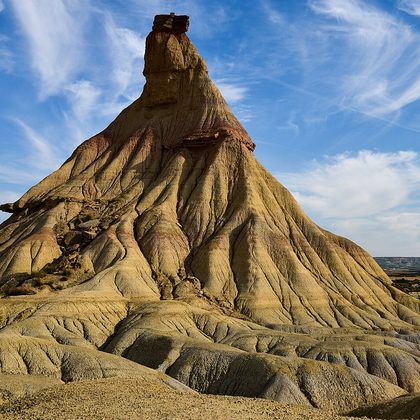
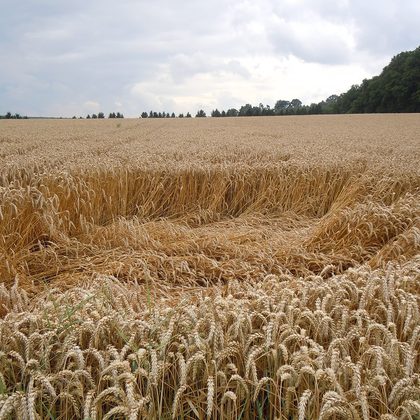
Flat stony desert: hamada and reg, gravel and loose stones with a thin scatter of low woody plants between them. In Morocco it also uses the edges of dry cereal fields, fallow and overgrazed waste ground where these run up against the desert, and in Israel the loess and gravel plains of the western Negev. It avoids sand and is not a bird of dunes. The nest is a scrape on open ground, usually tucked against a stone or a tussock, with the rim built up out of pebbles.
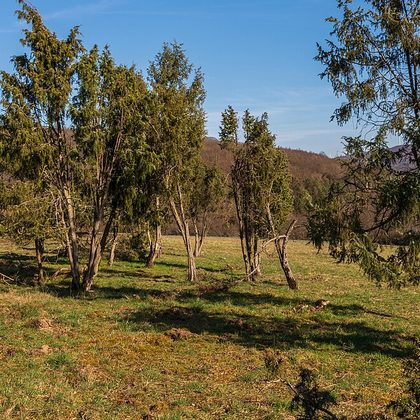
Where the bird is most at home, classified with EUNIS — the European standard for habitats.
Range and movements
From Western Sahara and southern Morocco east through Algeria, Tunisia, Libya and Egypt to Jordan, the Negev in Israel and northern Arabia. Within the area of this guide the best-known ground is in Morocco, with Tunisia, Algeria and the Israeli Negev besides. It does not migrate, but it wanders a great deal: birds follow the rain and the seed crop, so numbers on a given plain can differ enormously from year to year. Outside the breeding season it forms loose parties, in good years of several dozen birds.
- Resident
- Winter
- Passage
- dark = core range, pale = thinly spread
Where and when to look
Find a flat, bare stony plain and work it slowly with binoculars from the car or beside it — walking simply pushes the birds away. The classic site is the Tagdilt track near Boumalne Dades in Morocco, where the species often walks among the stones in small groups. Watch for what catches the light: the pale bill flashes and gives the bird away before the head pattern does. If a party flushes, look at the underwing, where the white cuts sharply against the black. Israel is a gamble: after a wet winter birds may appear on the loess plains of the western Negev, and in a dry year not at all.
Conservation status
Not threatened (LC). The range covers the whole northern rim of the Sahara and is vast, but the bird is thin and erratic within it, which makes trends nearly unreadable — a blank year on the Tagdilt track says more about rainfall than about the population. The real pressure comes from overgrazing, which strips out the thin layer of low shrubs and with it the seed supply, from the conversion of steppe to irrigated crops along the desert margin, and from the growth of off-road driving across the plains. At the northern edge of the range, in Morocco and Israel, it has become locally scarcer as a result.