All species › Passerines › Larks › Bar-tailed lark
Bar-tailed lark | Ammomanes cinctura
Rosse woestijnleeuwerik | Terrera colinegra
The smaller and paler of the two Ammomanes larks: a compact, plain sandy bird that trots across bare flat ground and gives itself away only when it flies, showing a black bar across the tail tip. Where desert lark takes the rock, this one takes the sand.

Voice
The song is short and plaintive: three or four clear descending whistles, tseee-tsew-tsewww, with silences between them, given from a pebble or in a slow undulating song flight low over the plain. It carries a long way over bare ground and sounds thinner and softer than the whistle of desert lark. The call is a short dry chup or a soft rolling prrt, usually from a bird that has just lifted off.
No freely licensed recording is available for this species yet.
Identification
A small, dumpy, crestless lark, plain sandy brown above with a rusty wash and no streaking at all. The underparts are clean creamy white, at most with a faint sandy shade along the sides of the breast — no proper streaks. The bill is short, blunt and pale horn, small for a lark. Legs pinkish, and a big dark eye set in a completely blank face. The mark that settles it is at the back: the tail is cinnamon-rufous with a broad black band across the tip and a narrow pale fringe below it, sharply cut. In flight the bases of the primaries glow rufous against black tips. It runs in short bursts, freezes between them, and flattens itself to the ground when uneasy.
Confusion species
Desert lark is the species it is muddled with everywhere, since the two share the same country. That bird is clearly larger and heavier, with a stout, deep-based conical bill in yellow to horn, and fine dark streaking across the throat and upper breast that is all but absent here. Its tail is dark-tipped too, but the change is diffuse and brown rather than a crisp black band, and the bird looks bigger-headed and slower on its feet. Three more desert larks walk the same plains: a pale one with a heavy yellow bill and white tail sides; a burly one with an enormous blue-grey conical bill and a black-and-white face; and a much larger, long-legged bird with a long decurved bill that strides over the sand like a wader and flashes a black-and-white wing. Bill and size sort all three out at a glance.
Habitat
Flat desert of sand or fine gravel with very little growing on it: sandy plains with scattered dwarf shrubs, the floors of broad wadis, the margins of dune country, and the belt where sand gives way to gravel. It avoids the rocky slopes and gorges that desert lark occupies; where the ground turns stony and steep, this species stops. The nest is a scrape in the open, built against a tussock or a stone and often rimmed with small pebbles.
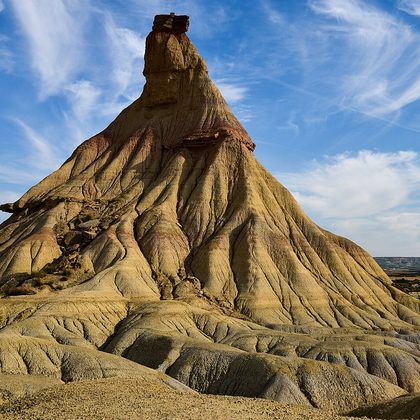
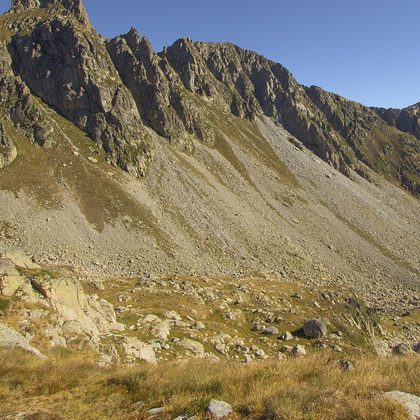
Where the bird is most at home, classified with EUNIS — the European standard for habitats.
Range and movements
From the Atlantic edge of the Sahara east through North Africa and Arabia to Iran and Pakistan. Within the area of the maps it lives in Morocco south of the High Atlas — the Draa plains, the Tafilalt and the flats near Boumalne Dadès — in southern Algeria and Tunisia, and in Israel and Jordan, where it is thinly spread through the Negev and the Arava and clearly scarcer than desert lark. On the map that amounts to a narrow southern strip; it does not occur in Europe.
- Resident
- Winter
- Passage
- Migration direction
- dark = core range, pale = thinly spread
Where and when to look
Drive at walking pace across a flat sandy plain at first light and watch for what runs rather than what flies. The birds often flatten and let you get to ten metres. Follow every lark that does take off until it lands: it spreads the tail as it drops in, and that is the moment the black bar shows. Then compare the bill — short and blunt — with those of the desert larks almost always mixed in with them. Write off the hours around noon, when everything is sitting in the shade of a bush.
Conservation status
Not globally threatened (LC): the range runs from the Atlantic coast to Pakistan, and although nobody has ever counted these plains, the density is low and even throughout. The species lives in country few people want, and the known pressures are local: overgrazing where stock is driven far out into the desert, off-piste driving, and the spread of rubbish tipping along desert roads. In Israel it is scarce and restricted to the southern Negev and the Arava; in Morocco it is more widespread. Reliable trend figures do not exist.