All species › Passerines › Larks › Desert lark
Desert lark | Ammomanes deserti
Woestijnleeuwerik | Terrera sahariana
The everyday lark of the rocky desert, and the bird you meet in almost every wadi from Morocco to Jordan. It is plain, heavy in the head and bill, and it comes in different shades from district to district: pale grey on limestone, red-brown on sandstone, almost black on the lava fields. Wherever it walks, it carries the tone of the ground under its feet.

Voice
The song is a short, plaintive whistled phrase of three to five notes, tsew-tsee-tsewww, falling at the end, repeated over and over with long silences between. In a gorge it bounces off the walls and sounds far bigger than the bird; early in the morning it is often the only sound in a wadi. It sings from a rock ledge and in a short song flight that climbs on stiff beats and ends in a glide. The call is a soft, cheerful chwee or a dull chrup, and a fast repeated tick when the bird is uneasy.
No freely licensed recording is available for this species yet.
Identification
A medium-sized, plain, crestless lark with a strikingly large head and a heavy, deep-based conical bill, yellow to pale horn with a dark culmen. Upperparts and underparts are uniform sandy to greyish brown, the throat a little paler, and fine, diffuse dark streaking runs across the throat and upper breast that you only see close to. The tail is rufous-brown with a broad dark brown tip, but the change is gradual. In flight it shows a rufous panel in the primaries with a dark trailing edge; there is no white anywhere, in wing or tail. The stance is front-heavy and the gait unhurried. It likes to sit still on a stone or a rock ledge, and against that background it is nearly impossible to pick out.
Confusion species
Bar-tailed lark is the only real pitfall, and it is often walking a stone's throw away. That bird is smaller and neater, with a small blunt bill, a completely clean unstreaked breast, and a tail with a sharply cut black band instead of a vague dark tip; it looks redder and more finely finished. When in doubt go to the bill first: this species carries what is almost a finch's bill, the other a proper little lark's. Beyond that, little in the rocky desert resembles it. The pale lark with the heavy yellow bill and white tail sides wants flat sand rather than stone; the burly species with the enormous blue-grey conical bill has a black-and-white face and heavy black blotches on the breast; the big long-legged lark with the long decurved bill is obvious on size and gait. Crested larks, which reach the desert edges, have a spiky crest, a streaked breast and rusty tail sides.
Habitat
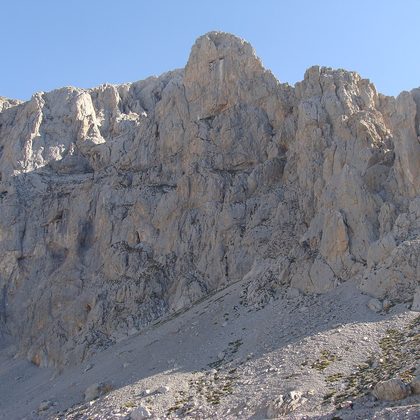
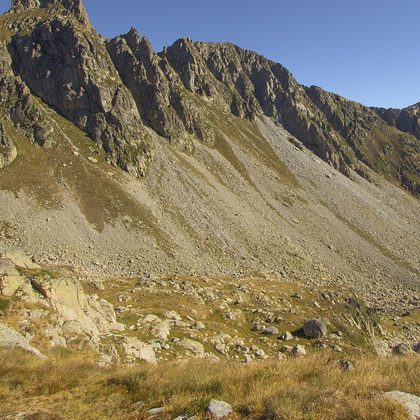
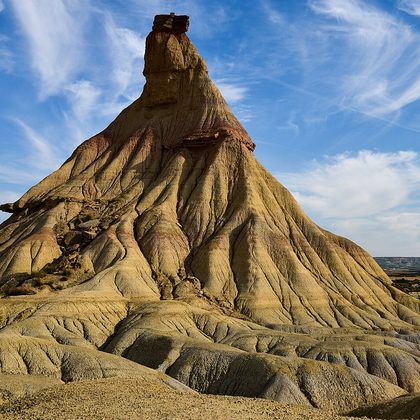
Rocky desert and everything that goes with it: wadi walls, screes, boulder fields, rock pavements, steep slopes along gorges and the floors of dry beds. It needs stone, not sand, and is absent from level drifting sand. It also lives around desert villages, ruins, dams and abandoned quarries, and comes right up to habitation to drink. The nest is a scrape under an overhanging stone or against a boulder, with a low rim of pebbles on the open side.
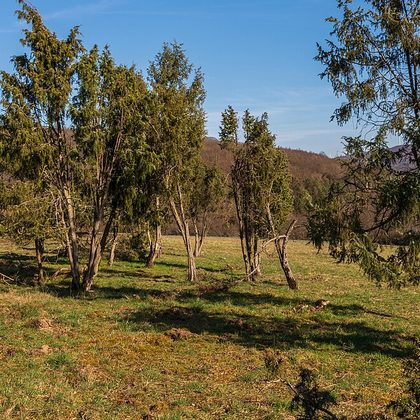
Where the bird is most at home, classified with EUNIS — the European standard for habitats.
Range and movements
From Morocco and the Western Sahara across the whole of North Africa and Sinai into the Levant, Arabia, Iran and Central Asia. Within the area of the maps it is by far the most numerous lark of the desert: in Morocco in the Anti-Atlas, the Todra and Dadès gorges, the Draa and the Tafilalt; then Algeria, Tunisia and Libya; and in Israel and Jordan in the Judean Desert, along the Dead Sea, in the Negev, the Arava and the canyons of Wadi Rum, Dana and Petra. A resident that holds the same territory year after year. It is entirely absent from Europe.
- Resident
- Breeding (summer)
- Winter
- Passage
- dark = core range, pale = thinly spread
Where and when to look
Walk into a wadi or a gorge at sunrise and then stand still. Within ten minutes the plaintive whistle comes off the rock face somewhere, and binoculars will find a bird sitting motionless on a ledge. Do not look for a fixed colour, look for a fixed shape: red-brown in the Dadès gorge, pale grey by the Dead Sea, dark on the basalt — but always with that big head and heavy bill. Later in the morning, water points and the edges of desert villages are dependable, since the bird drinks daily.
Conservation status
Not threatened (LC) and common right across the desert belt; of all desert birds this may be the least vulnerable. It occupies ground that cannot be brought into cultivation, it drinks at human water points, and it takes over the surroundings of villages, dams and quarries without difficulty. Locally, pressure of visitors in tourist gorges or the complete drying of springs can push it back, but there is no sign of decline on any scale. In Israel, where desert birds are followed most closely, it is one of the few that hold steady.