All species › Waders, gulls and terns › Painted-snipes › Greater painted-snipe
Greater painted-snipe | Rostratula benghalensis
Goudsnip | Aguatero bengalí
The only member of its family in this guide, and one of the few birds in which the roles are the other way round: the female is bigger, brighter, and the one that calls and displays, while the male sits on the eggs in dull brown and gold and raises the brood alone. To see one, walk a muddy, well-vegetated margin at dusk and watch for a shuffling, snipe-shaped silhouette that suddenly freezes.

Voice
Almost silent outside the breeding season, and even in it the calling is done by the female, the reverse of the usual arrangement. At dusk and through the night she gives a deep, hollow, booming note, ook … ook … ook, slowly repeated and sometimes kept up for minutes, like someone blowing across the neck of an empty bottle. It is very hard to place and seems to come from every direction at once. The male is almost mute; both give a short hoarse kek on flushing, and the male hisses at the nest.
No freely licensed recording is available for this species yet.
Identification
A dumpy, snipe-like wader with a long bill that droops and broadens slightly at the tip, short greenish legs and broad rounded wings. Both sexes show a pale crown stripe, a striking patch around the eye drawn out to a point behind it, and a broad pale band running down from the shoulder across the side of the breast, as if the bird had been cut in two. The female — the bird in the photograph — is the showy one: head and neck rich chestnut, a black breast band, upperparts dark bronze-green finely barred black with two golden braces down the mantle, and the eye patch pure white. The male is smaller and duller: greyish-brown head, a buff rather than white eye patch, and golden spots scattered over the wing coverts.
Confusion species
At distance the shape can suggest a snipe, and that is where it ends. Common snipe is sharply striped dark and cream, has a far longer dead-straight bill and pointed wings, and towers away rasping and zigzagging. Painted-snipe is warmer and more patterned, carries that unmistakable pale eye patch and the diagonal band across the breast side, and flushes weakly on broad rounded wings with the legs dangling, more like a rail than a snipe. Close up the drooping, slightly spatulate bill tip settles it.
Habitat
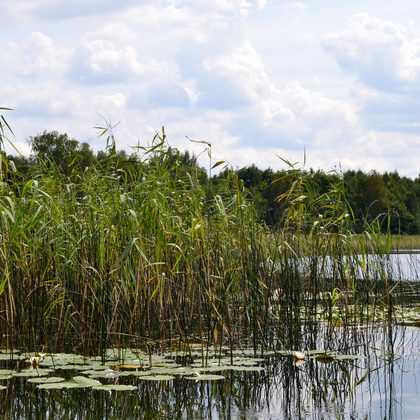
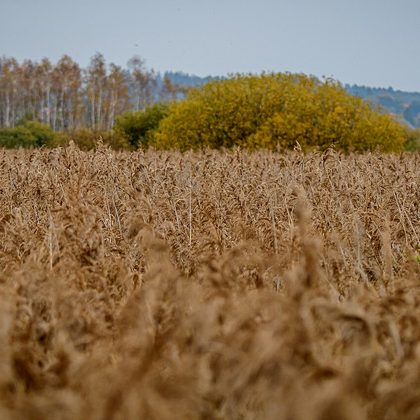
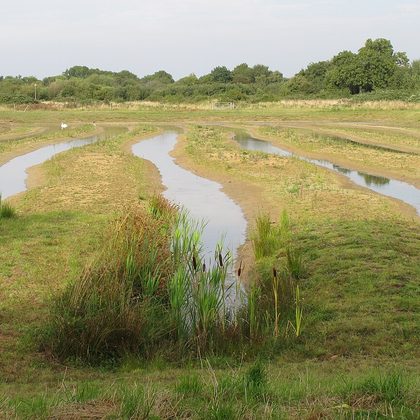
Shallow muddy freshwater margins with plenty of cover: reed and sedge fringes along marshes, overgrown ditches and irrigation channels, rice fields, wet meadows and above all fish ponds. It needs soft mud to probe in and vegetation to step into, and it is exactly that narrow strip where open and closed meet — often only a few metres wide — that makes it so hard to see.
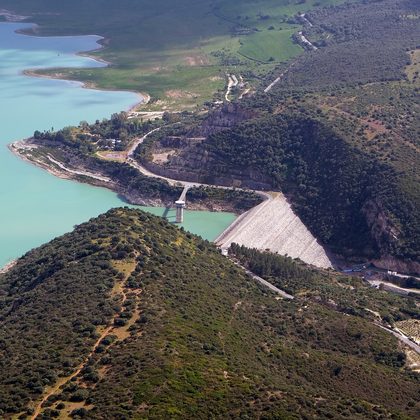
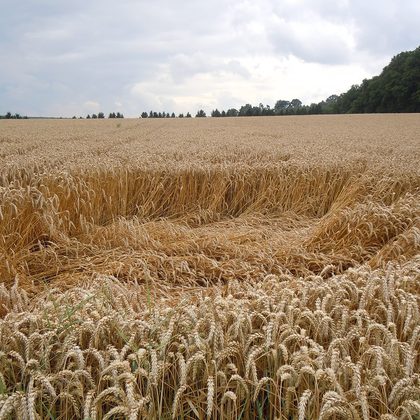
Where the bird is most at home, classified with EUNIS — the European standard for habitats.
Range and movements
Widespread in sub-Saharan Africa, Madagascar and from India through South-East Asia. Inside the map area there are two small outposts. In Egypt it breeds thinly in the Nile Delta and the Fayoum. In Israel a small population holds on in the fish ponds and marshes of the Sharon plain — Hama'apil, Gan Shmuel, Poleg Marsh and Agmon Hefer — where it has been recorded since the 1980s and annually in recent years. It has not reached Europe.
- Winter
- Passage
- dark = core range, pale = thinly spread
Where and when to look
In the last three quarters of an hour of light, take up position at the edge of a fish pond or an overgrown channel where mud meets cover, and sit still. Scan the vegetation edge slowly: the bird walks a short distance and then stands motionless for a long time, and the pale eye patch catches the eye before the rest of it does. After dark the female's booming tells you the bird is there, even though you will struggle to work out where.
Conservation status
Not globally threatened, but inside the map area everything hangs on a handful of sites. In Egypt drainage of marshes, concrete-lined irrigation canals and the clearing of bankside vegetation all press on numbers. In Israel the species depends entirely on fish ponds, and these are being filled in or converted to intensive crops at more and more places for economic reasons. Where fish ponds are managed as nature reserves, with shallow margins, mud and reed, painted-snipe holds on.