All species › Passerines › Tits › Grey-headed chickadee
Grey-headed chickadee | Poecile cinctus
Bruinkopmees | Carbonero lapón
The Grey-headed Chickadee is the tit of the taiga. It sits out the whole winter in the old conifer forest of Lapland and Siberia, living off hundreds of seeds and insects it cached itself in autumn. To see it in Europe you must travel to the far north, and even there it has become markedly harder to find over the past thirty years.

Voice
The slowest and deepest call of any European tit: a heavy, drawn-out, nasal tchay-tchay-tchay, usually introduced by two or three thin high notes — together tsi-tsi-tchayyy-tchayyy. Set beside Willow Tit, which already sounds slow and plaintive, this bird is a notch lower, broader and more spun out; the sound carries a long way across a silent snow-covered forest and is often the only sign that anything is alive. The song is a run of slow, clear, slightly descending whistles, tyoo-tyoo-tyoo, short and unadorned, heard mainly in March and April.
No freely licensed recording is available for this species yet.
Identification
A large tit with a proportionally long tail and loose, downy plumage that makes it look almost spherical in the cold. The cap is not black but dull dark brown, and runs far down the nape: a long brown hood without a trace of gloss. The bib is large and sooty black, with a ragged lower edge that spreads onto the upper breast — clearly heavier than in Willow or Marsh Tit, and the first thing to strike you on a perched bird. The cheeks are pure white and cover a broad area reaching well onto the sides of the neck. The strongest colour is on the flanks and undertail coverts: warm rusty to cinnamon, more saturated than in any other European tit. Upperparts are grey-brown, and pale edges to the secondaries give a faint light panel. The bill is short and stout.
Confusion species
Willow Tit and Marsh Tit — see their own species pages, where the difference between those two is worked out at close range. Within the European range of the Grey-headed Chickadee only Willow Tit really enters the picture; Marsh Tit does not occur in Lapland, so that comparison stays theoretical there. Against Willow Tit, this bird is bigger and longer-tailed, its cap is brown rather than dull black and runs further down the nape, its bib is larger and deeper, and its flanks are genuinely rusty where Willow Tit shows at most a warm buff. Marsh Tit differs more sharply still: glossy blue-black cap with a clean edge, a small neat bib, and nothing of that cinnamon on the flanks. The rule in the north is simple: a big tit with a brown hood and rusty flanks is a Grey-headed Chickadee, and once it calls there is no doubt at all.
Habitat
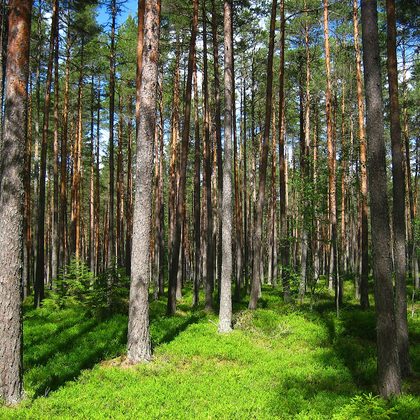
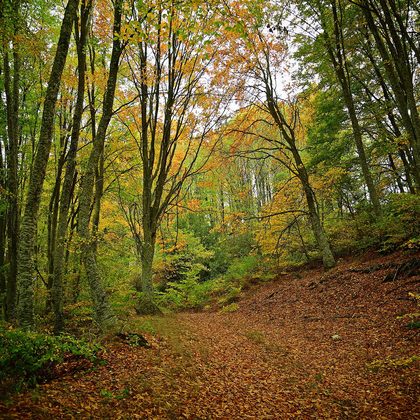
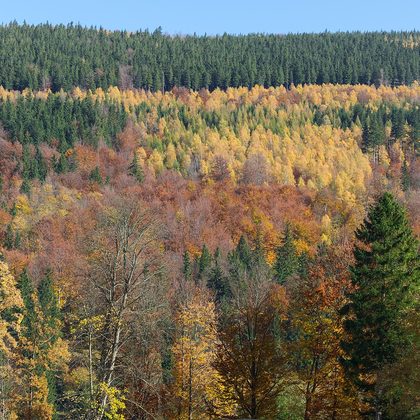
Old, open coniferous forest of the northern taiga: spruce and pine woodland with plenty of standing dead wood, laced with birch, along the edges of mires and in river and stream valleys. The mountain birch belt at the tree line and the willow and birch thickets along water count too; what matters is not the tree species but the age of the wood and the supply of soft, rotting trunks. The nest cavity is excavated by the bird itself or enlarged in soft rotten birch or willow; in Finnish Lapland it locally takes nest boxes. In autumn it lays in large stores in bark crevices and among needles, and on those it survives the polar winter.
Where the bird is most at home, classified with EUNIS — the European standard for habitats.

Range and movements
From Norwegian, Swedish and Finnish Lapland and the Kola Peninsula east across the whole of Siberia to Kamchatka, and over the Bering Strait into Alaska and north-west Canada — one of the few songbirds breeding on both continents. The European share is only a corner of that: south of the Arctic Circle it is all but absent. It is not a bird that turns up elsewhere in Europe: the species is markedly sedentary and hardly wanders at all. Even within Lapland pairs move very little and stay in the same patch of forest all year.
- Resident
- Breeding (summer)
- dark = core range, pale = thinly spread
Where and when to look
Go in winter. From December to March the Grey-headed Chickadee comes to feeding stations in Finnish Lapland — the best known is the one at Kaamanen between Ivalo and Utsjoki, where it sits on the fat alongside Willow Tit, Crested Tit and Siberian Jay. In summer it is far harder: walk old pine forest with standing dead trunks early in the morning, stand still, and listen for a slow, low tchayyy-tchayyy among the ordinary tit calls. Whistling and playback work poorly; patience and silence work better. Only then look at the brown hood, the large bib and the rusty flanks.
Conservation status
Not globally threatened, since the Siberian part of the range is enormous. In Fennoscandia, however, things are going badly: only a few hundred pairs remain in Sweden, where it stands high on the national red list, Norway has seen a steep fall too, and Finland — which holds by far the largest European share — shows a steady decline. The causes lie with modern forestry: clear-felling, the harvesting of old stands and the removal of standing dead trees take away both the nest holes and the food. Where old, uneven-aged taiga with dead wood is left standing, it holds on.