All species › Passerines › Hypocolius › Grey hypocolius
Grey hypocolius | Hypocolius ampelinus
Zijdestaart | Hipocolio
A slim, ash-grey bird with a long tail ending in a broad black band and black wingtips neatly spotted white, the male wearing a black mask that runs from the bill through the eye and joins across the nape. In the classification the grey hypocolius stands entirely alone: the only species in its genus, the only species in its family, with no close living relative anywhere. Inside this guide's area it belongs to winter — a flock in a date plantation in the Jordan valley or the Arava, found by a handful of birders each year and missed by many more.

Voice
A quiet species, and that matters more in the field than it sounds: you find a hypocolius with your eyes, not your ears. The ordinary note is a soft, slightly nasal mewing trrp or kurr, exchanged by members of a party from deep inside a bush and already lost at ten metres. On taking off there is a more rolling, grating tchirrr, and occasionally a short clear whistle. True song hardly exists; what the male produces in spring is no more than a run of those same soft notes with some squeaking between them. Standing in an Arava wadi listening for a call is therefore the wrong search: watch instead for the movement of a party crossing low and fast from one thicket to the next.
No freely licensed recording is available for this species yet.
Identification
About the size of a starling but far slimmer and much longer-tailed: a streamlined bird with a small head, a smooth swept-back crest that rarely shows, and a short black bill lightly hooked at the tip. The male is plain ash-grey throughout, bleached to cream on the head and underparts, without a streak or a spot anywhere. From the base of the bill a black mask runs straight through the eye, broadens behind it and continues across the nape, so that the black closes around the back of the head — that is the mark everything turns on. The primaries are black with sharply defined white tips, showing as a row of white dots on the closed wing and as a white flash in flight. The long tail is grey and ends in a broad, clean black band with no pale tip. Female and juveniles are sandy grey-brown, entirely lack the black mask, have little or no white on the primary tips and a duller, browner tail band. In flight the long tail dominates the shape, with fast direct wingbeats and short glides.
Confusion species
The real trap is a grey shrike. Great grey shrike and its Middle Eastern relatives are the same size, the same grey and also carry a black band through the eye, but that band stops behind the eye and never closes across the nape; a shrike also has a heavy hooked bill, white scapulars and a white patch at the base of the primaries that flashes as it takes off, whereas the hypocolius carries its white at the tips. The behaviour differs completely as well: a shrike sits alone and fully exposed on a wire or a projecting twig, a hypocolius sits inside a bush with ten or twenty others and shows itself only when the whole party moves. The female is more often taken for a bulbul, and white-spectacled bulbul is the same size and equally long-tailed — but it has a dark head with a white eye-ring, a yellow vent and a short thick bill. The overall impression also recalls waxwing, silky and unmarked with a crisp black-and-white wing pattern, but a waxwing is short-tailed, carries a real crest, a yellow tail tip and red waxy plates on the wing, and does not occur in the Levant.
Habitat
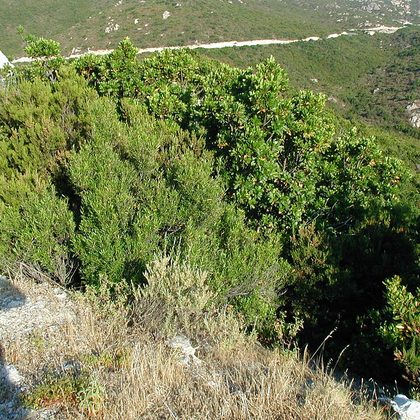
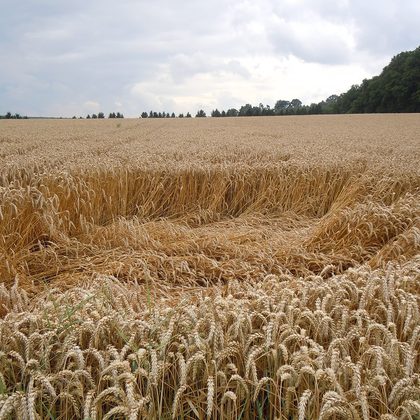
On the breeding grounds in Iraq and south-western Iran it is a bird of scrubby semi-desert: dense thickets of jujube, tamarisk and toothbrush tree, thorn scrub along the Tigris and Euphrates, date gardens, orchards and the edges of villages. In the Levantine wintering range the picture is the same but smaller: date plantations, tamarisk along the Jordan and the Dead Sea, acacia in the wadis of the Arava, and the gardens and shelter belts of the kibbutzim. Berries govern everything. Jujube and toothbrush tree come first, then mistletoe, dates, mulberry and whatever fruiting shrubs have been planted in gardens; insects are taken as well, chiefly in the breeding season. The nest is an untidy cup of twigs and plant fibre, low in a dense bush or in a date palm, and pairs often nest loosely together in the same thicket.
Where the bird is most at home, classified with EUNIS — the European standard for habitats.


Range and movements
The breeding range lies outside this guide: Iraq, south-western Iran, Kuwait and north-eastern Saudi Arabia. In winter birds move south and east to the Gulf states, Arabia and the far north-west of India, where flocks winter annually in Kutch. Within the map area the grey hypocolius is a scarce winter visitor to Israel and Jordan from November to March, with most records in the Jordan valley, around the Dead Sea, in the Arava and near Eilat; birds have also been reported from Sinai and very rarely from Turkey. Numbers swing hard from year to year: one winter brings parties of tens at several sites, the next almost nothing. It occurs nowhere further west or north in the map area, and a hypocolius in Europe is not one.
- Winter
- Passage
- dark = core range, pale = thinly spread
Where and when to look
December to February, and search for the berries rather than for the bird. In the southern Arava, at the Dead Sea oases and in the Beit She'an valley work through the date plantations, the jujube thickets and the stands of tamarisk, and keep to the first two hours after sunrise: that is when the parties feed, and for the rest of the day they sit motionless and invisible in dense cover. What you are looking for is not a bird but a line — eight to twenty long-tailed grey birds crossing low, fast and silently from one bush to the next. Then walk to that bush and wait rather than push into it; the party works back up into the light of its own accord. In such a winter follow the Israeli sightings pages, because a flock stays put as long as the fruit lasts, sometimes for weeks.
Conservation status
Not globally threatened. The range across Mesopotamia and the Gulf is large, and although the population has never been counted there is no sign of a rapid decline. The pressures lie on the breeding grounds: the draining of the Mesopotamian marshes and their only partial restoration, the loss of thorn scrub along the Tigris and Euphrates, and the conversion of old orchards and palm gardens. What matters for the reader is that the number of winter records in Israel says nothing about the species: it follows the berry crop and the weather in Iraq, and a winter without a single hypocolius means no more than that the birds found enough to eat closer to home. Birds turning up outside the usual season or well outside the usual area are judged cautiously, because the species is also kept in captivity in the Middle East.