All species › Passerines › Kinglets › Madeira firecrest
Madeira firecrest | Regulus madeirensis
Madeiragoudhaan | Reyezuelo de Madeira
The smallest bird on Madeira, and the only crest the island has: on Madeira there is nothing to confuse it with, because no other Regulus occurs there. On paper it is a different matter. Until 2003 it was described as a form of the common firecrest; since then it has been treated as a species in its own right, on the strength of differences in song and in the head pattern. See it in the laurel forest at Ribeiro Frio and you notice at once that something is different — darker, duller, longer-billed — but it takes a moment to say what.

Voice
Here lies the real separation from common firecrest, and it is large enough to work with in the field. A firecrest sings one even run of identical thin notes that gradually accelerates and grows louder and then breaks off dead, with no closing flourish. The Madeira firecrest does not: its song is built of short, varying phrases in which the notes rise and fall in pitch, with a clear rhythm to them, and the phrase does not stop abruptly but runs out into a rattling, slightly untidy ending. The whole thing sounds fuller, lower and more varied — more like a small hurried warbler than the thin sweep of a mainland crest. The call is a high zit in runs of two to four, a shade fuller and lower than a firecrest's and with more weight on each note. The warning that attaches to all crests applies here too: the sound sits so high that many observers over fifty hear only the nearest birds, and over sixty sometimes none at all. In the laurel forest, record rather than trust your ears.
No freely licensed recording is available for this species yet.
Identification
Round, short-tailed and big-headed like every crest, but with a proportionately long and fine bill that gives the head a sharper profile. An orange to orange-red stripe runs along the crown in the male, yellow-orange in the female, bordered black on both sides; those black borders are broad and carry well back across the crown, so that the top of the head looks dark in profile. Below runs a short greyish-white supercilium that stops just behind the eye, and beneath it a broad black eye-stripe that stays solidly black in front of the eye as well. The upperparts are dark olive-green, the underparts greyish white washed dingy buff on the flanks. There is at most a hint of bronze on the side of the neck. Two pale wing bars, with the black mark at the base of the secondaries that all crests carry. Juveniles lack the crown colour; the broad black crown borders and the heavy eye-stripe are already there.
Confusion species
On Madeira itself there is nothing to confuse it with: both goldcrest and common firecrest are absent, and this is the only crest in the archipelago. The problem is therefore not a field problem but a book problem, and it concerns the comparison with common firecrest, the bird you know from the mainland — see its own species page, where the head and shoulder pattern is set out from the other side. Four things point to Madeira. The supercilium is shorter and dirtier: it stops just behind the eye instead of running well beyond it, and it is greyish white rather than clean white. The eye-stripe is broader and stays thick and black between bill and eye as well, so the face reads dark and severe rather than crisply striped. The black borders along the crown are broader and extend further back. And the bill is distinctly longer and finer — the one character that gives you something to hold on to in a photograph of a single bird, and the reason to ask for a profile shot whenever a claim is made. On top of that, the bronze patch on the side of the neck, one of the better marks on a firecrest, is here all but absent, and the whole bird is darker green above and greyer below. The song, however, is what settles it, and that is described below. On the island itself only chiffchaff gets in the way, and then only for anyone judging by size: it is a third larger, elongated, plain olive-brown and has a long tail that it constantly dips.
Habitat
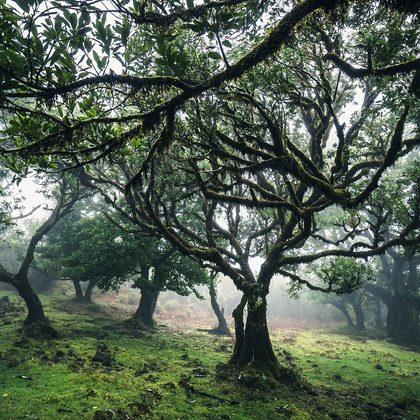
The core is the laurisilva: the damp, evergreen laurel forest of the northern slopes and the ravines, with til, vinhático, laurel and barbusano, dense and mossy and in cloud for much of the year. There it lives from roughly six hundred to sixteen hundred metres, at its densest in closed old forest. It also occupies the tree heath of the higher slopes, where Erica arborea and Erica platycodon grow into small crooked trees, and further the plantations of Japanese cedar, pine and eucalyptus, where it is clearly thinner on the ground but present. It is found as well in the gardens and parks of Funchal and along the levadas, down almost to sea level. The nest is the same hanging cup of moss, lichen and spider silk that all crests build, slung beneath a branch or in a dense tuft of fern or heath.
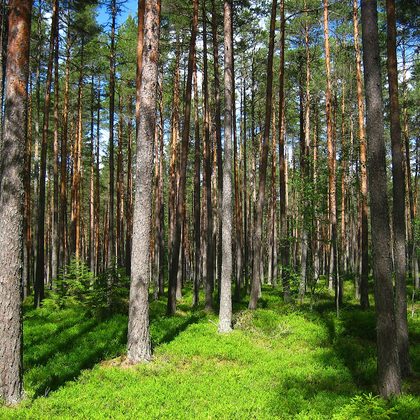
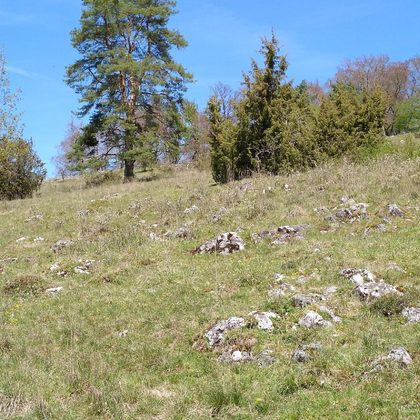
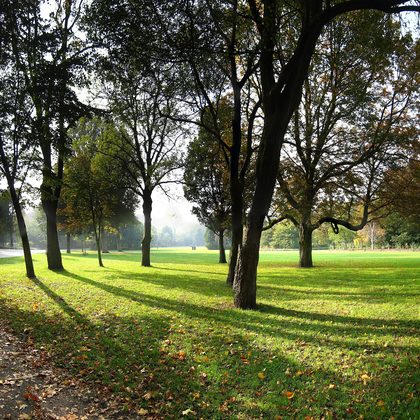
Where the bird is most at home, classified with EUNIS — the European standard for habitats.
Range and movements
The main island of Madeira only, and nowhere else on earth. It is absent from Porto Santo and the Desertas, and it does not occur in the Azores or the Canaries; the entire world range of the species therefore fits inside one island of barely seven hundred and forty square kilometres. Within that island it is common and widespread, occupying virtually every stand of closed woodland or tall scrub, from the laurel forests of the north and the central massif to the heath belt on the ridges and the planted slopes around them. It is resident and never leaves the island; no wild bird has been recorded away from Madeira. Birds do shift a little lower into the ravines in winter, which improves the odds of a good view along a levada in those months.
- Resident
Where and when to look
Go to the laurel forest, not to the coast. The classic places are Ribeiro Frio with the path to Balcões, the Levada do Caldeirão Verde from Queimadas, the Fanal forest and the area around Rabaçal; the bird can be found at all four in a morning. Walk slowly and listen first: the thin zit almost always reaches you before the bird does, and the rattling phrase that follows confirms the identification without binoculars. Then work the outer twigs rather than the trunk, because it feeds in the last few leaves and hangs upside down to do it. Early morning with cloud over the forest is much the easiest; the bird is strikingly unshy and will often let you watch it at two or three metres, which is your chance to take a proper look at that long bill.
Conservation status
Not globally threatened, and common on the island itself: numbers are stable and the species occupies nearly all the suitable woodland. Even so, this is a bird with one island and no second: anything that hits the forest of Madeira hits the entire world population at once. The large fires of 2010 and 2016 threw that into sharp relief; they struck mainly plantation and heath belt, but they showed how quickly it can go. Beyond fire, the laurisilva is under pressure from introduced plants, from eucalyptus and Japanese cedar planted around its edges, and from the trampling of the busiest levada paths. The protected area is large — most of the laurel forest lies within the natural park and is on the world heritage list — and that is the main reason the species is in good shape.