All species › Passerines › Chats and flycatchers › Güldenstädt's redstart
Güldenstädt's redstart | Phoenicurus erythrogastrus
Grote roodstaart | Colirrojo de Güldenstädt
The largest redstart in the world, and the only one you expect to meet on a snowfield. Within the area of this guide it lives only in the high Caucasus, above two thousand metres, among moraine, boulder field and old snow. The male is one of the most conspicuous passerines of the Palearctic: a snow-white crown, black upperparts, an enormous white wing panel and a deep rust-red belly and tail.

Voice
Reticent, and by the standards of the genus not impressive. The song is a short, thin phrase of two or three whistled notes followed by a dry rattle, roughly tsee-chew... trrrrt, usually from a boulder or a low bush and rarely sustained; in the wind of those altitudes it barely carries. Call: a soft tek or tek-tek, often preceded by a thin rising eee. In the winter flocks in sea-buckthorn scrub the birds call quietly to each other without stopping, and that murmur betrays the flock before the eye finds it.
No freely licensed recording is available for this species yet.
Identification
Heavily built for a redstart, with a large head, a stout bill and a fairly long tail — in silhouette closer to a small thrush than to a chat. The male has an entirely white crown and forehead running back onto the nape, a black face, throat and mantle below it, and a huge white wing panel that forms a broad white wedge on the closed wing and fills half the wing in flight. Breast, belly, rump and tail are deep orange-rust, far richer than on any other redstart, with dark central tail feathers. The female is plain pale grey-brown, paler below, with no head pattern and the same rusty rump and tail; she is clearly larger, bulkier and heavier-billed than other female redstarts, and on her that size is the best character.
Confusion species
In the Caucasus, black redstart is the real trap, because the form breeding there has a rust-orange rather than a black belly on the male, so the pattern is superficially similar at range. The differences are nonetheless large: Black redstart is smaller and slimmer, has a grey crown rather than a white one, and its white wing panel is a narrow stripe against the broad white field of Güldenstädt's. Common redstart shows white only on the forehead, as a narrow band, and has a plain dark wing. Females are harder: go by size, the heavy bill and the plain, expressionless head. For any redstart outside the high mountains the locality is the strongest argument — a Güldenstädt's in the lowlands is almost always something else.
Habitat
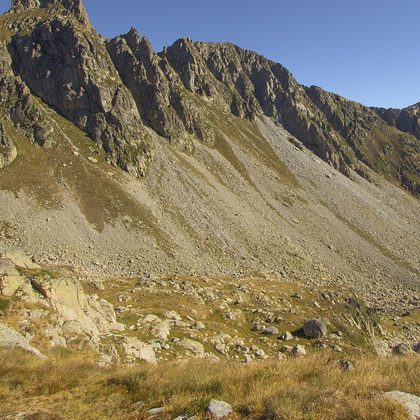
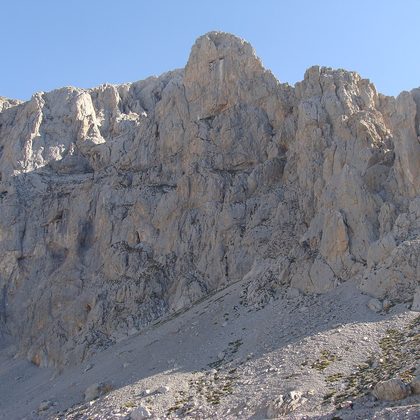
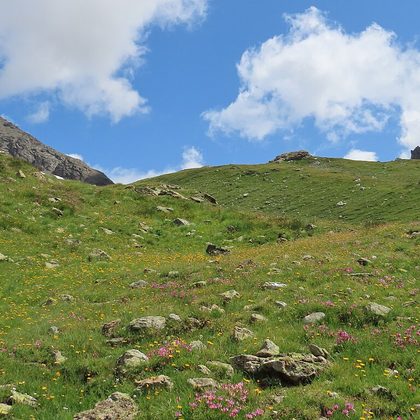
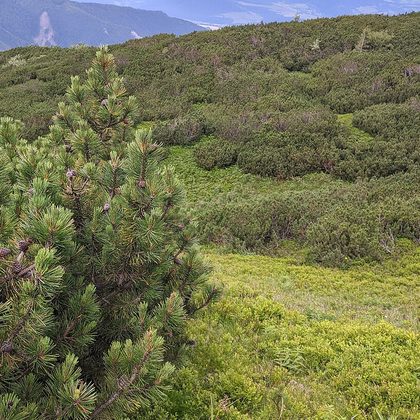
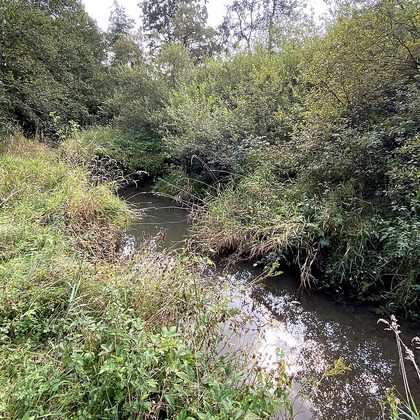
In summer, bare rocky altitude: moraine debris, boulder fields, stony slopes and alpine turf close to the snowline, in the Caucasus usually between 2,200 and 3,500 metres and in Central Asia to above 5,000. The nest goes deep in a crevice or under a block. In winter it drops into the valleys and concentrates in thickets of sea-buckthorn along river beds and alluvial fans, feeding heavily on the orange berries; that is also where it is easiest to find.
Where the bird is most at home, classified with EUNIS — the European standard for habitats.
Range and movements
A high-mountain bird of the south-western and central Palearctic: the Caucasus, and eastwards the Elburz, the Pamirs, the Tien Shan, the Altai, the Karakoram, the Himalaya and the mountains of western and central China. Within the area of this guide it is therefore confined to the Caucasus and the adjoining ranges of northern Iran — a bird at the very edge of Europe whose range runs far into Asia. There is no migration in the usual sense: the birds descend to the valleys in October and climb again in April. Away from those mountains it is an exceptional vagrant.
- Passage
- dark = core range, pale = thinly spread
Where and when to look
The country around Stepantsminda in Georgia, below Mount Kazbek, is the classic place. In June walk up from the village to the moraine and boulder fields above the last pastures and look for a large, strongly patterned redstart sitting out on a stone and shivering its tail; the white crown carries a long way against dark rock. Anyone there in March or November should try the valley floor instead: work through the sea-buckthorn thickets along the Terek and its side rivers, where dozens of birds may be feeding on the berries at once.
Conservation status
Not globally threatened. The range lies largely in thinly populated high mountains, far from farming and building, and numbers appear stable. The vulnerable link is not the breeding ground but the winter: the sea-buckthorn thickets of the mountain valleys are cut for firewood in many districts, or cleared during river engineering, and it is precisely those that the wintering birds depend on. Beyond that, as for every species of the snowline, the upward shift of vegetation belts under warmer summers is a long-term concern.