All species › Passerines › Chats and flycatchers › Red-flanked bluetail
Red-flanked bluetail | Tarsiger cyanurus
Blauwstaart | Ruiseñor coliazul
The red-flanked bluetail is a small, rounded chat of old damp taiga, and every plumage carries a tail of surprisingly clear blue. Fifty years ago it was a legendary rarity in Europe; today several hundred pairs breed in Finland and birds turn up on the North Sea coast every autumn.

Voice
The song is a short, wistful, descending whistled phrase that carries surprisingly far in silent spruce taiga: a few clear notes, hesitantly begun and then tumbling down, with a wistful fall at the close. It is repeated endlessly from a high branch in the crown of an old spruce, often at dusk and, on the light nights of June, around midnight too. The call is a soft rising hweet followed by a hard, low rattling tak-tak — that hweet-tak-tak pattern is for many observers the first hint that a Bluetail is in the bushes.
No freely licensed recording is available for this species yet.
Identification
Small and compact, with a big head, a large dark eye and an upright stance in which the tail is constantly and gently cocked and lowered. Every plumage shares two characters: a blue tail and rump, and an orange to rusty flank patch that stands out sharply against the white throat and belly. The adult male adds bright blue on head, back and wing coverts, with a pale blue supercilium and shoulder. Females and young birds — the ones seen in western Europe — are olive-brown above with only the blue tail and rump, a white throat cutting sharply against the dusky breast, and that orange flank patch. Males take three years to reach full blue and sing in the meantime in female-like plumage.
Confusion species
The combination of blue tail, white throat and orange flank patch has no counterpart in the area; the difficulty is that the bird is nearly always in cover and that the blue tail can look dull grey-blue in flat light. A Robin is rounder, orange on breast and face alike, and has a plain brown tail. Redstarts shiver their rufous tails without pause; a Bluetail cocks its own calmly up and down. In doubt, the white throat against the dusky breast — a sharply bounded white patch — is often easier to see than the colour of the tail. Nightingale and thrush nightingale are considerably larger, longer-tailed and show no blue at all.
Habitat
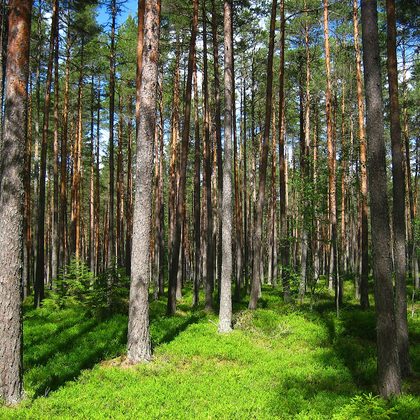
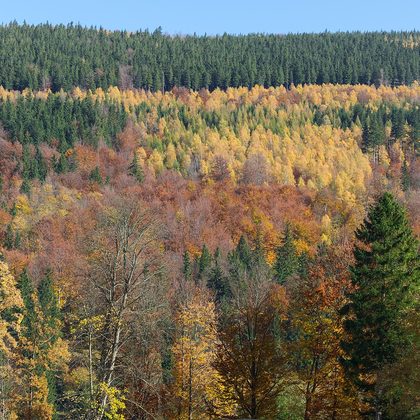
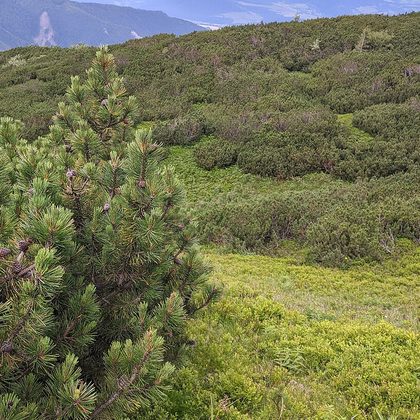
Old, damp coniferous and mixed forest with abundant dead wood, moss, tall herbs and a dense bilberry understorey: dark, undisturbed spruce woodland on slopes and along stream valleys. Northwards and higher up it grades into the birch and willow scrub of the treeline. In western Europe autumn birds appear in sea buckthorn, churchyards, gardens and coastal copses — that is where they stop, not where they breed.
Where the bird is most at home, classified with EUNIS — the European standard for habitats.
Range and movements
Breeds from northern Finland and adjacent Russia eastwards across the whole Siberian taiga to Kamchatka, Korea and Japan, and winters in South-East Asia, from the Himalayas to southern China and Indochina. The Finnish population has grown strongly since the 1990s and is now put at several hundred pairs, with breeding records into Sweden and Estonia — which makes the Bluetail a genuine, if scarce, breeding bird of the map area. At the same time autumn vagrancy to north-west Europe increases steadily: Britain now records the species annually, mainly on the east coast in October, where a single autumn once produced more than thirty.
- Breeding (summer)
- Winter
- Passage
- Migration direction
- dark = core range, pale = thinly spread
Where and when to look
For a breeding bird, travel to north-east Finland — Kuusamo, Salla, Rovaniemi — in the first half of June, and go out at three in the morning, when it is light and the forest is silent. Walk old spruce forest with plenty of dead wood and listen for the short descending whistle; the male sings high in the crown and is hard to find from the ground. On the North Sea coast in October the approach is the reverse: look low and dense, in buckthorn and elder, and listen for the hard tak-tak. A Bluetail will often sit motionless on a low branch in shade for minutes before moving — patience pays better here than walking.
Conservation status
Not globally threatened (IUCN: Least Concern), with a very large range and an increasing population. The westward spread into Finland and Scandinavia is one of the clearest changes in the European avifauna of recent decades. The bottleneck is habitat: the species needs old, damp, unlogged conifer forest with dead wood, and exactly that has become scarce in Fennoscandia. Where near-primeval stands are kept, it holds on.