All species › Waders, gulls and terns › Gulls and terns › Iceland gull
Iceland gull
Larus glaucoides | Kleine burgemeester | Gaviota polar
The gentle counterpart to the Glaucous Gull: as white in the wing, but smaller, rounder-headed and small-billed. On the water the giveaway is the long, tapered rear end, with the wingtips reaching far beyond the tail.

Voice
Higher and thinner than Glaucous Gull, nearer Herring Gull but reedier and more hurried. Almost always silent in a British harbour; the best chance of a call is a squabble over fish, a shrill cackling series. On the Greenland cliffs the long call rolls off a ledge much as a Herring Gull's does, but lighter.
No freely licensed recording is available for this species yet.
Identification
Adults show a mid-grey mantle, close to Herring Gull, and wholly white primaries. The bill is yellow-green with a red gonydeal spot, the iris pale yellow inside a dark red to purplish orbital ring, the legs pink; in winter the head is heavily streaked. First-winter birds are creamy white to pale buff with a fine, freckled pattern and a largely dark bill. Structure carries the identification: domed head, small bill, slight chest and a strikingly long wing that draws the body out behind.
Confusion species
Glaucous Gull is the standing confusion, and size alone will not get you there: a small female Glaucous and a large male Iceland overlap, so structure does the work. Iceland is slight and round-headed with a soft expression, against the bulky, deep-chested, flat-crowned Glaucous. Bill length and forehead shape are the key pair: here a short, fine bill with barely any gonydeal angle under a steeply rising forehead, the large eye set high in the head; there a long, thick bill with a strong gonydeal angle under a low, sloping forehead, the small eye set well forward. Primary projection beyond the tail is the most reliable measure at range: on Iceland the wingtips reach further than the bill is long, often one and a half to two bill lengths, and a swimming bird looks long and pointed behind; on Glaucous the projection falls short of the bill length. On first-year birds the bill-tip demarcation decides it: a first-year Iceland has a largely dark bill with at most a dirty pale base and a diffuse border, while a first-year Glaucous has a pink bill ending in a knife-sharp, straight-cut black tip. Race matters here too. Adult kumlieni carry grey pigment in the outer primaries, from smoky smudges to a grey subterminal pattern, often with a darker iris, while nominate glaucoides stays wholly unmarked white; young kumlieni average darker and more coarsely marked. The standing of kumlieni is still disputed, and although Ireland and western Scotland produce most European claims, the great majority of birds here are nominate, so be slow to label one. Beyond that, a bleached or albinistic Herring Gull is the classic trap: it keeps dark shafts inside worn, ragged, half-translucent primary tips where a real white-winger has clean, intact white ones, and its structure, bill shape and leg colour stay those of a Herring Gull. Finally, Icelandic and Scottish harbours hold Herring x Glaucous hybrids with pale but not white wingtips and an intermediate bill; they belong to neither white-winger.
Habitat
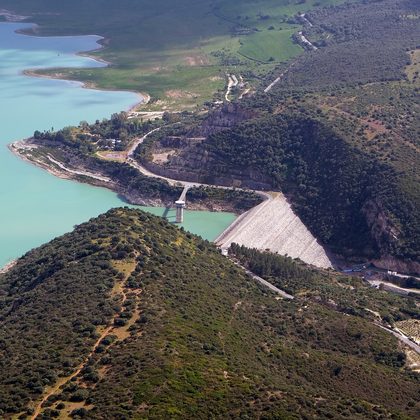
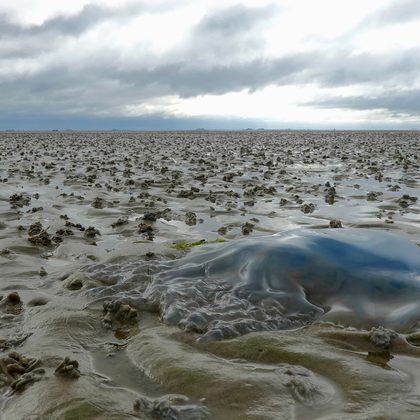
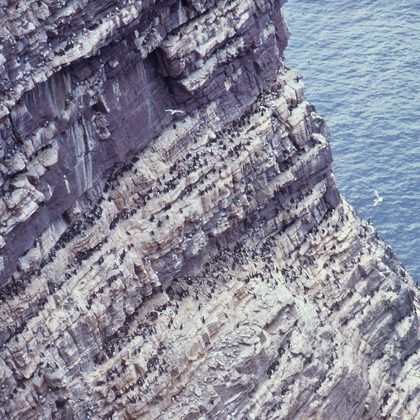
In winter a bird of fish quays, harbour walls and lock sills, of landfills and of the tideline where fish waste washes up; it begs behind trawlers and rests on harbour water. It breeds on steep cliffs along the Greenland fjords and in the Canadian Arctic. Between those two extremes it is at sea, working the wake of the fleet.
Where the bird is most at home, classified with EUNIS — the European standard for habitats.


Range and movements
Breeds in west and east Greenland and Arctic Canada, spreading in winter over Iceland, the British Isles and the North Sea. Iceland is the stronghold, with hundreds in the harbours; Shetland, the Outer Hebrides and the Irish and Scottish fishing ports hold birds every winter, and numbers thin quickly south of the Netherlands. In Iberia it is a marked rarity of the north coast.
- Winter
- Passage
- dark = core range, pale = thinly spread
Where and when to look
In February and March scan harbour water rather than the beach flock. A swimming Iceland Gull gives itself away by that long, tapered rear end reaching far past the tail, and it is often the tamest bird in the basin. Work Lerwick and Scalloway, Stornoway, Ullapool or Killybegs, and take your time over the head, because the soft face and the small bill convince where size does not.
Conservation status
Not globally threatened, with a large but thinly populated breeding range that is hard to census. The concerns are the changing ice cover around Greenland, the decline in trawler discards that the north-west European winter numbers ride on, and hunting in parts of the breeding range. For British and Irish observers the species is a fair index of hard north-westerly winters, and a good winter still delivers birds to a dozen ports at once.