All species › Waterfowl › Ducks, geese and swans › Lesser scaup
Lesser scaup
Aythya affinis | Kleine topper | Porrón bola
A North American diving duck that in Britain and Ireland turns up embedded in flocks of Tufted Duck and Scaup. It is a bird you pick out rather than find, and it repays anyone willing to work a reservoir flock properly.

Voice
Effectively silent here. Displaying drakes give a thin, soft whistle, whee-oo, that carries barely a few metres over open water; females a hoarse low kerr on take-off. Nothing you will hear while scanning a winter flock.
No freely licensed recording is available for this species yet.
Identification
The drake has a black head glossed purple in good light, a black breast, a grey back with coarser vermiculation than Scaup and dingy white flanks finely barred grey. The crown peaks towards the rear, giving an angular nape and a short-necked look. The blue-grey bill carries a small, narrow black nail. Females are warm brown with a sharply defined white blaze at the bill base and often a faint pale ear-spot; eclipse drakes are dark brown with traces of vermiculation on the flanks.
Confusion species
Scaup and Tufted Duck are the comparison. On Lesser Scaup the highest point of the head lies behind the eye, on the rear crown; on Scaup the peak sits over or in front of the eye and the crown runs round. The purple rather than green gloss flips with the light and should only ever confirm, never decide. The wing bar settles it: white across the secondaries, then changing abruptly to grey through the primaries, where Scaup carries white well out into the inner primaries. Tufted Duck has a black back, a tuft or nape bulge and a broad black bill nail. With females the trail goes cold. Female Tufted Duck can show a white bill base too, and Tufted Duck x Pochard hybrids mimic both head shape and back colour; only the open wing then remains, and without it a claim should stay open.
Habitat
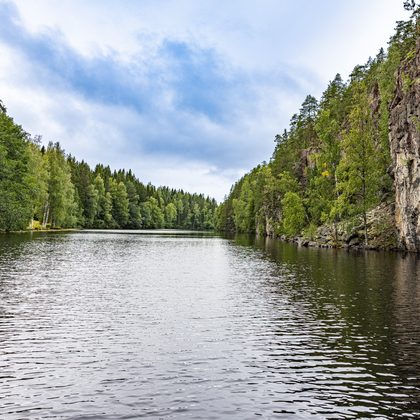
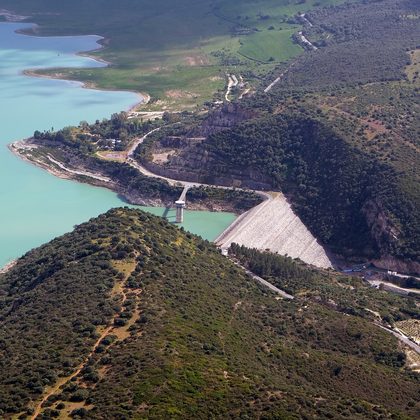
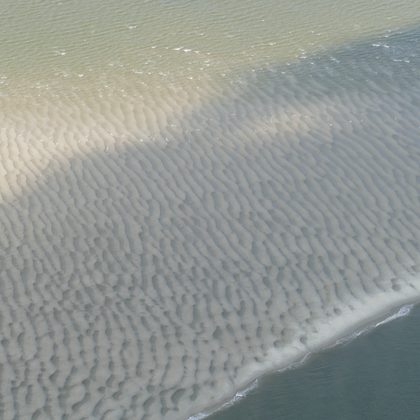
Deep fresh waters: reservoirs, gravel pits, park lakes and sheltered harbour basins, diving for zebra mussels, snails and insect larvae. Birds that reach the coast sit with Scaup over shallow sandy bottoms.
Where the bird is most at home, classified with EUNIS — the European standard for habitats.
Range and movements
Breeds across North America from the prairie potholes to Alaska and winters from the Great Lakes to the Gulf of Mexico. The first British record was a first-winter drake at Chasewater, Staffordshire, in 1987; the first female followed nine years later. It is now annual, with more than 150 birds reported, and Ireland takes a disproportionate share, with long-staying birds on the Cork and Wexford waters and the midland loughs.
- Resident
- Breeding (summer)
- Winter
- Passage
- Migration direction
- dark = core range, pale = thinly spread
Where and when to look
Between December and March work a reservoir or gravel-pit flock of Tufted Duck head by head. Look for the angular rear crown and the greyer flanks, then wait for a wing-flap: only with the spread wing in view is the identification finished.
Conservation status
Not globally threatened, but the North American population has fallen from roughly seven million in the 1970s to about three million. Loss of prairie wetlands, poorer condition of females on spring migration and the build-up of selenium and other contaminants are the usual explanations. For the handful reaching Europe the practical risks are lead shot and disturbance on recreational waters.