All species › Woodpeckers and allies › Woodpeckers › Lesser spotted woodpecker
Lesser spotted woodpecker
Dryobates minor | Kleine bonte specht | Pico menor
No bigger than a House Sparrow and light as a pen, the Lesser Spotted Woodpecker is Europe's smallest woodpecker and its hardest to find. It lives high in the thin twigs of alder, willow and poplar, where its high call betrays it long before its silhouette does.

Voice
A high, clear, evenly paced kee-kee-kee-kee-kee of six to twenty notes, far thinner and higher than Great Spotted's call and most like a Kestrel or a Wryneck. There is also a soft, short kik. The drum roll is surprisingly loud for such a small bird and is the best clue: much longer than Great Spotted's, one to one and a half seconds, but clearly weaker, higher and drier in tone, often swelling slightly at the end. In February and March both sexes drum freely.
Recording: Benoît Van Hecke — CC BY-SA 4.0 · Wikimedia Commons
Identification
A sparrow-sized dwarf with a short, pointed bill. The back is barred black and white — no big white shoulder ovals as on the other pied woodpeckers — and the underparts are dirty white with faint streaking on the flanks; there is no red under the tail at all. The male has a dull red crown with a narrow pale forecrown, the female a dirty white to buff crown with no red whatsoever. Juveniles of both sexes show a rusty crown patch, smaller and duller on young females, and look untidily streaked below. The flight is weak and deeply bounding, almost butterfly-like.
Confusion species
Confusion is nearly always a matter of size. Middle Spotted Woodpecker is half again as large and much bulkier, with big white shoulder ovals instead of a barred back, an open white face and a salmon-pink vent — a colour Lesser Spotted never shows. Middle Spotted also works trunks and thick limbs, while Lesser Spotted hangs in the outermost twigs, often upside down like a tit. Great Spotted is larger still and has a scarlet rear end. If all you get is a small black-and-white bird in the canopy, check the back: the barring is decisive.
Habitat
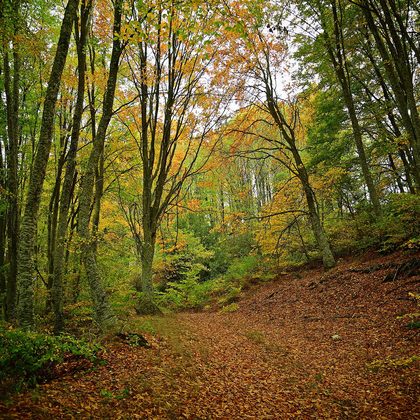
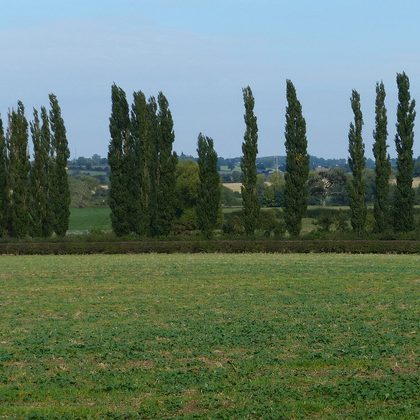
Damp, mature broadleaved woodland with plenty of dead and dying thin wood: alder carr, willow scrub and poplar rows along streams and rivers, but also old parks, orchards and estate woodland. It feeds among thin branches and twigs, in the canopy and on dead limbs, and in winter often travels with roving tit flocks.
Where the bird is most at home, classified with EUNIS — the European standard for habitats.

Range and movements
From Ireland and Spain to Scandinavia, Russia and Japan. In the Netherlands it is a scarce resident throughout, commonest on the sandy soils, in stream valleys, along the major rivers and on old estates; numbers have fallen over recent decades. In Spain it occurs in the north and along the Pyrenees, in broadleaved and gallery woodland, and is virtually absent further south.
- Resident
- Breeding (summer)
- Winter
- Passage
- dark = core range, pale = thinly spread
Where and when to look
Late February to early April, while the leaves are still off and the birds are drumming. Walk an alder carr or an old poplar row on a windless morning and listen for the long, thin roll and the high kee-kee-kee, then scan the slender treetops against the sky. Outside spring your best chance is to follow a roving tit flock until you pick the unobtrusive black-and-white bird out of it.
Conservation status
Not globally threatened (IUCN: Least Concern), but clearly declining across much of western Europe; numbers in the Netherlands and the United Kingdom have dropped sharply. The likely causes are the tidying away of dead and thin wood, the loss of damp alder and willow woodland and the decline of canopy insects. Leaving dying limbs standing and conserving wet woodland is the most effective response.