All species › Bustards › Bustards › Little bustard
Little bustard
Tetrax tetrax | Kleine trap | Sisón común
A bustard the size of a pheasant, built like a small goose and as nervous as a partridge. Outside the display season it is a sandy smudge that only registers when it flushes; in April a male gives himself away at a kilometre with a dry, snorting bark and with the purr of his wings.

Voice
The male displays from a bare scrape trodden out within the crop. He stands tall, inflates the black-and-white neck, throws the head back and every ten to twenty seconds delivers a short, dry, snorting prrt, like someone blowing through pursed lips. This is often followed by a leap of a metre or more with a brief burst of wingbeats producing a whistled sisisisi. In flight the male's narrowed outer primaries generate a sustained purring whistle that on still mornings carries further than the call itself, and it is often the first sign of the bird.
Recording: Benoît Van Hecke — CC BY-SA 4.0 · Wikimedia Commons
Identification
The breeding male has a slate-grey face and a black neck crossed by two clean white bands, the upper a narrow V beneath the throat, the lower a broad collar. Back and coverts are ochre with fine black vermiculation, underparts pure white. Females and winter males lack the neck pattern and are entirely ochre, streaked and barred, with a finely streaked neck. In flight the wing looks strikingly white with only the primary tips black; flight is fast and low on stiff, shallow beats.
Confusion species
On the ground a female or juvenile suggests a large hen pheasant or even a partridge, but the neck is longer, the head smaller and rounder and the legs long and yellow. In flight the almost wholly white wing is diagnostic: no gamebird shows that. Great Bustard is four times the weight and has a black trailing edge to the wing.
Habitat
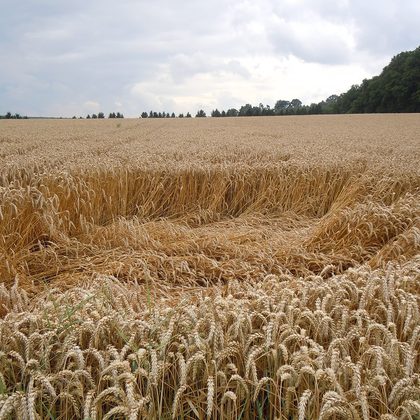
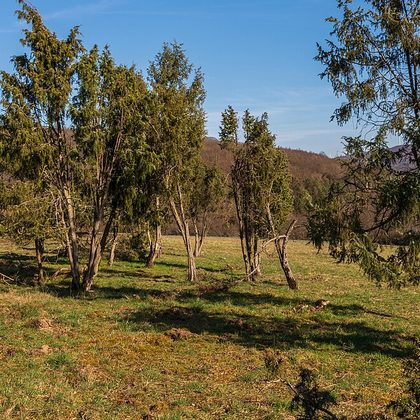
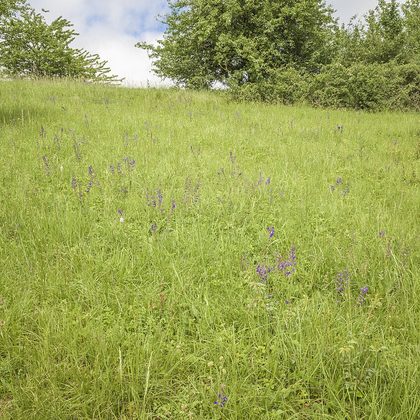
Extensive dry arable with plenty of fallow, alfalfa, vetch and sainfoin, and dry steppe grassland with a low, open structure. Males choose display sites with short cover and clear sightlines; females nest in taller vegetation a few hundred metres away. Outside the breeding season birds flock on stubbles and green cover crops.
Where the bird is most at home, classified with EUNIS — the European standard for habitats.
Range and movements
Breeds from Iberia and southern France east to Kazakhstan, having been lost from Hungary, Germany and almost all of Italy. In Britain a very rare vagrant of a handful of records a decade, almost all in late autumn and winter and mostly on coastal fields in the south and east; the female at Fraisthorpe in Yorkshire over the 2014–15 new year was the best-watched of recent times.
- Breeding (summer)
- Winter
- Passage
- Migration direction
- dark = core range, pale = thinly spread
Where and when to look
The Crau near Saint-Martin-de-Crau in Provence is the most accessible display ground in western Europe: males call across the stony plain in May and can be heard from public tracks. Be there before sunrise, because calling stops within a couple of hours and after that you get flushing birds and nothing else.
Conservation status
Near Threatened globally and falling sharply in the western population. Arable intensification is the cause: loss of fallow and fodder legumes, field enlargement, irrigation and insecticides that remove the invertebrate food chicks depend on. In France parts of the population survive only on agri-environment agreements and restocking, and those local birds go back on released stock.