All species › Birds of prey › Hawks, eagles and kites › Long-legged buzzard
Long-legged buzzard | Buteo rufinus
Arendbuizerd | Busardo moro
The Long-legged Buzzard is the large, long-winged buzzard of the steppes, bare hillsides and cereal plains of the Mediterranean and further east. It looks heavier and slower than a Common Buzzard, almost like a small eagle, and an adult gives itself away at range by its plain orange-brown tail. In north-west Europe it remains a rare sight.

Voice
Almost always silent away from the territory. At the nest and in display it gives a drawn-out, plaintive peeeeh-ah, hoarser and lower than the mewing of a Common Buzzard and with a rasping start closer to a crow. When agitated it adds a short, sharp series of keh-keh-keh. A vagrant in north-west Europe is virtually never heard.
No freely licensed recording is available for this species yet.
Identification
Bigger and heavier than a Common Buzzard, with long broad wings, a long arm and a proportionately longer tail; the head projects clearly in front of the wing. It soars with the wings in a pronounced V and flaps slowly and heavily, more like a small eagle than a buzzard. In the usual pale type the head and breast are cream to light ochre while belly and trousers are deep rufous to almost black, so that the dark belly patch stands out sharply against the pale breast. The underwing is largely white with big black carpal patches and a dark trailing edge; from above a pale panel shows at the base of the primaries. The adult tail is plain orange-brown to rusty red without bars, and from below often looks almost translucent white. Juveniles are duller and warmer buff-brown, with a faintly and finely barred, less orange tail, a narrower dark trailing edge and a pale iris. A dark morph also occurs, near-uniform blackish brown, on which the pale primary panel remains the handhold.
Confusion species
The Common Buzzard is the yardstick, and the difference starts with build: it is compact, with broad rounded wings, a short broad tail and a head that hardly projects, while the Long-legged is a size larger, longer in wing and arm, and carries the head further forward. The tail decides it. On an adult Long-legged it is plain orange-brown and unbarred; on a Common Buzzard it is always finely barred with a dark terminal band, however pale the bird may otherwise be. A pale Common Buzzard also shows dark carpal patches and a pale head, but its dark markings below form a broken, U-shaped band across the breast, set higher and looser than the compact dark belly patch of a Long-legged. The Rough-legged Buzzard is confusingly similar on paper: a pale head, a dark belly patch and large black carpal patches on a white underwing. Again the tail settles it: clean white at the base with a sharply defined broad black terminal band in the Rough-legged, orange-brown and unbanded in the Long-legged. Watch behaviour and wing action too: a Rough-legged hangs hovering in the wind for minutes, while a Long-legged hovers only rarely and soars with a slower, heavier beat and a deeper V. Juvenile Long-leggeds are hardest, because their tail is paler and vaguely barred; then rely on size, the long arm, the heavy bill and the long, bare-looking legs. At distance a young Lesser Spotted or Steppe Eagle can briefly enter the reckoning through the raised-wing glide and the pale primary bases, but those have a far longer hand, a shorter tail and a darker, plainer body.
Habitat
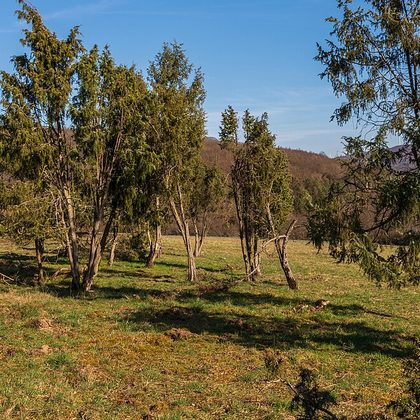
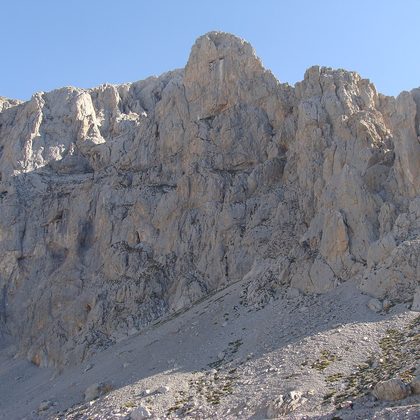
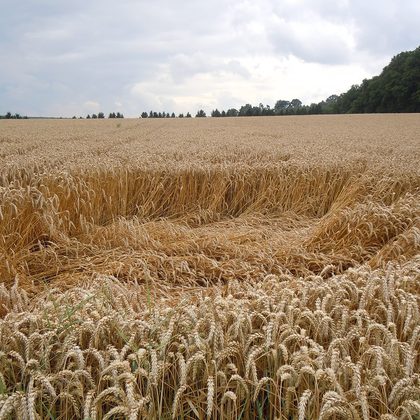
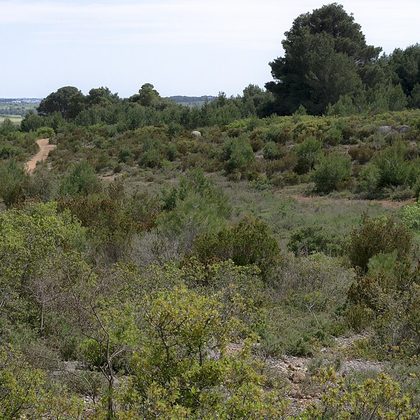
Dry, open and hilly country: steppe and semi-desert, bare slopes with rock bands, gorges and flat-topped hills, wide cereal country with fallow, and in North Africa the edges of wadis and oases. It nests on a rock ledge, in a low tree or on an electricity pylon. It hunts from a post, a rock outcrop or gliding low along the slope, taking ground squirrels, voles and young hares, plus lizards, snakes and large insects; at carrion it joins kites and vultures without ceremony.
Where the bird is most at home, classified with EUNIS — the European standard for habitats.

Range and movements
A breeding bird of south-east Europe, the Mediterranean and Central Asia: Greece, Bulgaria and the rest of the Balkans, Turkey, the Caucasus, southern Russia, Iran and further east, together with the subspecies cirtensis in North Africa from Morocco to Libya and on the Arabian Peninsula. Northern and eastern birds move to East Africa and the Middle East, while southern populations largely stay put. In south-east Europe the species has increased and pushed north over recent decades. In Britain it is not on the list at all, and in the Netherlands it stays a genuine rarity: one record up to 1979 and about ten since 2000, including a bird that wintered on the Maasvlakte in three successive years. In Spain it is likewise a vagrant, with records in Andalusia, Murcia and the Canary Islands; only in Ceuta is it treated as resident.
- Resident
- Breeding (summer)
- Winter
- Passage
- dark = core range, pale = thinly spread
Where and when to look
Look for it where it belongs. Drive through the open hills of Thrace, Lesbos or the Bulgarian steppe in March, April or May and scan slopes, rock bands and pylons; on a sunny morning it lifts off of its own accord and the orange tail glows against the light. If you find a strikingly large, pale-headed buzzard further north, photograph it from behind as it pulls away: the tail is the only feature that settles the case.
Conservation status
Not globally threatened (IUCN: Least Concern), with a wide range and a stable to slightly increasing European population; in Greece, Bulgaria and Romania both numbers and range have grown clearly in recent decades. Even so, poisoning from illegally laid baits, electrocution on medium-voltage pylons and illegal shooting weigh heavily in places. Turning steppe and extensive cereal land into intensive arable or plantation costs hunting ground, and in North Africa nests are robbed for falconry.