All species › Birds of prey › Hawks, eagles and kites › Northern harrier
Northern harrier | Circus hudsonius
Amerikaanse blauwe kiekendief | Aguilucho norteamericano
The Northern Harrier is the North American bird that was long counted as part of the Hen Harrier and has been treated as a separate species since about 2016. It hunts the same low, rocking quartering flight over the same kind of open ground, and in Europe it is one of the hardest vagrants of all to prove. Almost every European record concerns a brown bird on the wet coastal grassland of a western island.

Voice
Silent away from the breeding grounds, and a European vagrant is never heard. On the North American breeding marshes the male gives a rapid, chattering kek-kek-kek-kek in display and in defence of the nest, and the female a plaintive, insistent peee-yew at food passes. Those calls are essentially identical to a Hen Harrier's and are of no use in separating the two.
No freely licensed recording is available for this species yet.
Identification
A harrier of Hen Harrier build: long wings held in a shallow V, a long tail, and a slow, rocking, quartering flight low over open ground. The adult male is pale grey above and white below, with a black wingtip, a white rump and, unlike a Hen Harrier, a scattering of small rusty spots on the flanks and belly and a darker, more clearly outlined trailing edge to the underwing. The adult female is dark brown above with buff-mottled coverts, a strongly barred tail, a white rump and heavily streaked buff underparts. The juvenile is the plumage that most often reaches Europe and the one worth memorising: deep orange-rufous below, essentially unstreaked across the belly with dark streaking limited to the breast sides and flanks, a dark face with a bold pale surround to the eye and a broad dark boa closing round the neck, and a strikingly contrasted underwing on which blackish secondaries form a solid dark band against pale, finely barred primaries. Juvenile males show a pale greenish-yellow iris, juvenile females a dark one. Structurally the wing looks a shade longer and narrower than a Hen Harrier's, with the outer primary long enough that five fingers are usually countable.
Confusion species
Everything turns on the Hen Harrier, and the honest starting point is that the two overlap in almost every feature, so a good many birds simply cannot be named. Adult males are the easier pair: a Northern Harrier male shows rusty spotting on the flanks, belly and underwing coverts where a Hen Harrier male is clean white, and a darker, more sharply defined dark trailing edge to the underwing, whereas the Hen Harrier's trailing edge is grey and softly drawn. On females and above all on juveniles, work through a suite of characters rather than one. Underpart colour: juvenile Northern Harrier is deep orange-rufous and largely unstreaked on the belly, the dark streaks confined to the breast sides, while a juvenile Hen Harrier is paler buff and streaked right down the belly and flanks. Underwing contrast: Northern Harrier shows blackish secondaries forming a solid dark band against pale primaries, a contrast a Hen Harrier does not reach, being coarsely barred across the whole width of hand and arm. Head: Northern Harrier has a darker, more contrasted face with a bolder pale eye-surround and a wide dark boa around the neck. Rump: the white patch is smaller, squarer and more sharply cut off in Northern Harrier, larger and more diffusely edged in Hen Harrier. Primaries: the outer primary is longer in Northern Harrier, so five fingers are usually countable, whereas on many Hen Harriers that outermost feather is shorter and only four really stand out — a difference of degree, not a proof. Rufous-toned juvenile Hen Harriers exist and account for most claims that fail, so treat any candidate as a Hen Harrier until several features point the same way, and photograph the spread underwing and the rump if you can. The other grey harriers are a lesser problem: Montagu's is slimmer with a pointed wing, only four fingered primaries and two dark bars on the underwing, and Pallid is paler with a narrow black wedge on the outer four primaries and a narrow pale collar closing round the neck like a boa.
Habitat
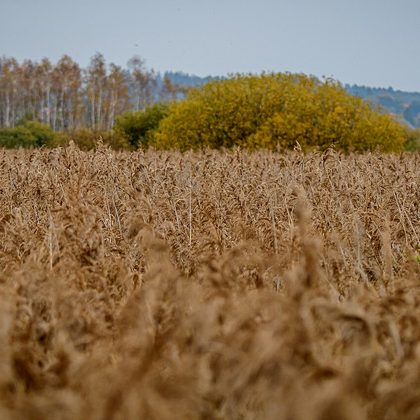
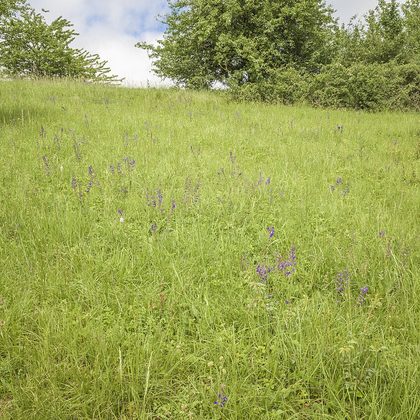
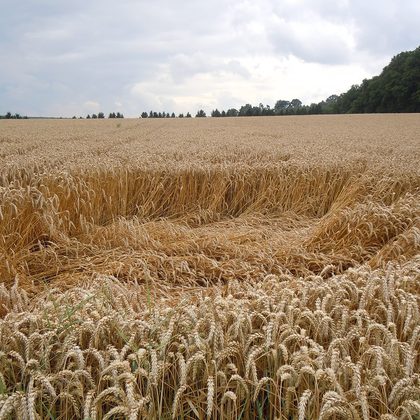
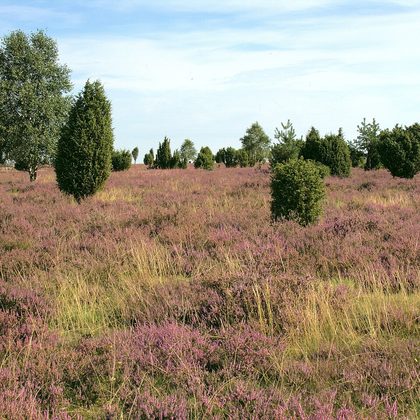
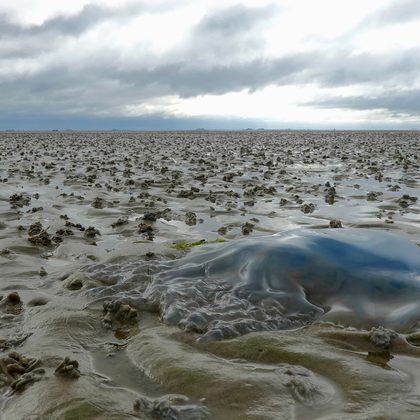
Freshwater and brackish marshland, wet meadows, prairie and rough grassland, young clear-fell and, in winter, stubble fields, saltmarsh and coastal dunes. It nests on the ground in dense low vegetation and roosts communally on the ground outside the breeding season, exactly as a Hen Harrier does. European vagrants have almost all been found on wet, treeless coastal ground: island machair, saltmarsh, rough grazing and reclaimed marsh.
Where the bird is most at home, classified with EUNIS — the European standard for habitats.
Range and movements
Breeds right across northern North America, from Alaska and Canada south into the northern United States, and winters from the northern states to Central America and northern South America. In Europe it is a genuine vagrant with no breeding, no regular wintering and no regular passage. Britain and Ireland hold about ten accepted records, the first on the Isles of Scilly in 1982 and most of the rest since 2008 in Scotland, East Anglia and the south-west, with a few further claims still under assessment; an earlier bird that wintered at Cley in Norfolk in 1957 and 1958 was debated for decades and was never accepted. On the European mainland the species is essentially unrecorded, and as far as is known there is no accepted record for either the Netherlands or Spain. Any figure quoted should be read as provisional, because the identification standard has tightened as the plumages have become better known.
Where and when to look
Realistically this is a bird you find by working the Hen Harriers rather than by looking for a Northern Harrier. In October and November on a western island — Scilly, the Outer Hebrides, western Ireland — take every brown harrier that quarters the machair and get the underwing on camera as it banks: the solid dark secondary band against pale primaries is what separates a candidate from the many rufous juvenile Hen Harriers. Note the belly, the face pattern and the rump in that order, and accept that a bird seen once, briefly and from below is not identifiable.
Conservation status
Not globally threatened (IUCN: Least Concern), but numbers in North America have fallen over recent decades as prairie, wet meadow and marsh have been drained and ploughed, and the species is listed as threatened or of concern in several states. Pesticide residues thinned eggshells badly in the mid-twentieth century and remain a background worry. In a European context the conservation questions belong entirely to North America; here the species is a handful of records, and the practical issue is that an unknown share of vagrants passes unrecognised among wintering Hen Harriers.