All species › Passerines › Crows and jays › Maghreb magpie
Maghreb magpie | Pica mauritanica
Maghrebekster | Urraca magrebí
Step out of the car anywhere in Morocco and within the hour you will see your first magpie — and it will have a bright blue patch of bare skin behind the eye. The Maghreb magpie is north-west Africa's magpie: glossier, shorter-tailed, and wearing the one ornament no European magpie has. It has been treated as a separate species for some years now; AviList 2025 carries it as Pica mauritanica.

Voice
The same hard chattering rattle as Eurasian magpie: an accelerating chak-chak-chak carrying across yards and village edges, given all year and hardest in alarm at a cat or a goshawk. Add soft gurgling notes between mates and a shrill kee-yek at the nest. A birder travelling from Andalucía to Morocco meets no new sound; voice will not tell you which species you have.
No freely licensed recording is available for this species yet.
Identification
At first glance a magpie: black and white, long graduated tail, white primaries flashing in flight. The difference is in the face. Behind and below the eye lies a bare patch of skin, sky-blue to violet, big enough to catch the eye at ten metres without binoculars and brightest on displaying birds in early spring. Beyond that the tail is shorter, so the whole bird looks stockier, the white of belly and scapulars is slightly reduced, and the gloss on wing and tail is a strong blue-green. Sexes alike. Juveniles are short-tailed and dull, with a pale grey-blue face patch that only brightens through the first autumn.
Confusion species
Eurasian magpie is the only possible confusion, and in the field the question rarely arises, because the two nowhere meet: the Strait of Gibraltar lies between them, magpies to the north, Maghreb magpies to the south. Set them side by side and two things decide it. First the bare blue patch behind the eye, which Eurasian magpie lacks entirely — its face is fully feathered and plain black. Second the tail, which on Maghreb magpie is noticeably shorter, so the bird looks less drawn out and trails less tail behind the wings in flight. In flight action, gait and behaviour there is nothing else to separate them.
Habitat
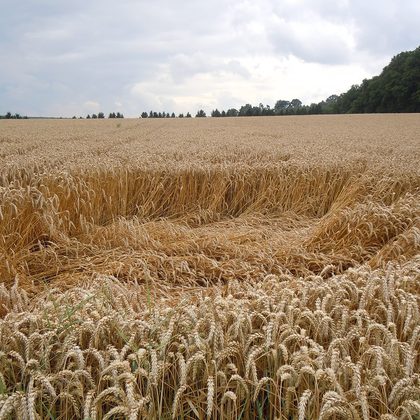
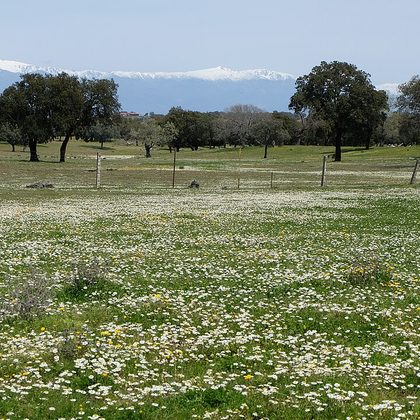
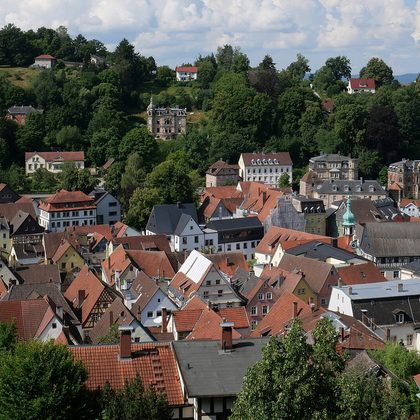
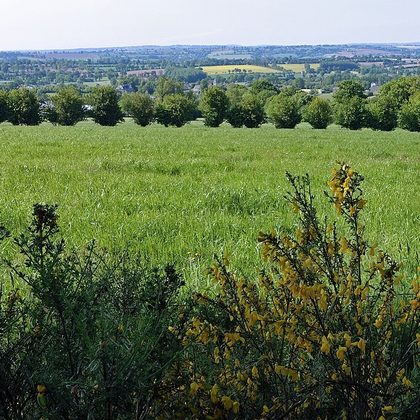
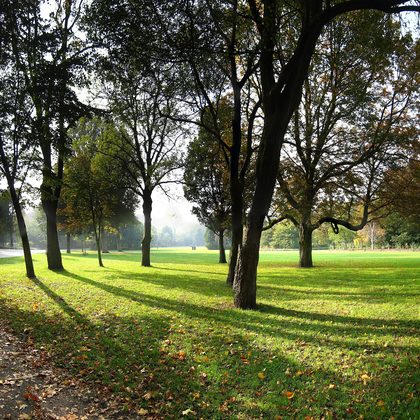
Half-open farmland with standing trees is its world: cereal fields with scattered olives and argan, orchards and almond groves, cactus and agave hedges along field boundaries, oases and palm gardens, and the fringes of villages and cities. In Marrakech, Agadir and Fez it walks between the café terraces, and along the roads it sits on the wires. It avoids both closed woodland and true desert; the nest is a large domed ball of sticks in an acacia, an olive or a date palm.
Where the bird is most at home, classified with EUNIS — the European standard for habitats.
Range and movements
North-west Africa only, so its entire world range falls inside this guide. Morocco is the core, from the Atlantic plains and the Souss across the Middle Atlas to around two thousand metres, then northern Algeria and Tunisia out to roughly the desert edge. Southwards it stops where the Sahara begins, and it has never made the jump across the Strait of Gibraltar: there is no Spanish record. Resident, with no more than local wandering by young birds.
- Resident
- Winter
- Passage
- dark = core range, pale = thinly spread
Where and when to look
The whole of Morocco is Maghreb magpie country, but the blue patch needs range, and range is easiest where the birds are used to people: the gardens and park edges of Marrakech, the tip outside a village, a café car park on the road to Taroudant. Early in the morning with the sun behind you the patch shows deepest. Check the tail length on every group you pass — it registers most strongly if you have just come over from Spain.
Conservation status
Not threatened (IUCN: Least Concern) and numerous throughout its range; it profits from arable farming, orchards and village refuse, and over recent decades has been moving further into the cities. It is shot or taken from the nest in places, and in parts of Tunisia and Algeria it is scarcer than in Morocco. The real gap is not the bird but what is known about it: because it was counted as a form of Eurasian magpie for so long, separate study is thin and there are no reliable trend figures.