All species › Falcons › Falcons › Merlin
Merlin
Falco columbarius | Smelleken | Esmerejón
The Merlin is Europe's smallest falcon: a compact, stocky hunter that skims low over saltmarsh and heath and snatches small songbirds out of the air in a flat, headlong chase. In the Netherlands you see it mainly between October and April, and usually only briefly.

Voice
Usually silent away from the breeding grounds. At the nest or when disturbed, a fast, shrill, sharply rattling ki-ki-ki-ki-ki, higher, faster and thinner than a Kestrel's kek-kek-kek. The female begs with a drawn-out, plaintive eeeh-eeeh. In the Netherlands you will rarely if ever hear one.
Recording: Bubulcus — CC BY 3.0 · Wikimedia Commons
Identification
Small and solidly built, with a short tail and fairly short wings that are broad-based but sharply pointed; in flight it looks stubby, almost like a large thrush on falcon wings. The male is blue-grey above, with a cream, rufous-streaked breast and a grey tail with a single broad black terminal band. Females and juveniles are dark grey-brown above, heavily brown-streaked below, with several pale bars across the tail. The face matters most: there is barely a moustachial stripe, at most a faint shadow, and no clear pale supercilium — the face looks flat and plain, without a helmet. The flight is fast, low and flickering with short glides, rarely high and never hovering.
Confusion species
Kestrel is the commonest mistake: it is slimmer, with a much longer tail and longer, more rounded wingtips, hovers regularly over one spot and hunts voles; the male has a rufous back with black spots and a grey head. Merlin virtually never hovers and hunts by low, headlong pursuit. Hobby is longer and far slimmer, with long scythe-shaped wings like a giant swift, a short tail, a sharp black-and-white head pattern with a bold moustache, and rufous trousers on adults. When in doubt look at the face — an obvious helmet and moustache argue against Merlin — and at the manner of flight.
Habitat
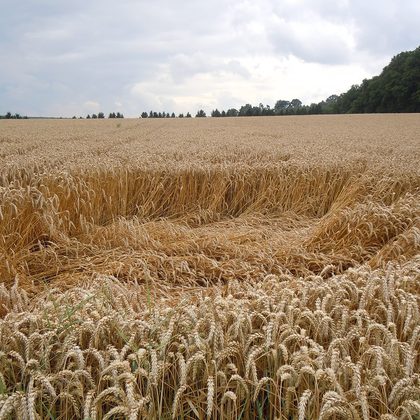
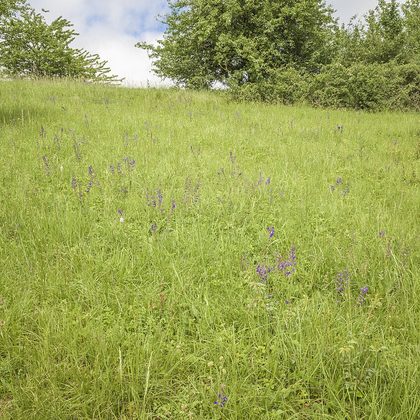
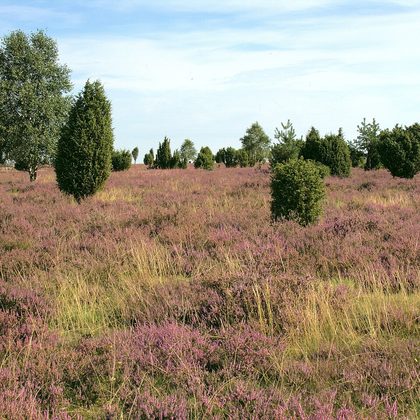
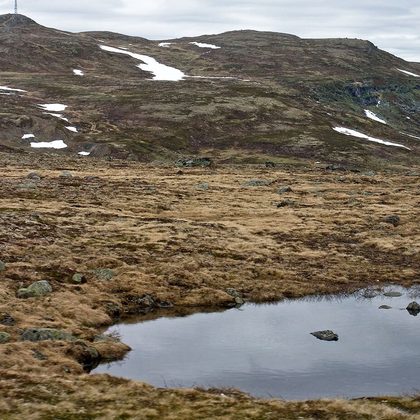
Breeds on open heather moor, blanket bog, tundra and bare mountainsides in northern Europe, often in an old crow's nest or on the ground. In winter it is a bird of wide open ground: saltmarsh and sea walls, arable fields, grassland, dune sands and heath — anywhere small songbirds gather. It uses low perches such as a clod, a fence post or a fallen tree, and prefers to stay below the horizon.
Where the bird is most at home, classified with EUNIS — the European standard for habitats.

Range and movements
Breeds in Iceland, Britain, Scandinavia and northern Russia; northern birds move south to winter in western and southern Europe and around the Mediterranean. The Netherlands has no breeding birds but several hundred wintering individuals each year along the Wadden coast, in the Delta and on the Veluwe and Drenthe heaths. In Spain it is a scarce winter visitor, chiefly on the plains of the Meseta, in rice fields and around coastal lagoons.
- Resident
- Breeding (summer)
- Winter
- Passage
- Migration direction
- dark = core range, pale = thinly spread
Where and when to look
October to March, on a winter morning on a sea wall or beside a saltmarsh. Stand still and scan low along the vegetation: a Merlin often gives itself away when an entire flock of Meadow Pipits or Twite explodes into the air. Check low perches out in the open too. Migration peaks in October and March give the best odds at coastal watchpoints.
Conservation status
Not threatened (IUCN: Least Concern) and globally stable. In Europe the species recovered after the DDT years, but numbers are falling again in parts of Britain and Fennoscandia through loss of heath and bog, afforestation of open ground and the decline of small songbirds. As a Dutch winter visitor the numbers have if anything fallen over recent decades.