All species › Passerines › Sylvia warblers › Moltoni's warbler
Moltoni's warbler | Curruca subalpina
Moltoni's baardgrasmus | Curruca de Moltoni
Moltoni's warbler is the bird of the Tyrrhenian Sea: Sardinia, Corsica, the Balearics and northern Italy. It is the third of the three subalpine warblers and at the same time the easiest, because it gives itself away with a sound the other two do not have: a dry rattle, as if a long-tailed tit were sitting in the maquis. The male, too, is not red below but soft salmon-pink. The species carries the name of the Milanese ornithologist Edgardo Moltoni.

Voice
The rattle is the trademark: a dry, fast trrrrt of roughly half a second to a second, hard and wooden, exactly the sound of a long-tailed tit or a Wren in a bush. It is given all year and by both sexes, and it is the only sound that separates the three subalpine warblers without a photograph. The song is a fast, high, insect-like chatter, thinner and more hurried than in the other two, with the rattle thrown in again and again — that little rattle in mid-phrase is by itself enough. It is delivered from a projecting twig or in a short song flight over the scrub, from late April into June, mainly in the morning.
Recording: Tanguy Loïs — CC BY-SA 4.0 · xeno-canto
Identification
A small, long-tailed warbler with a red eye-ring. The male is blue-grey on head and mantle — a cooler grey than the other two subalpine warblers — and soft salmon or rose-pink from chin to belly, pale in tone and without a clean border; the pink runs diffusely on to the flanks and lower belly. The white submoustachial stripe is short, narrow and barely noticeable. The outer tail feathers are white and the next one in carries a square white tip, exactly as in Western Subalpine. The female is brown-grey above and cream-white with a faint pink wash below, with the reddish orbital ring and a thin pale ring around it. The species returns later than the other two and moults its flight feathers only in the winter quarters, which gives it an even, little-worn plumage in spring.
Confusion species
Western and eastern subalpine warbler are the problem — see their own pages, where the same difference is described from the other side. On a spring male the colour of the underparts decides, and in Moltoni's it is pink rather than red: a pale salmon-pink that fades out smoothly, against the warm orange-red of Western, which also fades out but is clearly deeper and more orange, and against the deep brick-red of Eastern, which in addition stands sharply on a white belly. The blue-grey upperparts and the short, narrow submoustachial stripe support it. The tail is the same in Moltoni's and Western — a square white tip on the penultimate feather — so it separates Eastern only. On females and first-years the plumage is hopeless, but here this species has a way out the other two lack: the call. Moltoni's gives a dry, rattling trrrrt of almost a second, like a long-tailed tit or a Wren, where Western gives a single dry tek and Eastern a doubled t-tret. Anyone who hears that rattle is finished, whatever the age or sex. A female can also suggest a small Whitethroat, but that has a broad rusty wing panel and no red eye-ring.
Habitat
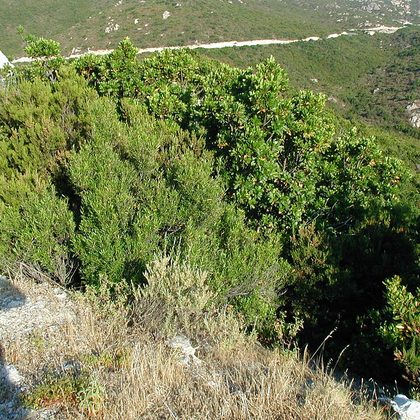
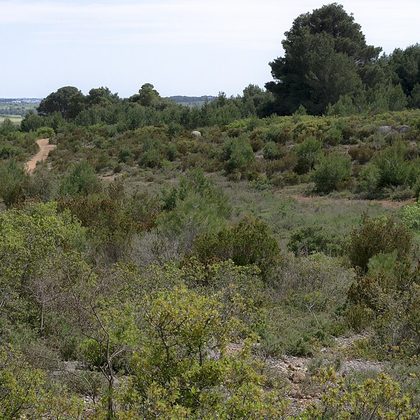
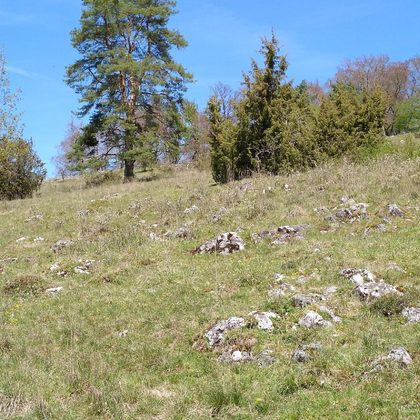
Medium to low bushes at the edge of warm broadleaved woodland, especially downy oak, and tall Mediterranean maquis. On Sardinia, Corsica and the Balearics that means classic mastic, strawberry-tree and cistus scrub with a few taller trees in it; in northern Italy it sits lower and more openly, along wood edges, on rank slopes and in the mosaic of hedges, scrub and farmland of the hills and river plains. From sea level to about 1,600 metres.
Where the bird is most at home, classified with EUNIS — the European standard for habitats.

Range and movements
Breeds around the Tyrrhenian Sea: on the Balearics, Corsica, Sardinia and some small Tyrrhenian islands, and on mainland Italy from Liguria and Piedmont eastwards through Tuscany and Emilia-Romagna into the Marche. It winters in the western Sahel, from the Atlantic coast to Niger and northern Nigeria. It arrives late, usually not before mid-April or early May, and leaves early again. In Spain it is the subalpine warbler of the Balearics — Mallorca, Menorca, Ibiza, Formentera and Cabrera — and otherwise a scarce migrant along the east coast. In north-west Europe it is an exceptional vagrant, but thanks to the rattle it is easier to prove there than either of its relatives.
- Breeding (summer)
- Passage
- dark = core range, pale = thinly spread
Where and when to look
Mid-May on Mallorca or Sardinia, in maquis on a sunny slope, early in the morning. Search with your ears first: a dry rattle in the scrub that you almost take for a long-tailed tit is this species. Then walk slowly towards it and wait for the male to perch on a twig; in good light the pink rather than red breast shield is obvious at once. The same recipe works in autumn, and then recording the rattle is the only thing that will really name a drab female.
Conservation status
Not threatened (Least Concern). The range is small and fragmented, but within it the species is common, and on the Balearics, Corsica and Sardinia it is among the commonest singers of the scrub. Because the range is limited, local damage weighs more heavily than with the other two subalpine warblers: wildfires on the islands, building and tourism along the coast, and the clearance of scrub and hedges in the Italian farmed landscape. As a long-distance migrant wintering in the Sahel it also shares the swings of rainfall there.