All species › Passerines › Sylvia warblers › Western subalpine warbler
Western subalpine warbler | Curruca iberiae
Westelijke baardgrasmus | Curruca carrasqueña
Western subalpine warbler is the warbler of the Spanish cistus scrub: a small, long-tailed bird with a red eye-ring that throws its hurried chatter down the hillside from the tip of a bush and drops straight back into cover. Since 2013 what used to be called one Subalpine Warbler has been treated as three species, and this is the western one — the bird of Iberia, southern France and north-west Africa. In Britain and the Low Countries it is a great rarity.

Voice
The song is a fast, rattling chatter of two to three seconds that recalls a Whitethroat but runs more evenly and more musically, with fewer scratchy and more clear notes: chre-chre-chirre-chirre-chrit, like a small tune being reeled off. It comes from the top of a cistus or rosemary bush, and often in a short song flight in which the bird springs up at an angle and drops back still singing. In this species the call is what everything hangs on: a hard, dry, monosyllabic tek, usually in a short series, exactly the way a lesser whitethroat tacks — never the fuller, doubled note of Eastern Subalpine and never Moltoni's rattle. Song runs from late March into June, fiercest in April and in the first hour after sunrise.
Recording: Philippe_Grange — CC0 · xeno-canto
Identification
Smaller and finer than a Whitethroat, with a proportionally long tail that is often flicked up. The male has a slate-grey head and mantle with a brownish cast, and from the chin well down onto the belly a warm brick-orange that simply fades out — the absence of a clean border is itself the feature. The white submoustachial stripe is narrow and weak. There is an orange-red orbital ring, the iris is red-brown and the legs are pale brown. The outer tail feathers are white, and the next feather in shows a small square white tip. The primary projection is short and broad, with four to six tips visible. The female is brown-grey above and cream-white below with a pink wash, shows almost no submoustachial stripe, and keeps only the reddish orbital ring with a thin off-white eye-ring outside it.
Confusion species
Everything turns on the three subalpine warblers — see also the Eastern Subalpine and moltoni's warbler pages, where the same difference is set out from the other side. On a singing spring male there are three things to do. First the underparts: in Western the orange-red runs on without a border onto the belly, in Eastern a deeper brick-red throat and breast stand sharply against a white belly, and in Moltoni's it is not red at all but a pale salmon-pink, equally diffuse. Second the submoustachial stripe: narrow and weak in Western, broad and conspicuous in the eastern birds of the Balkans. Third the tail: in Western and Moltoni's the penultimate feather carries a square white tip, in Eastern a narrow white wedge along the shaft — photographable, rarely visible. With females and first-years it stops there: they cannot be separated on plumage, and only the call decides, or else the place the bird is standing in. Western calls a hard, dry, monosyllabic tek, exactly a lesser whitethroat's tacking; Eastern gives a fuller, often doubled t-tret and Moltoni's a dry rattle. Beyond that, a female suggests a small Whitethroat, but that species has a broad rusty wing panel and no red eye-ring, while spectacled warbler has a bold white eye-ring, dark lores and a far warmer rufous wing.
Habitat
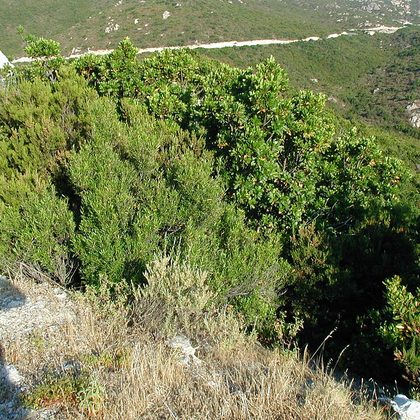
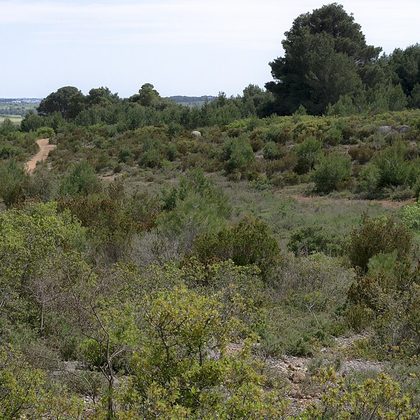
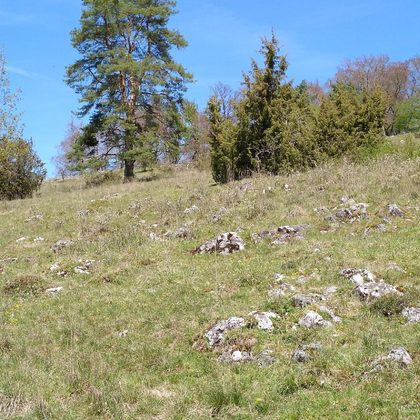
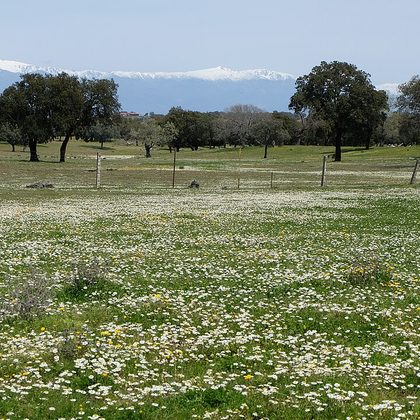
Low, dense, aromatic Mediterranean scrub on dry sunny slopes: cistus, kermes oak, rosemary and broom, the early stages in which a felled or burnt oak wood closes over again, and beyond that dehesa, pine and juniper woodland with a thick shrub layer. It wants bushes from knee height to head height with the odd projecting song perch, and avoids both bare steppe and closed forest. In Spain from sea level to 1,900 metres, commonest between 600 and 1,000 metres.
Where the bird is most at home, classified with EUNIS — the European standard for habitats.
Range and movements
Breeds on the Iberian Peninsula, in southern France and in north-west Africa, with a small outpost in the extreme north-west of Italy, and winters in the Sahel south of the Sahara. Spain holds by far the largest share: SEO/BirdLife puts it at some 4.5 million birds, densest in the two Castiles and Aragón, with gaps along the Cantabrian coast, in La Mancha, in southern Extremadura and in the lowlands of Levante. Birds return between late February and May, peaking in late March, and leave between August and October, peaking in late September. In north-west Europe it is an exceptional vagrant, and many older records still stand as 'subalpine warbler sp.' because they could not be taken to species.
- Breeding (summer)
- Passage
- Migration direction
- dark = core range, pale = thinly spread
Where and when to look
Late March and April, in flowering cistus scrub, in the first hour after sunrise. Do not look inside the bush but at the tops: the male sings deliberately in the open and gives itself away with short song flights. Record the call the moment you hear it, because on a female or an autumn bird that is the only thing that will fix the species. Good country is the sierras around Madrid, the Serranía de Cuenca and the hills of Aragón; in August and September migrants also use low scrub along dry watercourses and on the coast.
Conservation status
Not threatened. The Red List does not yet assess it separately but treats it together with eastern subalpine warbler under the broad species Sylvia cantillans, listed as Least Concern; the 2013 split, in other words, has not yet been worked through. In practice this is a very numerous bird with a large range and a Spanish population that looks stable. The pressures are those of Mediterranean scrub: clearance of matorral for arable land and olive planting, large fires, and at the other end the closing over of abandoned grazing land into continuous woodland.