All species › Passerines › Sylvia warblers › Eastern subalpine warbler
Eastern subalpine warbler | Curruca cantillans
Balkanbaardgrasmus | Curruca carrasqueña oriental
Eastern subalpine warbler is the eastern member of the trio: the subalpine warbler of the Greek phrygana, of southern Italy and Sicily and of the thorny hills of the Balkans east into western Turkey. The male is the most crisply marked of the three — deep red throat and breast, a broad white submoustachial stripe and a snow-white belly — and is accordingly the only one of the three you dare name at a distance in spring. Its Dutch name points at the Balkans, but the range starts at the heel of Italy.

Voice
The song is a hurried, rattling warble of two to four seconds, fuller and noisier than Western Subalpine's, with short grating motifs among the clear ones: cherre-cherre-chirri-chirri-chree. It comes from the top of a holm oak or a thorn bush and often in a small song flight over the phrygana. The call matters more than the song: an abrupt, short tek in the birds of southern Italy and Sicily, and a fuller, usually doubled and slightly rolling t-tret in Balkan and Turkish birds, as if the tick catches for a moment. That doubled roll is the most usable sound character against Western Subalpine, which always gives a single dry tick. Song runs from early April into June, loudest in the morning and, in warm weather, again towards evening.
No freely licensed recording is available for this species yet.
Identification
A small, slim warbler with a long tail and a red eye-ring. The male has a dark slate-grey head and mantle, and a deep brick-red throat and breast that are sharply bounded: below them the belly is white, and the change is a line rather than a fade. The white submoustachial stripe is broad and conspicuous, especially on the birds of the Balkans and Turkey, which represent the form albistriata; on those of southern Italy and Sicily the red is a little paler and the stripe narrower. The primary projection is long and narrow, with six or seven tips visible. The penultimate tail feather carries a narrow white wedge along the shaft, not a square tip. The female is brown-grey above and off-white with a sandy pink wash below, shows the stripe only faintly at best, and keeps the reddish orbital ring with a thin pale ring outside it.
Confusion species
Western Subalpine and moltoni's warbler are the whole problem — see their own pages, where the same difference is described from the other side. The decisive image is the contrast below: in this species a deep brick-red throat and breast with a sharp border against a white belly, in Western a warm orange-red running on to the belly without a border, and in Moltoni's a pale salmon-pink that also fades out. The broad white submoustachial stripe of the eastern birds is a useful support, and the primary projection here is longer and narrower. Anyone with a photograph of the spread tail is finished: only Eastern shows the narrow white wedge along the shaft of the penultimate feather, where the other two have a square white tip. On females and first-years no plumage character holds, and only the call is left — here an abrupt tek in the south Italian form and a doubled, rolling t-tret in Balkan birds, against a single dry tek in Western and a true rattle in Moltoni's. Beyond that a female suggests a small Whitethroat, but that lacks the red eye-ring and shows a broad rusty wing panel, while spectacled warbler has a white eye-ring, dark lores and a far more rufous wing.
Habitat
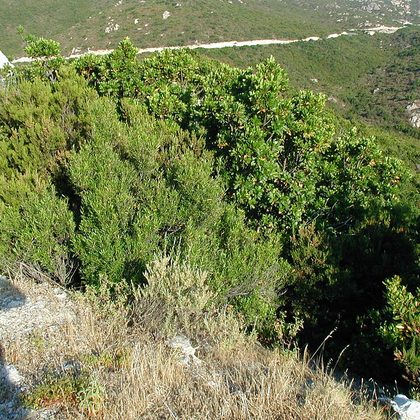
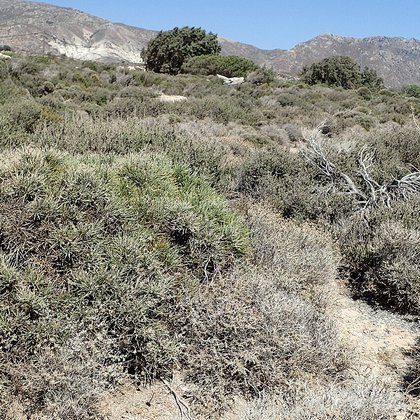
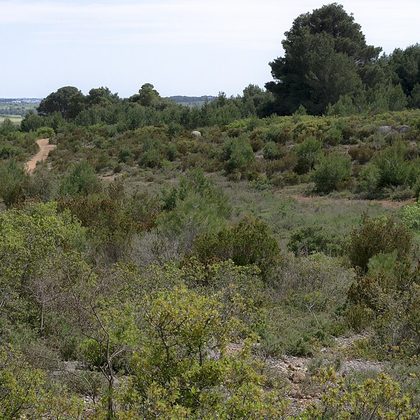
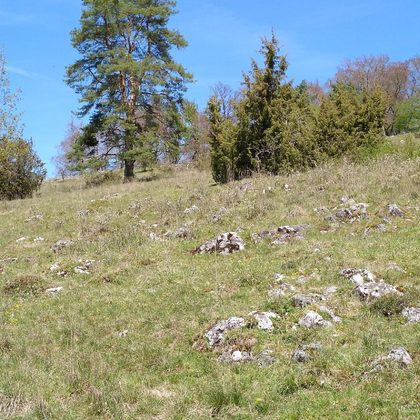
Warm, dry, thorny Mediterranean scrub: maquis of holm oak, strawberry tree and mastic, garrigue on limestone, and above all the low, spiny phrygana of Greece and the Aegean islands, where it is the characteristic singer of every thorny cushion bush. Also in neglected olive groves, along wood edges and in montane scrub to well over a thousand metres. It wants scrub with openings in it and projecting twigs to sing from, and disappears once the scrub closes into woodland.
Where the bird is most at home, classified with EUNIS — the European standard for habitats.
Range and movements
Breeds from central and southern Italy and Sicily eastwards across the Balkans — Croatia, Bosnia, Montenegro, Albania, North Macedonia, Bulgaria and Greece — into western Turkey, and winters in the Sahel from Chad and Sudan west across the belt. On Crete and the Aegean islands it is one of the commonest scrub songbirds in spring. It arrives in late March and April and leaves in August and September. In the Netherlands it is an exceptional vagrant, and then almost always a spring male, because only those can be clinched; in Spain it is a vagrant with a handful of accepted records.
- Breeding (summer)
- Passage
- Migration direction
- dark = core range, pale = thinly spread
Where and when to look
April and May, on Crete, Lesbos or in the Peloponnese, in phrygana on a south-facing slope, early in the morning. Walk a track along the edge of the scrub and watch for singing birds on the topmost twigs; the males are so crisply marked that the red breast shield, the white stripe and the white belly all register in one look. In autumn always record the call: a doubled roll is then worth more than a series of photographs of a drab female.
Conservation status
Not threatened (Least Concern). The species is numerous over a large range and European numbers look stable; in Greece, Turkey and the Balkans it is one of the commonest scrub birds. Three things press over the longer term: the clearance of phrygana and maquis for olive planting and coastal building, large fires in dry summers, and the gradual closing over of abandoned grazing land into woodland. Because the birds cross the Sahara and winter in the Sahel, rainfall there also works through into the numbers.