All species › Passerines › Parrotbills › Ashy-throated parrotbill
Ashy-throated parrotbill | Suthora alphonsiana
Grijskeeldiksnavelmees | Picoloro gorjigrís
A tiny reedbed bird from the mountains of south-west China that has lived in the marshes near Varese since 1995. It is the only parrotbill with a self-sustaining population in Europe, and at the same time one of the hardest birds on the continent to put a name to: it shares its Italian reedbeds with a second species it is barely separable from.

Voice
Rarely one bird, almost always a party, and the sound of that party is the field mark: a busy, high, slightly tinny twittering that shifts along the reedbed as the flock moves. The contact call is a short chip or chee-chip, in rapid series and from all sides at once; between them comes a nasal rattling chrrit, low and dry, most like a small box being shaken. Real song hardly exists — at most a thin phrase of three to five slender, slightly descending notes. Audible all year, most obvious on still autumn days when the parties are at their largest.
No freely licensed recording is available for this species yet.
Identification
Essentially a ball with a tail: a rounded body under thirteen centimetres long, half of which is tail. The bill is the family badge — very short, deep and laterally compressed, horn to greyish yellow, and so stubby that the profile of the head breaks off abruptly at the front. Crown and nape are warm chestnut, sharply demarcated against the dull brown mantle. The clincher lies below that: cheek, throat and upper breast are grey, with fine dark streaks across the throat, and the grey extends as a hood onto the side of the neck. The wing is dark brown with chestnut fringes, the very long tail graduated. The iris is pale, with a narrow pale eye-ring. Sexes alike. In flight the impression is helpless: short, weak flutters from one reed clump to the next with the tail trailing like a streamer.
Confusion species
It all turns on the Vinous-throated Parrotbill, with which it lives intermixed in northern Italy — see that bird's own page, where the same difference is set out from the other side. That species is a shade smaller and warmer throughout: the pinkish orange-brown of the crown runs on gradually over cheek and nape without a sharp border, and throat and breast are pink to wine-coloured with fine streaks, never grey. So the Ashy-throated has a two-tone head, the Vinous-throated a one-tone head. Be honest here: in Lombardy and Piedmont the two fly together and intermediates have been reported, so a bird with a half-grey cheek is better left unnamed. Among native birds only the Bearded Reedling shares this habitat; it is larger, warm ochre-brown, with a pointed yellow bill, the male carrying a black drooping moustache. A Long-tailed Tit has the same tail but a black, white and pink head and keeps to scrub, not reeds.
Habitat
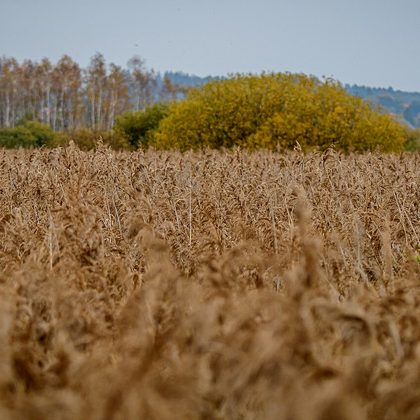
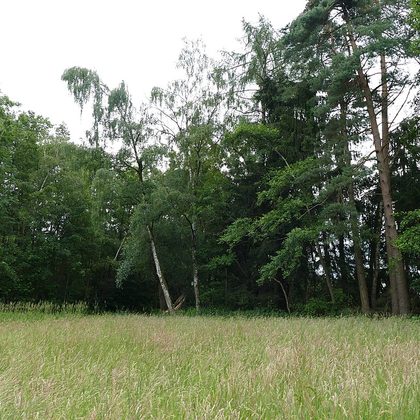
In Italy almost entirely tied to damp lowland rank growth: extensive reed, the silting margins of marsh pools, ditch and canal banks, and above all the transition from reed to scrub, with meadowsweet, grey willow and giant goldenrod. Also the overgrown edges of rice fields and reed-filled railway ditches. Climbs the stems in parties, nearly always within a metre of the water. Insects and spiders in summer; in winter seeds, buds and hibernating insects picked out of dead reed stems — that winter food explains how the species gets through a Lombard winter.
Where the bird is most at home, classified with EUNIS — the European standard for habitats.


Range and movements
The native range lies in south-west China — Sichuan, Guizhou and Yunnan — and in the far north of Vietnam, in rank grassland, bamboo and tea plantations between roughly 300 and 2,350 metres. In Europe the species occurs only in northern Italy. The population goes back to birds that escaped or were released from a bird dealer near Lake Varese in 1995, some hundred and fifty of them. The first stronghold was the Palude Brabbia between Lake Varese and Lake Comabbio, where twenty-one birds were trapped in 1998 and at least a hundred were present in 1999. Since then the birds have worked north and west along the Ticino valley and Lake Maggiore into Piedmont, with the first Swiss records in 2017. The Lombard population is now put at several thousand birds, although that figure is not broken down by species.
Where and when to look
The Palude Brabbia near Varese is the classic address, with the reedbeds along the Ticino a good second. On a still morning walk a bank beside a broad reedbed and listen above all: the twittering of a party gives itself away long before the birds do. Then stand and track the sound with your eyes through the seed heads; every few minutes a bird climbs to the top of a stem and balances there for a second, and that is the moment to take the head pattern. Look specifically at the border between crown and cheek. Do not walk into the reed — the flock simply moves fifty metres on.
Conservation status
Not globally threatened (IUCN: Least Concern) and a common bird of scrub and rank growth in south-west China. In Europe it is an introduction founded on escaped trade birds, and the only self-sustaining parrotbill population on the continent. That population has grown from nothing to several thousand birds in thirty years and is still spreading slowly along the river valleys. Damage has not been demonstrated. What is conceivable is on record: the birds take invertebrates in spring and seed and buds in winter, which overlaps with what Reed Bunting and Reed Warbler are after in the same reedbed. But no study has tied a decline in any native reedbed bird to this species, and the area involved is small in a country where reed marsh is scarce anyway. Two points do deserve attention. First, nobody has worked out how the numbers divide between this species, the Vinous-throated Parrotbill and any intermediates; until that is done, every species-specific estimate is guesswork. Second, the bird itself sits in a vulnerable habitat in Italy: the same drainage and scrub encroachment that threaten the reed threaten it too. It is not on the EU list of invasive alien species of Union concern.