All species › Passerines › Parrotbills › Vinous-throated parrotbill
Vinous-throated parrotbill | Suthora webbiana
Bruinkopdiksnavelmees | Picoloro acanelado
The smaller of the two parrotbills that ended up in the marshes of northern Italy: a warm pinkish orange-brown ball with a long tail and a bill like a miniature parrot's. In China it is one of the commonest garden birds; in Europe it holds a handful of square kilometres of reed in Lombardy and Piedmont, tangled up with a second species it is barely separable from.

Voice
A party is noisier than birds this small have any right to be: a continuous, high, thin twittering that travels through the reed with the flock. The contact call is a slender chip-chip, rapidly repeated and from several birds at once; when excited, a dry nasal chrrr runs through it. The song is barely more than an accelerated run of the same notes, two or three seconds long, usually from a reed stem. It cannot be reliably separated from the Ashy-throated Parrotbill in the field — telling the two apart means looking at the head.
No freely licensed recording is available for this species yet.
Identification
Smaller and rounder still than the Ashy-throated Parrotbill: eleven to twelve and a half centimetres, most of that tail. The bill is very short, deep and stubby, horn to grey-brown with a paler tip. The whole bird is warm and uniform: crown and forehead are rufous brown and pass without a sharp border into cheek, nape and mantle, so the head reads as one tone. Throat and upper breast are pink to pale wine-red with fine, diffuse streaking — the colour that gave the bird its English name. The wing shows chestnut fringes on the secondaries and coverts, giving a rusty glow in sunlight. The iris is dark, with no obvious eye-ring. The tail is very long and graduated. Juveniles are darker and plainer above. Sexes alike.
Confusion species
The whole difficulty is the Ashy-throated Parrotbill, which lives in the same Italian reed — that bird's page sets out the same difference from the other side. It is slightly larger and has a two-tone head: the chestnut crown is cut off sharply against a distinctly grey cheek, throat and upper breast, with fine dark streaks on the grey throat. On the Vinous-throated none of that grey is present: crown, cheek and throat flow into one another and the throat is pink, not grey. So do not look at the crown — it is rufous on both — but at the cheek. And bear in mind that intermediates fly around in northern Italy; a bird that sits between the two is best left unrecorded. Otherwise only the Bearded Reedling shares the habitat in Italy: much larger, ochre-brown, with a pointed yellow bill and, in the male, a black drooping moustache. Long-tailed Tit has the same tail silhouette but a black, white and pink head and a thin bill, and keeps to scrub.
Habitat
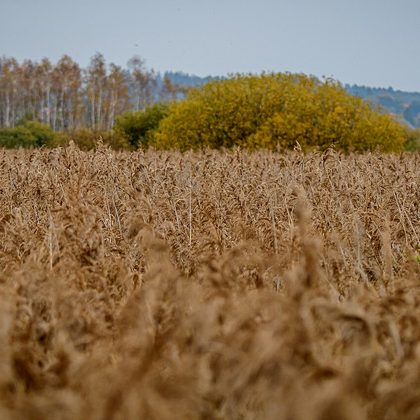
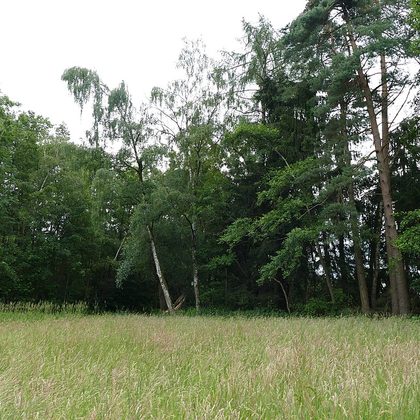
In northern Italy tied to damp lowland rank growth: reed fringes, silting marsh margins, ditch and canal banks and the transition zone from reed into willow and meadowsweet scrub, often with giant goldenrod. Also along rice fields and on rank railway and road verges with reed. In China it additionally occupies scrub, bamboo, tea plantations and even city gardens — that breadth of habitat is why it was assumed the bird would get further in Europe than it so far has. Climbs the stems in parties, low above the water. Takes insects, small fruit and seeds, and in winter whatever overwinters inside dead reed stems.
Where the bird is most at home, classified with EUNIS — the European standard for habitats.


Range and movements
Natively an East Asian bird: from northern Vietnam and southern China north to Manchuria and the south of the Russian Far East, plus Korea and Taiwan; in China mostly below 1,400 metres, on Taiwan up to 3,100. In Europe only in northern Italy, in the same area as the Ashy-throated Parrotbill: the marshes around Lake Varese, the Palude Brabbia, the Ticino valley and the reedbeds towards Lake Maggiore and Piedmont. That population goes back to the escape of some hundred and fifty trade birds in 1995. The Lombardy checklist carries it as a naturalised breeder. How many of the several thousand birds in the area belong to this species has never been established — and that is precisely the problem.
- Winter
- dark = core range, pale = thinly spread
Where and when to look
The same places as for the Ashy-throated Parrotbill: the Palude Brabbia near Varese and the reedbeds along the Ticino. Find the twittering, stay on the path and wait for a bird to climb to the top of a stem. Then take all the time you need over one thing: the cheek. If it looks as warm brown as the crown, this is your bird; if there is an obvious grey hood, it is the other one. Photograph anything doubtful — colours deceive in backlight, and an image can be judged at leisure afterwards.
Conservation status
Not globally threatened (IUCN: Least Concern) and one of the most numerous small songbirds in East Asia, right into gardens and parks. In Europe it is an introduction founded on escaped trade birds, holding a range at most a few tens of kilometres across. How this population is faring cannot be stated with confidence, and that is not carelessness but the heart of the matter: the Italian birds have never been counted species by species, and older sources treated the two as one. The Lombardy list carries this name alone, while the literature on the same marshes deals mostly with the Ashy-throated Parrotbill. No damage has been demonstrated. In theory there is competition for food with Reed Bunting and Reed Warbler, and displacement within the reed is conceivable, but no study has tied a decline in any native species to these birds. What does matter is the question the other way round: Italian reed marsh is shrinking, and both parrotbills depend on it entirely. The species is not on the EU list of invasive alien species of Union concern.