All species › Passerines › Laughingthrushes › Red-billed leiothrix
Red-billed leiothrix | Leiothrix lutea
Japanse nachtegaal | Ruiseñor del Japón
One of the most heavily traded cage birds in the world, and since the 1990s an ordinary breeding bird in the woods of northern Italy, south-west France and Catalonia. Seeing one is another matter — it lives in the thickest cover available — but hearing one is easy: a loud, rolling whistled phrase that in some Italian woods drowns out everything else.

Voice
The song is a loud, fast, warm whistled phrase of five to ten syllables with a clear up-and-down shape: chew-wee-chew-weeto, often ending on a rising note, and repeated from cover with short pauses for as long as you care to listen. At a distance it suggests a Blackcap, but it is fuller, louder and far more uniform in structure. The contact call is a hard, nasal chrreep or chek, given in series by a party; when alarmed, a dry rattle. In northern Italian woodland the species is numerous enough that soundscape measurements attributed well over a third of all bird sound to it. Heard from February into July, and sporadically for the rest of the year.
No freely licensed recording is available for this species yet.
Identification
Small and compact, with a big head, a short neck and a slightly forked tail with dark corners. Upperparts are dull olive-green, the head greyish with a broad pale yellow area around the eye. Two things settle it: the coral-red bill with a dark base, and the wing panel. On the closed wing the primaries carry a lemon-yellow fringe at the base that grades outwards through orange into a sharp fiery-red patch, with black behind it. The throat is bright yellow and runs into an orange breast; the flanks are grey-green, the undertail pale. Females are duller throughout and show a smaller wing patch, orange rather than red; young birds have a dark, almost black bill. The flight is short and fluttering, bush to bush, with the red and yellow flaring for a moment.
Confusion species
No native European bird comes close: a red bill, a yellow throat and a red-and-yellow wing panel simply do not occur here in combination. Confusion comes from two other directions. First, from native birds glimpsed in cover: a Greenfinch diving into a bush is also green and yellow with yellow in the wing, but has a thick pink conical bill and a deeply forked tail. Second, from other escaped aviary birds. The Silver-eared Mesia, a close relative also widely kept, is clearly bigger, with an orange-yellow bill, a silver-grey ear patch and an orange-red rump. Anyone in southern Europe watching a small green bird with a red bill in a thicket need not hesitate long.
Habitat
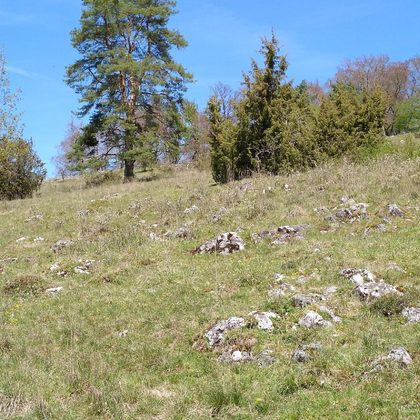
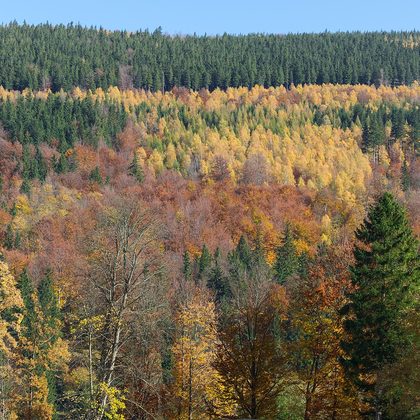
Broadleaved and mixed woodland with a dense, impenetrable shrub layer, almost always near water: sweet chestnut, oak and beech woods with holly, laurel, bramble and hazel, streamside woodland, run-wild bamboo plantings and the overgrown edges of forest tracks. In Catalonia it is holm oak and pine with a thick understorey. Open ground is avoided, which is unusual for an introduced bird, since most established aliens take to open and disturbed land. The nest is a deep cup low in a bush or a bamboo clump. Insects and spiders in summer; berries and soft fruit in autumn and winter.
Where the bird is most at home, classified with EUNIS — the European standard for habitats.



Range and movements
The native range runs from north-east Pakistan and the southern Himalaya through northern India, Nepal, Bhutan and Myanmar to southern and eastern China, mostly above a thousand metres. In Europe there is a series of nuclei, all of them going back to escaped cage birds. The largest are in northern and central Italy — Liguria, Tuscany, Lazio, the Colli Euganei — and in south-west France, where the bird is commonest along the gave de Pau in the Pyrénées-Atlantiques; a French estimate put the national total at roughly five thousand birds in 2015. Smaller nuclei exist in the Île-de-France (the forest of Montmorency), in the hinterland of Nice, in Ariège, in Portugal and in Catalonia. A review in 2017 counted thirty-seven separate European nuclei. Since 2019 there has been a cluster in Wiltshire and Somerset in England, where breeding is suspected but unproven. In the Netherlands and Belgium only single escaped birds occur.
- Resident
- Breeding (summer)
- Winter
- Passage
- dark = core range, pale = thinly spread
Where and when to look
Go in April or May to a chestnut or oak wood with a dense understorey in the Ligurian or Tuscan hills, or to the wooded slopes of Collserola above Barcelona. Walk in on the song until you are almost on top of it, then stand dead still beside a bramble or laurel thicket: the birds move in small parties low through the cover and will often come into the open for a moment if you make a thin squeaking noise. Do not expect a view from above — look at knee height inside the bush.
Conservation status
Not globally threatened (IUCN: Least Concern) and common across its native range. In Europe it is a naturalised introduction going back to cage birds that escaped or were released, growing steadily in both numbers and range since the 1990s. On damage the honest answer is that none has been demonstrated anywhere in Europe. What exists is a set of indications. In northern Italy the species takes up a large share of the soundscape, and experimental work showed that Blackcap and Robin alter their singing behaviour in its presence. There is dietary overlap — fruit and invertebrates — with native scrub birds, and it is dominant at food in the field. It also carries avian malaria without suffering much from it; on Hawaii that has been disastrous for native birds, whereas in Europe not a single case has been traced to it. No population decline of a native species has yet been attributed to it. Spain has listed it in the Catálogo español de especies exóticas invasoras (Royal Decree 630/2013), in the strictest category for the Canary Islands; France and Italy run no control programme.