All species › Tubenoses › Northern storm petrels › Monteiro's storm petrel
Monteiro's storm petrel | Hydrobates monteiroi
Monteiro's stormvogeltje | Paíño de Monteiro
Monteiro's storm-petrel breeds on two bare islets off Graciosa in the Azores and nowhere else on earth. It is a small dark storm-petrel with a white rump band that can barely be told from its neighbour at sea, and it was described as a separate species only in 2008 — not on plumage, but because two groups turned out to be nesting on the same rocks half a year apart.
No freely licensed photograph of a living wild bird of this species exists.
Voice
Silent at sea; everything happens at night above the colony. The flight call is a rasping, rhythmic rattle much like that of band-rumped storm-petrel but higher and shorter, and it was exactly that difference that led Luís Monteiro in the 1990s to start counting the two groups separately. From inside the crevice comes a guttural purring broken by short, hard wicka notes. On Ilhéu da Praia the chorus runs from late April into August, and on a moonless night you stand in the middle of it.
No freely licensed recording is available for this species yet.
Identification
A storm-petrel about the size of Leach's: blackish brown, with long, slightly bowed wings and a narrow white band running straight across the rump that does not extend far onto the flanks. The tail is shallowly forked and looks square at sea. The pale bar across the greater coverts of the upperwing is a dull greyish brown, the underwing is uniformly dark, and the feet do not project beyond the tail. The flight action is steady and unhurried, with long low glides and easy banking, closer to a miniature shearwater than to a fluttering bat. One character is genuinely usable in the field: in July, August and September this species is moulting primaries and tail, so the wing shows gaps and the tail looks short and ragged, while band-rumped storm-petrels in the same waters are still in fresh feather.
Confusion species
Band-rumped storm-petrel is the whole problem, and no plumage character separates the two at sea with any confidence: same size, same rump band, same flight. What does help is date and moult. Off Graciosa, Monteiro's breeds in summer and band-rumped in autumn and early winter, so a bird hanging around the islets in June or July is almost certainly Monteiro's and one in November almost certainly the other; and in summer Monteiro's is in heavy wing moult while band-rumped is not. Outside that window a bird has no name. European storm-petrel is smaller and shorter-winged, flutters through the troughs, and shows a broad square white rump reaching the flanks plus a white bar along the underwing. Leach's storm-petrel has a more angled, kinked wing, an obvious pale diagonal band across the upperwing, a V-shaped rump patch with a dark central line, a forked tail and a bounding, veering flight.
Habitat
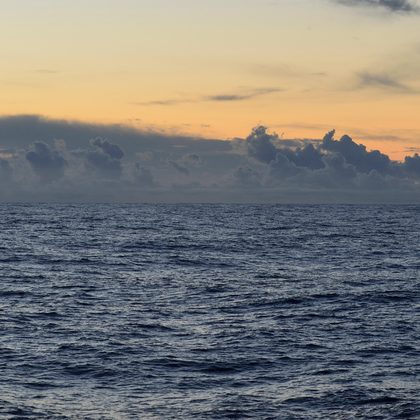
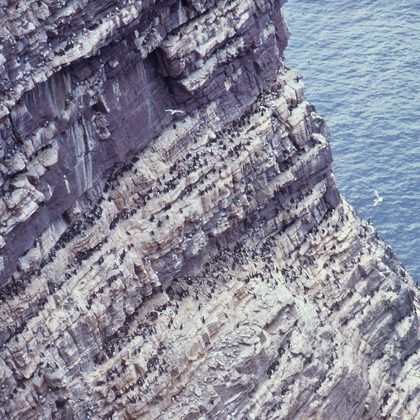
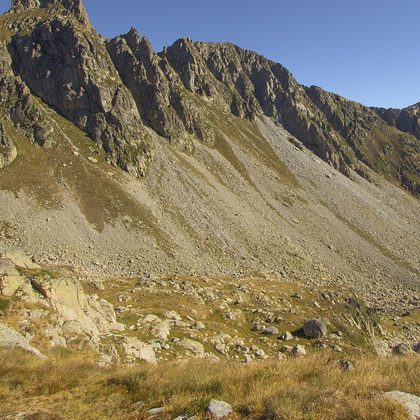
Pelagic away from the colony, over deep water around the Azores, where it picks small crustaceans, fish fry and oily scraps from the surface while hovering and pattering. It breeds in crevices, cavities under boulders and in the loose rock of bare low islets free of rats and cats, and visits the colony only in darkness. On Ilhéu da Praia artificial nest chambers have also been sunk into the ground, and a good share of the colony now uses them.
Where the bird is most at home, classified with EUNIS — the European standard for habitats.
Range and movements
Endemic to the Azores. The core is Ilhéu da Praia and Ilhéu de Baixo off Graciosa; small numbers also breed on islets off São Jorge and Flores, and breeding is suspected off Corvo. The entire world population is put at three to five hundred pairs. Where the birds go outside the breeding season is only partly known: tracking points to the open Atlantic south and south-west of the archipelago. The species has not been recorded on the European mainland, and part of the reason is simply that nobody could put a name to one at sea.
- Breeding (summer)
Where and when to look
There is only one place: Graciosa. Book an evening boat out of Praia da Graciosa to Ilhéu da Praia in June or July — landing needs a natural park permit, but from the boat you can watch the first birds coming in at dusk and hear the chorus carry across the water. By day a chummed pelagic off Graciosa or Pico gives the best views; take your time and look at the state of the wing and tail, because in summer the moult is the only thing that will let you name a bird. Do not expect certainty from anyone who saw only a silhouette.
Conservation status
Vulnerable (IUCN). Three to five hundred pairs on a handful of islets is a precarious position by definition: a single rat, cat or ferret washed or carried ashore could clear a colony within a few years. On Ilhéu da Praia the colony has grown clearly since rabbits were removed, the vegetation recovered and artificial nest chambers were built in, and that is the case study the Azores keep pointing at. Predation by gulls and barn owls plays a part as well, along with light pollution on the inhabited islands, which draws fledglings into the harbours on their first flight.