All species › Passerines › Chats and flycatchers › Moussier's redstart
Moussier's redstart | Phoenicurus moussieri
Diadeemroodstaart | Colirrojo diademado
The most beautiful bird in the Maghreb, and mercifully one of the easiest. The male carries a white band that starts just above the eye and sweeps round behind the ear in a broad arc towards the nape — the diadem that gives him his name — with a black face below it and a burning orange-red breast in front. He sits on a roadside stone, quivers his rusty tail and lets you approach to ten metres. Outside Morocco, Algeria and Tunisia he occurs nowhere in the world.

Voice
The song is short, hurried and a little scratchy: a rapidly rattled phrase in three or four parts, in which a clear whistle runs into a dry rattle and a squeaky ending — tree-churrurru-tsee — often given in runs of four or five phrases with short pauses. It has no fixed rising opening of the kind common redstart uses; the whole thing sounds more like a small, hurried warbler. It sings from a stone, a low bush or a telephone wire, from January into May and hardest in March and April. Call: a clear, short weet, usually followed by one or two dry tk notes.
No freely licensed recording is available for this species yet.
Identification
Small and round-headed, smaller and more compact than a common redstart, with a short bill and a tail that shivers without stopping. The male: black head, throat, mantle and wings; a broad, clean white stripe runs from the forehead above the eye and bends down and back behind the ear coverts into the side of the neck, where the two halves almost meet on the nape. The black wing carries a large white panel at the base of the primaries. Breast, belly, flanks, rump and tail are deep orange-red, only the centre of the tail dark. The female is warm grey-brown above and pale orange-buff below, with a rusty rump and tail, a large dark eye in a plain face and usually a small, dull white mark on the wing. Juveniles are scalloped, again with that tail.
Confusion species
The male is unmistakable on his own ground, provided you look at the white band and not merely at the orange. Common redstart, which breeds in the Maghreb and passes through it, has a white forehead only, ending as a narrow supercilium and never curving round the ear to the nape, and is blue-grey on crown and mantle rather than black, with no white in the wing. Black redstart does show a white wing panel, but is sooty or grey below and lacks both the orange breast and the white head band entirely. The females are the real work: a female Moussier's is smaller and rounder-headed than a female common redstart, warmer orange below right through to the undertail coverts, and nearly always shows a trace of the white wing panel that a female common redstart never has. Terrain helps as well: Moussier's redstart belongs to open stony slopes with low scrub, common redstart to old woodland.
Habitat
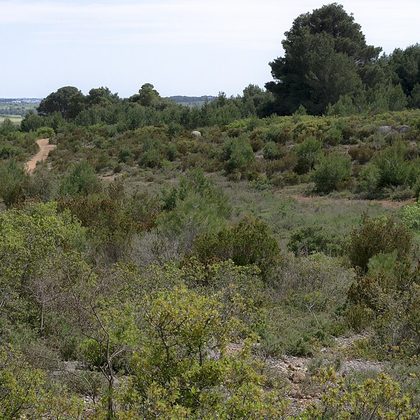
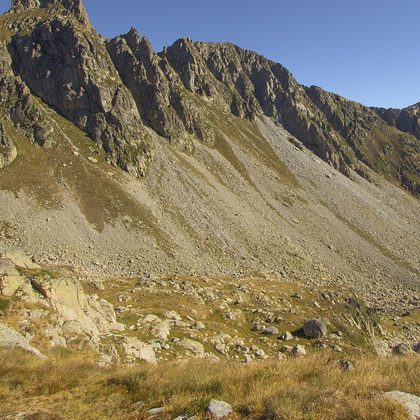
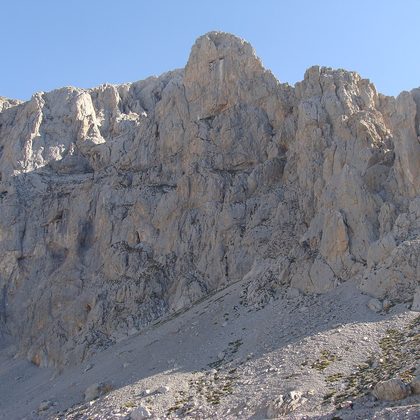
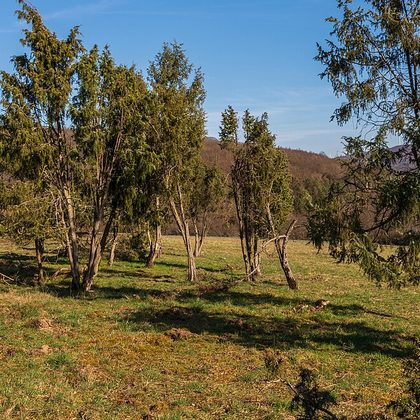
Open stony slopes with low scattered scrub and plenty of bare ground between: garrigue and dwarf-palm plain, rocky hillsides, screes, ravine edges, cleared ground and the open margins of cedar and oak forest, from sea level to above three thousand metres in the High Atlas. The nest goes low, in a crevice between stones, under an overhanging tussock or in a field wall. It hunts by dropping from a low perch onto bare ground. In winter the mountain birds descend to the valleys and appear in olive groves, orchards, wadis, steppe and the northern fringe of the Sahara.
Where the bird is most at home, classified with EUNIS — the European standard for habitats.
Range and movements
A bird of north-west Africa and nowhere else: Morocco, northern Algeria and northern Tunisia, centred on the High Atlas, the Middle Atlas, the Anti-Atlas and the Rif, and extending into the Algerian Tell and the mountains of Tunisia. Resident, but with a clear altitudinal movement: birds breeding above two thousand metres leave that ground in October and return in March. Some winter as far as the Saharan oases. North of the Mediterranean it is a major rarity, with a handful of records in Spain, France, Italy and Malta, almost all in the winter half of the year.
- Resident
- Breeding (summer)
- Winter
- Passage
- Migration direction
- dark = core range, pale = thinly spread
Where and when to look
The road from Marrakesh over the Tizi n'Tichka, or the slopes around Oukaïmeden in the High Atlas, from March to May. Simply stop at a stony slope with low scrub and work along the verge stones, the boulders and the wires: the male is nearly always on the highest point around and that orange shows at a hundred metres. In winter there is no need to go up at all — the birds are then in the olive groves and along the wadis around Marrakesh and Agadir, and on the coast near Essaouira. Look for the white band rather than the colour; the band is what makes the species.
Conservation status
Not globally threatened (IUCN: Least Concern). The range is small — the species occurs nowhere else on earth — but within it the bird is common to very common, and it thrives in country that grazing and felling have made more open. Of all the birds of the Maghreb this is one of the few that profits from a half-degraded landscape: wherever forest gives way to bare ground with scattered bushes, it is there. Attention therefore falls less on the species itself than on the system around it; what may reach the mountain birds in the longer run is warming, which pushes the usable zone in the Atlas upwards, and the drying of the high springs.