All species › Passerines › Chats and flycatchers › Common redstart
Common redstart | Phoenicurus phoenicurus
Gekraagde roodstaart | Colirrojo real
Redstart and black redstart are the pair every beginner has to sort out first. The Redstart is a bird of old, open woodland with bare ground beneath it — the sessile oakwoods of Wales and the west country, Highland birchwood, ancient parkland pasture and old orchards. The male in April, with his white forehead and burning orange breast, is among the most beautiful birds in Britain, and most people never see one, because he sings high in the canopy and rarely stays on a branch for long.

Voice
The song is a short, wistful phrase that always opens the same way: a drawn-out rising hooeet, then two or three identical clear notes, then a hurried, untidy ending that changes from phrase to phrase and regularly carries scraps of other species — hooeet-tu-tu-tu-tcherrr. That fixed rising opening is the handle; the rest is never twice the same. Sung from mid-April into June, hardest in the first hour after sunrise, usually from a bare twig high in a tree. Call: a clear, questioning hooeet, almost always followed by one or two clicking tek notes, running into a long series of ticks when the bird is anxious.
No freely licensed recording is available for this species yet.
Identification
A slim, upright chat with a rusty-orange tail and rump that quivers without stopping; the shiver catches the eye before any colour does. The breeding male has a clean white forehead running back as a narrow white supercilium, a black face and throat below it, and a blue-grey crown and mantle above. Breast and flanks are warm orange-rust, the belly paler. In autumn broad grey-buff feather fringes veil all of that, so the black and white half disappear and the male looks dull and washed out. The female is warm grey-brown above and pale orange-buff below, with no black and no white forehead, a large dark eye in a plain, open face, and the same rusty tail. Juveniles are wholly spotted and scalloped, again with that tail.
Confusion species
Black redstart is the only real difficulty — see its own species page, where the same distinction is set out from the other side. Its male is sooty black with a grey crown and a white wing panel, without a white forehead and without orange on the breast. Between the females the decision lies in the underparts: Black redstart is cold and uniform grey-black to sooty grey, Redstart is warm sandy brown with a clear orange-buff wash across breast and belly, and has a paler, more open face and a finer build. Habitat nearly always helps: stone, concrete and industry against old woodland, orchard and farmyard. Juvenile Robins are sometimes taken for young Redstarts but lack the shivering red tail; Nightingale is bigger and heavier, with a long warm-brown tail that it cocks and spreads rather than shivers.
Habitat
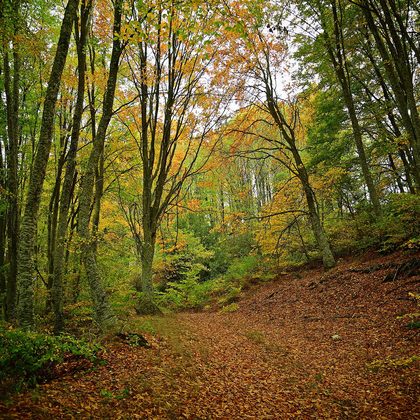
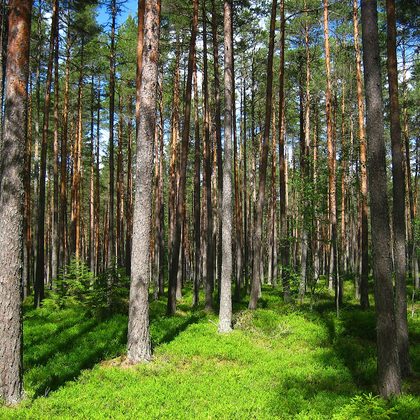
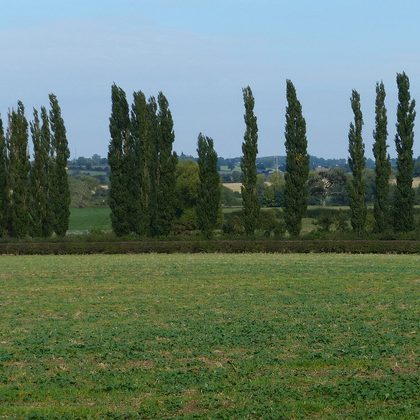
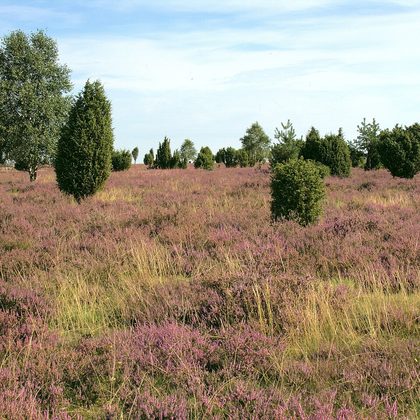
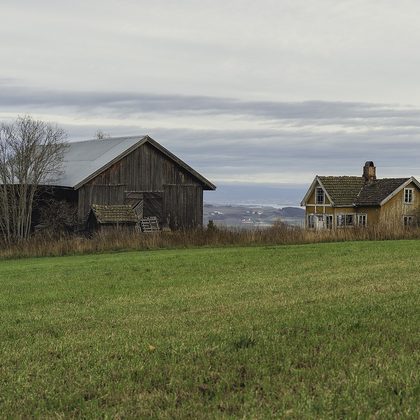
Old, open woodland with dead timber and little understorey, where the bird can drop from a low branch onto bare ground: western sessile oakwood grazed by sheep, upland birchwood, old pine forest on sandy soil, heath with scattered pines, traditional orchards, hedgerow timber, wood pasture and parkland, and farmyards with pollards or old walnut trees. The nest goes in a cavity — an old woodpecker hole, a split in a fruit tree, a gap in a wall, or a nest box with a generous entrance. The combination of holes, low perches and open ground below is what decides it; a dense shrub layer makes a wood useless to it.
Where the bird is most at home, classified with EUNIS — the European standard for habitats.
Range and movements
Breeds from Ireland and Iberia far into Siberia and from Lapland to the mountains of north-west Africa; every bird winters in the Sahel, south of the Sahara. In Britain it is a summer visitor from mid-April to September, overwhelmingly in the north and west — Wales, the Welsh Marches, the Lake District, the Pennines and the Highland glens — and thin on the ground in the arable south and east. In the Netherlands it is a bird of the sandy soils, with 20,000 to 25,000 pairs. On passage, in May and again from August to early October, it can turn up anywhere, including town gardens and coastal scrub. In Iberia it breeds locally in the montane forests of the northern half and passes through in large numbers.
- Resident
- Breeding (summer)
- Passage
- Migration direction
- dark = core range, pale = thinly spread
Where and when to look
Late April, the first hour after sunrise, in an old oakwood on a western hillside or a heath with scattered pines: stand still and wait for that drawn-out hooeet from a treetop. Once you have found the singer, look for the white forehead, which flares at long range in low sun. August and September are far easier: migrants then sit low in hedges, on wire fences and along woodland edges — mostly females and young birds — and the shivering rusty tail is the only character you need.
Conservation status
Not globally threatened. British numbers rose strongly through the late twentieth century after the Sahel droughts of the late 1960s and early 1970s cut the population sharply, and they still swing with rainfall on the wintering grounds: a dry year in the Sahel shows up in European numbers the following spring. In the Netherlands the species has been increasing significantly since about 2010, after a deep fall that emptied the west and north as traditional orchards, pollards and untidy farmyards disappeared. Leaving dead wood standing, keeping old fruit trees and hollow farmyard trees, and grazing or otherwise keeping the woodland floor open are the quickest ways to help it.