All species › Passerines › Chats and flycatchers › Rufous-tailed rock thrush
Rufous-tailed rock thrush | Monticola saxatilis
Rode rotslijster | Roquero rojo
A short-tailed, big-headed chat of sunny mountain slopes that perches on top of the largest boulder in sight and then climbs into a hovering song flight. The male — blue-grey head, burnt-orange underparts, short orange tail — is one of the finest birds of southern Europe. It is a great rarity in north-western Europe; to see one, you go to the mountains.

Voice
The song is a short run of soft, fluting, faintly plaintive notes with a rolling, gurgling middle section — much fuller and warmer than the scratchy songs of most rock birds — and often laced with mimicry. It is delivered from a rock point and, more distinctively, in a song flight: up at a steep angle on fast wingbeats, then parachuting back to the rock with wings and tail spread. Calls: a short, hard chack like two pebbles, and a thin rising wheet that usually precedes the ticking. Heard from late April into July, mainly early in the morning.
No freely licensed recording is available for this species yet.
Identification
Heavily built, short-tailed and long-billed, with a large head and an upright stance; on the ground it runs and hops like a wheatear rather than a thrush. The breeding male has a blue-grey head, throat and upper mantle, dark brown wings, orange-rust underparts right down to the undertail, and a short orange-red tail with darker central feathers. A white patch on the lower back is usually hidden by the closed wings but flashes out in flight or when the bird stretches. In fresh autumn plumage broad pale fringes cover all of this, so the whole bird looks scaly and the blue turns dull. The female is brown, densely vermiculated and scalloped above and below, with a pale eye-ring and the same short orange-red tail — in every plumage that tail is the character that settles it.
Confusion species
Blue Rock Thrush is the species that matters, and the tail decides: on rufous-tailed rock thrush it is short and orange-red, on Blue Rock Thrush longer and dark blue-grey with no red at all. The male Blue Rock Thrush is also blue throughout, with no orange below; its female is darker, colder grey-brown and longer-tailed than the female Rufous-tailed, which is warmer brown and shows orange in the tail. Females and juveniles are taken for Blackbird, but Blackbird is larger, much longer-tailed and uniformly dark, without the vermiculation and without orange in the tail. Northern wheatear shares the upright stance and the boulders but is far smaller, shows a white rump with a black inverted T in the tail, and has no orange on the body.
Habitat
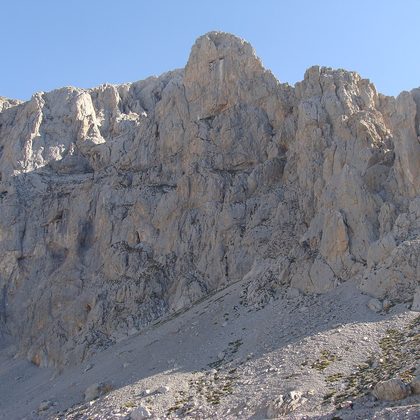
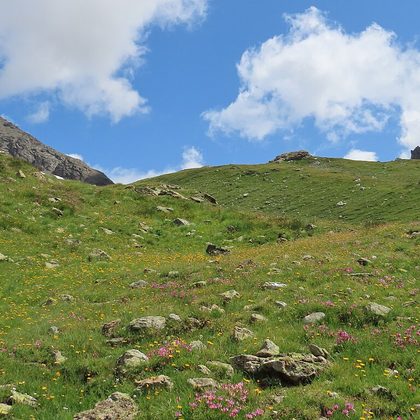
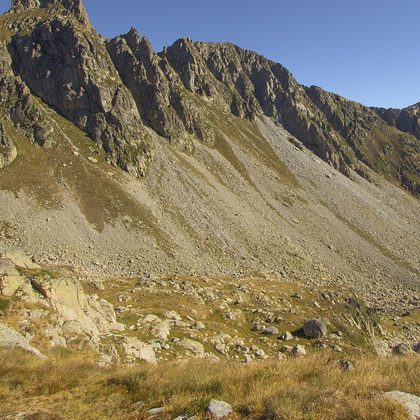
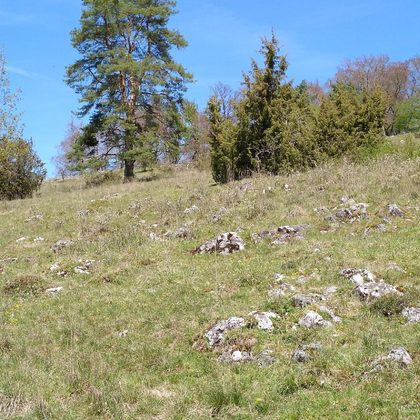
Open, sunlit mountain slopes at or just below the treeline, where crags, boulders and scree alternate with short alpine pasture and low scrub. It forages on foot over short turf and bare stony ground between the rocks, and uses loose boulders, rock edges and sometimes ruins and old sheep folds as lookouts and song posts. The nest goes in a crevice or under a stone. Usually between 800 and 3,000 metres, higher in the south of the range than in the north.
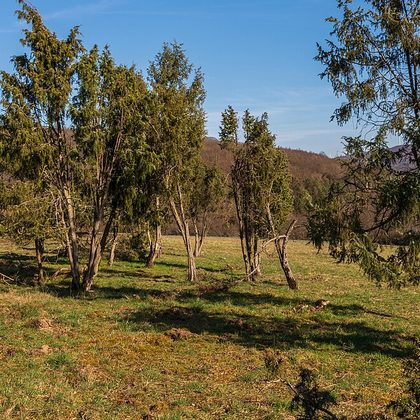
Where the bird is most at home, classified with EUNIS — the European standard for habitats.
Range and movements
Breeds in the mountains of north-west Africa, Iberia, southern France, the Alps, the Apennines, the Balkans, Turkey and the Caucasus, and on eastwards through Central Asia to northern China. The entire population winters in Africa south of the Sahara, in savanna and open stony country from the Sahel to East Africa, so within the area of this guide it is a summer visitor only. In Britain and the Netherlands it is a vagrant of the highest order, with a handful of accepted records apiece, most of them in late spring.
- Breeding (summer)
- Passage
- Migration direction
- dark = core range, pale = thinly spread
Where and when to look
The Pyrenees, the French Alps or the Picos de Europa in the first half of June, between roughly 1,500 and 2,200 metres: walk a pass road or a boulder field where short turf and rock alternate, and look for a bird sitting on the highest stone around. At range the orange registers first, not the blue. If that fails, wait for the song flight — the parachuting return to the rock is recognisable at several hundred metres and names the bird even when the colours are lost against the sun.
Conservation status
Not globally threatened, but in retreat across western and central Europe for decades: in the Alps, the Jura, southern France and parts of Iberia the lowest breeding sites have been given up and the species is moving uphill. The causes run together — the end of extensive sheep and goat grazing, which lets the short open turf close over with scrub, and warmer summers, which push the suitable zone higher than the mountains reach. In Turkey, the Caucasus and the Balkans numbers are considerably more stable.