All species › Passerines › Reed warblers › Moustached warbler
Moustached warbler | Acrocephalus melanopogon
Zwartkoprietzanger | Carricerín real
The one streaked Acrocephalus you can meet in a reedbed in January: a resident of Mediterranean marshes with a sooty black crown, a snow-white supercilium and a habit of flicking its tail up while it works the reed bases just above the water. It is in full song in February, weeks before any migrant warbler is back.

Voice
The song starts where no other Acrocephalus starts: with a series of slow, clear, rising whistles, lu-lu-lu-lu, recalling a Nightingale, before breaking into a hurried scratchy jumble of rolls and nasal notes much like a Sedge Warbler's. That sweet run-up is the decisive feature; once learned, it settles the species right across the Mediterranean. It sings early — from late January, peaking in February and March — and also at night, and often starts up again in autumn. Call: a hard dry tchek and, in alarm, a rattled tcherrr.
No freely licensed recording is available for this species yet.
Identification
Slightly smaller and more compact than Sedge Warbler, with a short rounded wing and a tail that is regularly cocked. The crown is sooty black to dark slate and almost unstreaked, and it is cut off sharply against a broad, pure white supercilium that stays broad behind the ear-coverts and ends squarely. The lores are black and the ear-coverts greyish; together they give the masked face that names the bird. The mantle is warm chestnut with heavy black streaks, the rump plain rusty and unstreaked. The throat is strikingly white against creamy underparts with warm buff flanks. The bill is fine and pointed, the legs dark flesh to grey-brown. The primary projection is short, shorter than on Sedge Warbler, so the bird looks round and stubby-winged.
Confusion species
Sedge Warbler is the species that matters — see its own page as well. There the crown is dark brown and clearly streaked with a diffuse edge, the supercilium is creamy or off-white rather than pure white and narrows towards the rear, and the lores and ear-coverts are brown rather than black and grey. Moustached Warbler also looks shorter-winged and rounder-tailed, is warmer chestnut on the back, and cocks its tail, which Sedge Warbler does not. Aquatic Warbler has a broad pale crown stripe between two black bands, a finely streaked rump and two pale braces on the back. Reed and Marsh Warblers are entirely unstreaked above and show only a short, faint supercilium; Reed Warbler adds a warm rusty rump and grey-brown legs, Marsh Warbler a dull olive rump and pale flesh legs. Savi's Warbler has a plain brown crown, a vague supercilium and a strongly graduated tail, and reels rather than whistles. One shortcut saves a great deal of work in the south: this is the only streaked Acrocephalus sitting in Mediterranean reed in midwinter.
Habitat
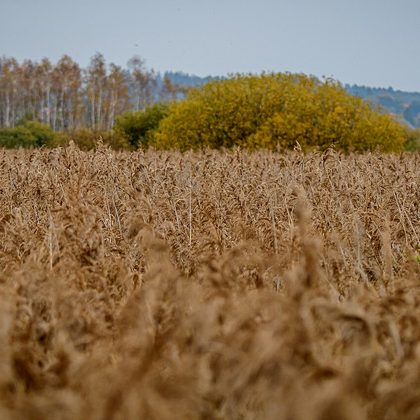
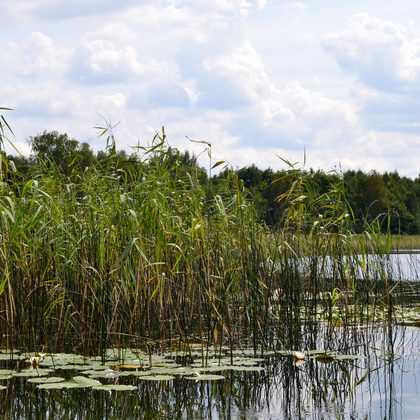
Permanently wet, old reedbeds with plenty of dead standing stems and a dense litter layer, and above all sawsedge and sedge fen that holds water all year. Unlike Sedge Warbler it avoids drying margins and thin young reed: it needs a stable water level and an untidy, multi-year sward in which it can forage within a few centimetres of the water, much of it on the stem bases and on floating leaves. Also in brackish lagoons and in the broad reed fringes of rice fields and canals, provided the reed is old and dense. The nest is slung low over water among sedge or reed stems.
Where the bird is most at home, classified with EUNIS — the European standard for habitats.


Range and movements
A patchwork of marshes around the Mediterranean and the Black Sea: Iberia, southern France, Italy, the Balkans, Greece and Turkey, with scattered sites in north-west Africa and the Middle East, and eastwards through the Caspian region far into Central Asia. Western birds stay put all year and move at most from one marsh to the next; eastern populations migrate south. North of the Alps the species has never gained a foothold, and it is an exceptional vagrant to Britain and the Low Countries. The nearest breeding sites to the North Sea lie in southern France and northern Italy.
- Breeding (summer)
- Winter
- Passage
- Migration direction
- dark = core range, pale = thinly spread
Where and when to look
February or March in the Camargue, the Ebro Delta or the Albufera de Valencia, shortly after sunrise. It is already singing when no migrant warbler is back, and that halves the work: a warbler singing in reed in those months with a Nightingale-like run-up is this bird. Then find it low among the reed stools — it often feeds within centimetres of the water — and check the black crown, the white throat and the cocked tail. If the reed runs out onto a dry margin, walk on: this bird lives where the water stands all year.
Conservation status
Not globally threatened (LC), but that category hides how badly it is doing at the western edge of its range. The species depends entirely on permanently wet, mature reed and sedge marsh, and exactly that has become scarce around the Mediterranean through drainage, water abstraction, salinisation and the annual cutting and burning of reed. In Spain it is now one of the most threatened marshland birds, with the Albufera de Valencia, the Valencian coastal fens, the Ebro Delta and s'Albufera on Mallorca as its last strongholds, and numbers there have fallen sharply over recent decades. The encouraging part is how quickly it answers management: where the water level is kept high all year and old reed is left standing, it rebuilds within a few seasons.