All species › Passerines › Reed warblers › Paddyfield warbler
Paddyfield warbler | Acrocephalus agricola
Veldrietzanger | Carricero agrícola
A small, warm-toned Acrocephalus of the low reed fringes around the Black and Caspian Seas: short-billed, long-tailed, with a striking white supercilium dark-edged above, and a restless habit of flicking tail and wings. In north-west Europe it is a late-autumn rarity that has cost many a ringer a long evening.

Voice
The song is faster and more musical than a Reed Warbler's and full of mimicry, but it lacks the headlong unbroken stream of a Marsh Warbler: short clear motifs with nasal and grating notes between them, at a shifting tempo, something like chek-chek-weedweed-chirrr-tyoo-tyoo, usually from a reed stem or a tamarisk twig and sometimes in a short song flight. The call is sharp and useful in the field: a short hard chek and a dry rattling chrrr, which at a ringing site often gives the bird away before it is seen.
No freely licensed recording is available for this species yet.
Identification
Small and rounded, with a short fine bill, dark at the tip and pale at the base of the lower mandible — clearly shorter than on any other brown Acrocephalus. The upperparts are warm sandy brown with a rusty cast, and the rump is warm and contrasts slightly with the mantle. The head pattern is the best feature: a long creamy-white supercilium starting in front of the eye and running broadly behind it, bordered above by a dark line along the side of the crown, with a dark eye-stripe below. The crown therefore looks dark-framed. Underparts creamy white with warm buff flanks. The primary projection is short — about half the exposed secondaries, with five or six primary tips — and the tail is long and clearly graduated, often held up and flicked along with the wings. Legs pale flesh to light brown.
Confusion species
Reed Warbler is the first to rule out: bigger, longer-billed and longer-winged, with a short faint supercilium and no dark upper border, and none of the restless tail-flicking. Marsh Warbler is a cooler olive-brown with a yellow wash, has a long primary projection with seven or eight crisply spaced tips and pale legs, and sits in rank herbage on dry land rather than in low reed at the water's edge. Blyth's Reed Warbler is the hard one in autumn: greyish olive without warm tones, a longer and heavier bill, a short supercilium barely reaching behind the eye, and dark legs. Sedge and Moustached Warblers are heavily streaked on mantle and crown. In short: warm colour, short bill, dark-framed crown and a long, flicked tail make a Paddyfield Warbler.
Habitat
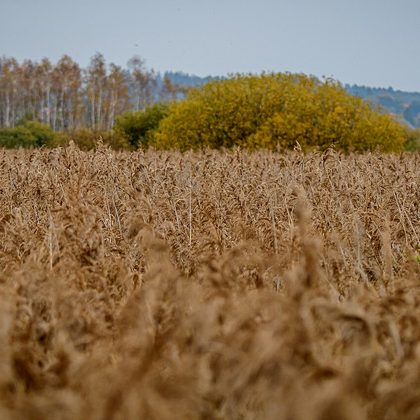
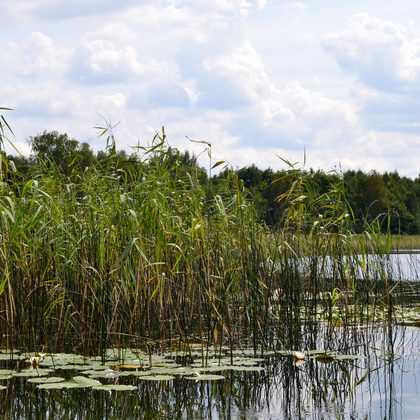
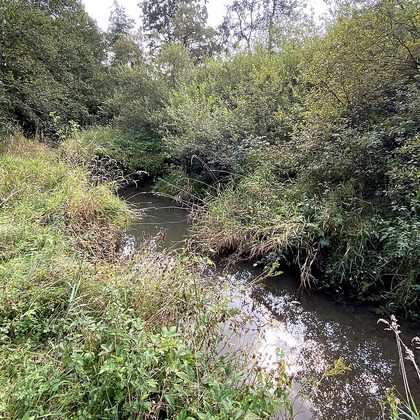
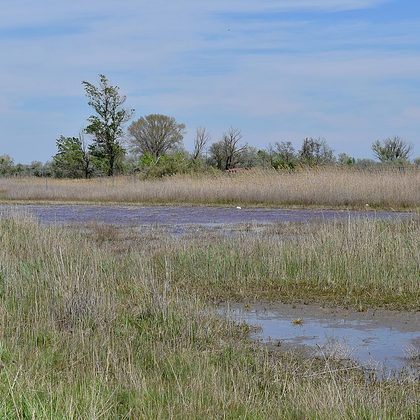
Low, dense, wet vegetation along the edges of lagoons, salt lakes and slow rivers: short reed and reedmace in shallow water, sedge beds, tamarisk and saltmarsh scrub on the bank, choked ditches and the reed fringes of rice fields. Unlike Reed Warbler it does not need tall old reed but a low, thin strip, often right on the transition from open water to saline shore; it feeds close to the ground and rarely climbs high. The nest is a deep cup woven low over the water among thin stems.
Where the bird is most at home, classified with EUNIS — the European standard for habitats.
Range and movements
The core lies around the Black and Caspian Seas: the Danube Delta, the Bulgarian and Romanian coastal lakes, Ukraine and the Crimea, the Sea of Azov, southern Russia, the Caspian shores and Turkey, and from there east through Kazakhstan to Mongolia and north-west China. All birds winter in Pakistan, India and Sri Lanka, in the rice fields that gave the species its English name. At the western edge the range is slowly expanding along the Black Sea. In Britain and the Low Countries it is a scarce vagrant, almost all records falling in late autumn at coastal sites, and many of them in the hand.
- Breeding (summer)
- Passage
- dark = core range, pale = thinly spread
Where and when to look
Late May or June along the Bulgarian coastal lakes at Durankulak and Shabla, or in the Danube Delta: work the low reed on the water-to-shore transition and watch for the small, restless warbler that cocks its tail. Look first at the supercilium and above all at the dark line above it, then at the short bill. Anyone who finds a candidate at home in autumn should count the primary tips and note the leg colour; without photographs of wing and head the case against Blyth's Reed Warbler cannot be closed.
Conservation status
Not threatened (LC): the range is huge and numbers are broadly stable, with a slow expansion westwards along the Black Sea. Where it goes wrong, it goes wrong locally: the draining and embanking of coastal lagoons, water abstraction from the rivers that feed the salt lakes, the burning and annual cutting of shoreline reed and the clearance of tamarisk scrub along the banks. Because the species needs exactly that narrow low fringe, it is sensitive to bank hardening and to water management that lets the fringe disappear. In the wintering areas, rice fields and riverside reed remain plentiful for now.