All species › Passerines › Reed warblers › Blyth's reed warbler
Blyth's reed warbler | Acrocephalus dumetorum
Struikrietzanger | Carricero de Blyth
Despite the name, not a reed bird at all: it sings from a nettle bed, a willow thicket or an overgrown village garden in Finland and the Baltic states. The song is the trademark — a slow, unhurried stream of imitations in which every motif is repeated a few times before the next one starts, usually delivered at night. The species has been pushing west for decades.

Voice
Slow, deliberate and utterly distinctive. The bird sings short motifs — a clear whistle, a nasal tchek-tchek, an imitation of Swallow, Oriole, sparrow, or of an Indian species picked up in the winter quarters — and repeats each one two to four times before moving on, always with a brief pause between. Where Marsh Warbler sweeps you along, Blyth's gives you time to count; that metronomic patience is the best feature the species has. It sings mostly at night and at first light, from late May into July, usually half hidden at mid height in a bush. Call: a hard dry tchek and a short rattled tchrrr.
No freely licensed recording is available for this species yet.
Identification
Cool greyish olive-brown above without any warm tone and without streaking, and with a rump that does not contrast with the mantle: the impression is flat and uniform. The bill is long, fine and pointed, with an orange to pale flesh lower mandible that often has a dark tip; the forehead slopes away flatly, so head and bill together look long and rather pointed. The pale supercilium is clearest between bill and eye and stops just behind the eye; there is a narrow pale eye-ring. Underparts off-white with at most a faint dingy yellow wash on the flanks, far colder than on Marsh Warbler. The wing decides it: the primary projection is short, about half the exposed secondaries, with six tightly bunched primary tips. The legs are dark grey-brown, toes included. At rest the bird looks long and narrow, small-headed, with a long tail held up as it climbs.
Confusion species
Marsh Warbler is what it all turns on — see its own page, where the same difference is set out from the other side. Marsh Warbler is warmer and greener with a yellow wash on breast and flanks, has a long primary projection with seven or eight widely spaced tips, pale flesh legs, a steep forehead and a shorter, broad-based bill. Blyth's Reed Warbler is colder and greyer, shorter-winged, longer and finer in the bill, darker-legged, and shows a more obvious supercilium in front of the eye. Song separates them without fail as well: Marsh Warbler pours its imitations out in one headlong accelerating stream, Blyth's takes its time and repeats every motif two to four times with a short pause between. Reed Warbler has a warm rusty rump contrasting with the mantle and a short faint supercilium, and sits in reed standing in water. Paddyfield Warbler is smaller and warmer, with a short bill, a long supercilium dark-edged above, and pale legs.
Habitat
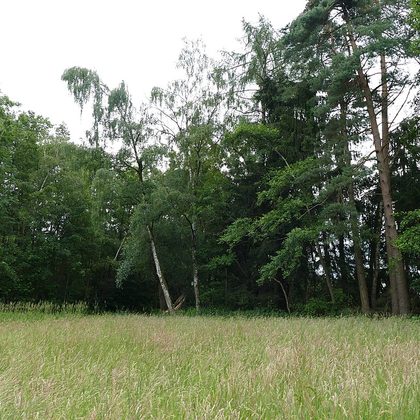
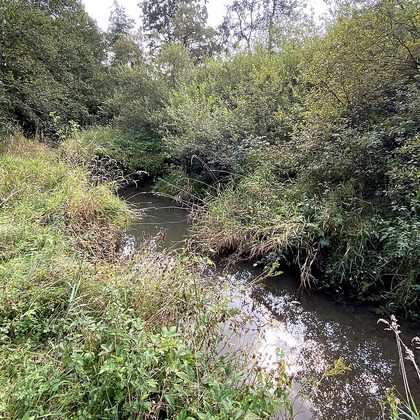
Damp scrub and tall herbage on dry ground, never reed standing in water: willow and alder thickets along streams and lake shores, woodland edges and clearings with nettle, meadowsweet and cow parsley, rank hedge banks, young birch regrowth, and in Finland and the Baltic states strikingly often overgrown village gardens, park edges and the lilac and mock-orange bushes beside houses. What it needs is a dense herb layer with scattered bushes and saplings above it as song posts. The nest is slung low in the herbage or a bush, usually below a metre.
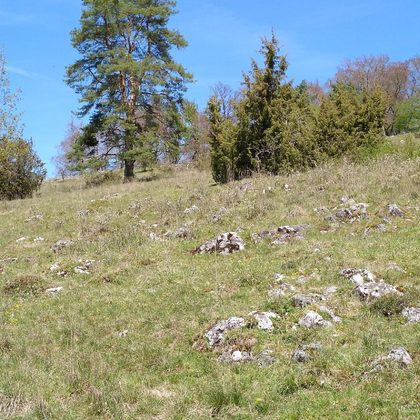
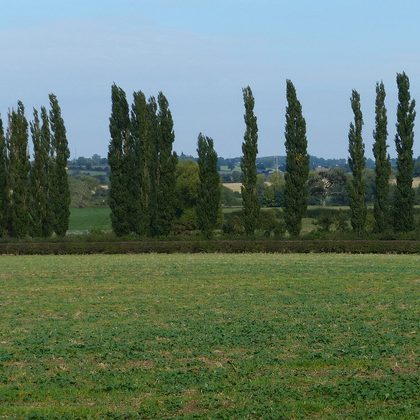
Where the bird is most at home, classified with EUNIS — the European standard for habitats.

Range and movements
From Finland, Estonia, Latvia and Lithuania east through Belarus and Russia into central Siberia, with outposts in the mountains of Central Asia. Finland and the Baltic states have gone from almost empty to tens of thousands of singing males within a few decades, and Sweden and Poland are being taken up in turn. All birds migrate south-east and winter in India, Nepal, Bangladesh and Sri Lanka, which is why they arrive only in late May and are gone again in August. In Britain and the Low Countries it is a scarce but annual visitor: singing males in June, and autumn birds at coastal ringing sites, with the species now recorded far more often than a generation ago.
- Breeding (summer)
- Passage
- dark = core range, pale = thinly spread
Where and when to look
The first half of June, between eleven at night and sunrise, in southern Finland or Estonia. Walk a village edge or a rank woodland margin and listen for a singer that repeats each little phrase neatly: that is the bird, and the song is a hundred times more reliable than the view. If you do see it, go straight to wing and legs: short primary projection with six bunched tips, and dark legs. Anyone who hears a candidate at home should record the sound before reaching for the binoculars — with this species that is the piece of evidence that counts.
Conservation status
Not threatened (LC) and one of the few warblers doing better across the board: the range has been shifting west and north for decades, and in Finland and the Baltic states it has gone from a rarity to a common breeding bird. Neglect works in its favour — abandoned farmsteads, gardens left to run wild, rank stream valleys and young regrowth on clear-fells all deliver exactly the cover it wants. The pressures are correspondingly small and local: the clearing of scrub and rank vegetation, flail-cutting of ditch banks in June while the nests are still slung in the stems, and the loss of scrub in the South Asian winter quarters.